
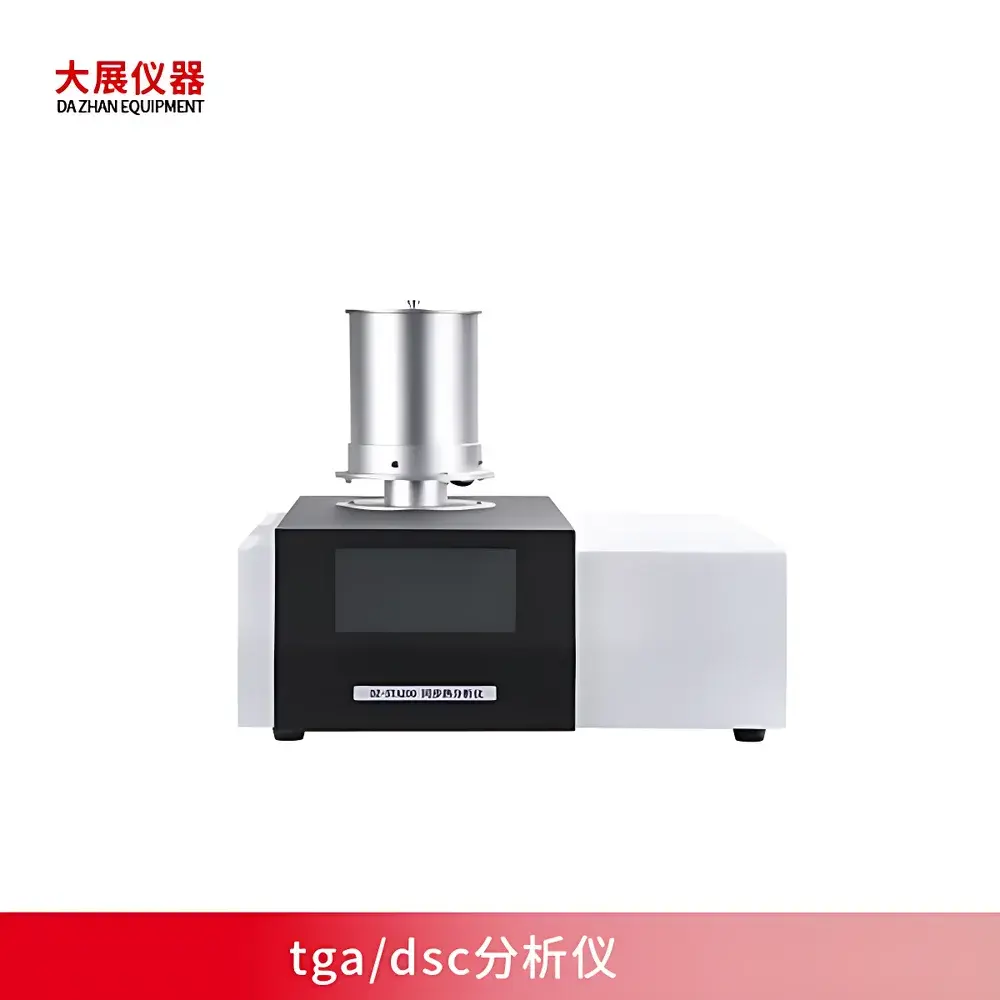
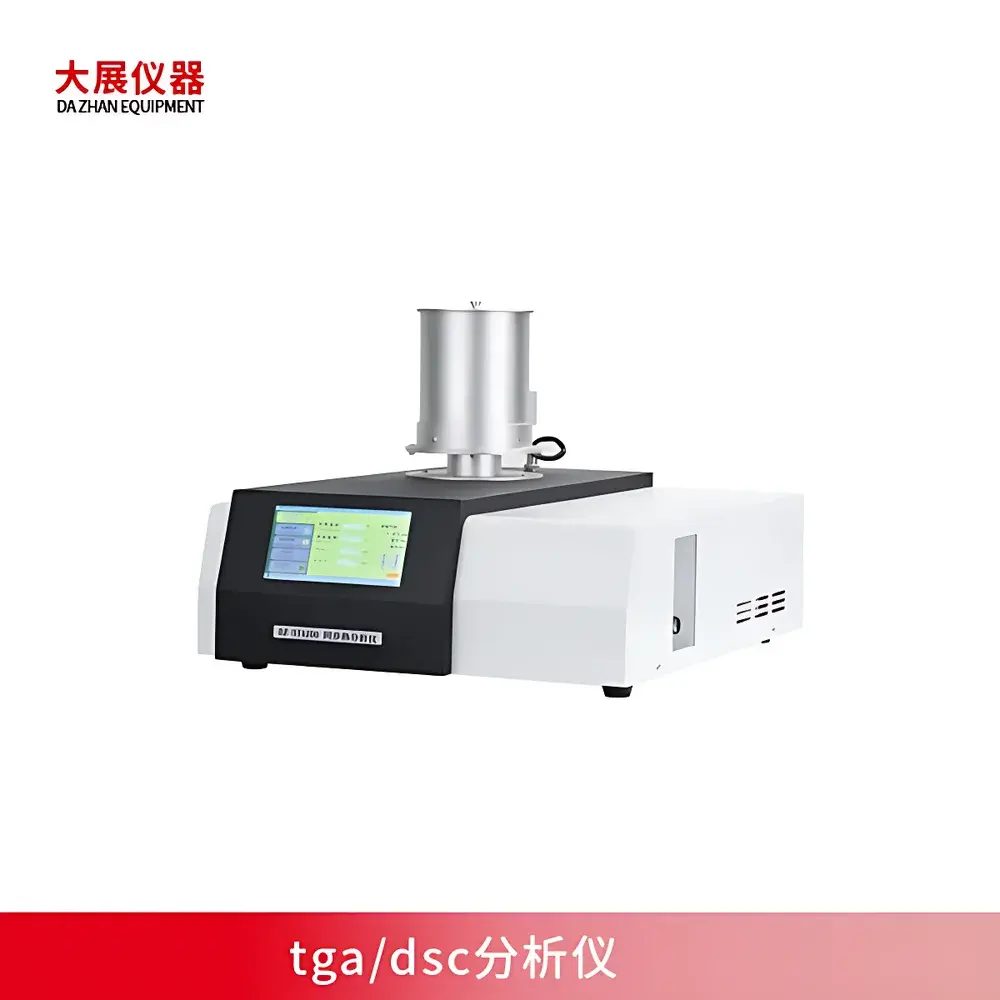
Nanjing Dazhan DZ-STA200 Simultaneous Thermal Analyzer (TGA/DSC)
| Brand | Nanjing Dazhan |
|---|---|
| Origin | Jiangsu, China |
| Manufacturer Type | Manufacturer |
| Country of Origin | China |
| Model | DZ-STA200 |
| Price Range | USD 11,200–16,800 (based on exchange rate ~¥80,000–¥120,000) |
| Temperature Range | Ambient to 1200 °C |
| Heating Rate | 0.1–100 °C/min |
| Max Sample Mass | 5 g |
| Atmosphere Options | Inert, oxidizing, reducing |
| Temperature Resolution | 0.01 °C |
| Temperature Stability | ±0.1 °C |
| TG Sensitivity | 0.1 µg |
| TG Accuracy | 0.01 mg |
| DSC Range | ±1000 mW |
| DSC Sensitivity | 0.1 µW |
| DSC Accuracy | 0.01 mW |
| Cooling Time (1000 °C → 100 °C) | ≤15 min |
| Gas Control | Dual-channel mass flow control with integrated flow meters |
| Display | 7-inch 24-bit color LCD touchscreen |
| Data Interface | Standard USB |
| Calibration | Multi-point temperature and enthalpy calibration |
| Compliance Support | ASTM E1131, ASTM E1269, ISO 11358, ISO 17225, USP <1225>, GLP-compliant audit trail in software |
Overview
The Nanjing Dazhan DZ-STA200 Simultaneous Thermal Analyzer is an engineered platform for concurrent thermogravimetric analysis (TGA) and differential scanning calorimetry (DSC) measurements under controlled atmospheric conditions. It operates on the principle of simultaneous mass loss detection (via high-stability microbalance) and heat flow differential measurement (via symmetric sensor design), enabling precise correlation between thermal events—such as decomposition, phase transitions, oxidation, and crystallization—and their associated enthalpic and mass-change signatures. Designed for routine QC laboratories, R&D centers, and academic thermal analysis facilities, the DZ-STA200 supports method development and validation across polymers, pharmaceuticals, ceramics, battery materials, and inorganic compounds. Its operational envelope—ambient to 1200 °C, heating rates from 0.1 to 100 °C/min, and dual-gas atmosphere control—meets the technical scope required for ASTM E1131 (TGA), ASTM E1269 (heat capacity), and ISO 11358 (polymer degradation kinetics) protocols.
Key Features
- High-precision dual-sensor architecture: Independent ceramic-rod–coupled thermobalance and symmetrical DSC sensor ensure minimal cross-talk and long-term baseline stability.
- Optimized thermal isolation: Separated power supply unit, active air-cooling module, and multi-layer insulation shield the microbalance and electronics from furnace radiation and mechanical vibration.
- Top-opening furnace design: Enables rapid sample loading/unloading without realignment; accommodates standard ceramic and aluminum crucibles (including hermetic and vented variants).
- Dual-gas manifold with digital mass flow control: Supports programmable switching between inert (N₂, Ar), oxidizing (air, O₂), and reducing (H₂/N₂, CO/N₂) atmospheres—either static or dynamic (flow range: 0–200 mL/min per channel).
- Intelligent thermal management: Adaptive cooling algorithm achieves ≤15 min cooldown from 1000 °C to 100 °C, minimizing turnaround time without compromising sensor longevity.
- Multi-segment temperature programming: Up to 32 user-defined steps—including ramp, hold, and custom rate profiles—with optional extension to 72-hour isothermal duration for long-term stability studies.
Sample Compatibility & Compliance
The DZ-STA200 accepts solid, powder, and thin-film samples up to 5 g (standard configuration: 0.1 mg–2 g; extended range available). Compatible crucible types include high-purity α-alumina, platinum, and sealed stainless-steel options for volatile or reactive systems. The instrument supports compliance-critical workflows: built-in calibration routines cover temperature (In, Sn, Zn, Al, Ag reference metals) and enthalpy (indium, zinc) per ISO 11357 and ASTM E967; software enforces electronic signature, version-controlled method storage, and full audit trail per FDA 21 CFR Part 11 and GLP requirements. All thermal data files retain metadata including operator ID, instrument serial number, gas composition logs, and environmental chamber readings.
Software & Data Management
The embedded Windows-based analysis suite provides real-time visualization of TGA, DTG, DSC, and derivative curves (dQ/dt, d²m/dt²). Raw data export is supported in CSV, TXT, and universal .QTX formats; batch processing enables automated peak integration, onset/offset determination, residual mass quantification, and kinetic modeling (e.g., Ozawa-Flynn-Wall, Kissinger). Reports are generated in PDF with customizable templates—including headers, footers, regulatory disclaimers, and company branding—and exported to Excel for statistical analysis (e.g., ANOVA, reproducibility assessment across batches). Data integrity safeguards include automatic backup to external USB drives, encrypted local database storage, and time-stamped revision history for all method edits.
Applications
- Pharmaceuticals: Quantification of hydrate/solvate loss, polymorph transition temperatures, excipient compatibility screening, and oxidative stability of APIs under ICH Q1A–Q1E conditions.
- Polymers: Degradation onset (Td₅%), char yield prediction, filler content estimation (e.g., CaCO₃, SiO₂), and curing kinetics via isothermal DSC.
- Battery Materials: SEI layer formation analysis, cathode thermal runaway thresholds (e.g., NMC, LFP), and electrolyte decomposition pathways under N₂/O₂ switching.
- Ceramics & Composites: Sintering profile optimization, binder burnout monitoring, and thermal expansion coefficient derivation via TMA-coupled mode (optional).
- Fuels & Biomass: Calorific value estimation, ash content determination, and pyrolysis kinetics modeling per ISO 17225 (solid biofuels).
FAQ
What calibration standards are recommended for routine verification?
Indium (156.6 °C), tin (231.9 °C), zinc (419.5 °C), and silver (961.8 °C) are traceable reference materials for temperature calibration; high-purity indium (28.71 J/g) and zinc (104.9 J/g) are used for enthalpy calibration per ISO 11357-2.
Can the DZ-STA200 operate under vacuum?
No—vacuum operation is not supported. The system is rated for atmospheric pressure only, with maximum dynamic gas flow of 200 mL/min per channel and minimum static pressure equivalent to ambient.
Is remote monitoring or network integration possible?
Yes—the USB interface supports connection to LAN-enabled PCs; optional Ethernet module (DZ-NET-1) enables TCP/IP communication, SCADA integration, and centralized fleet management via third-party LIMS platforms.
What maintenance intervals are advised for optimal performance?
Crucible cleaning after each run; furnace zone inspection every 200 operating hours; microbalance zero-check before each session; full sensor recalibration recommended every 6 months or after 500 cycles, whichever occurs first.
Does the software support IQ/OQ/PQ documentation packages?
Yes—pre-validated installation qualification (IQ) and operational qualification (OQ) protocols are included. Performance qualification (PQ) templates align with USP , EP 2.2.44, and ASTM E2554 for thermal analytical instruments.
Related Products



