
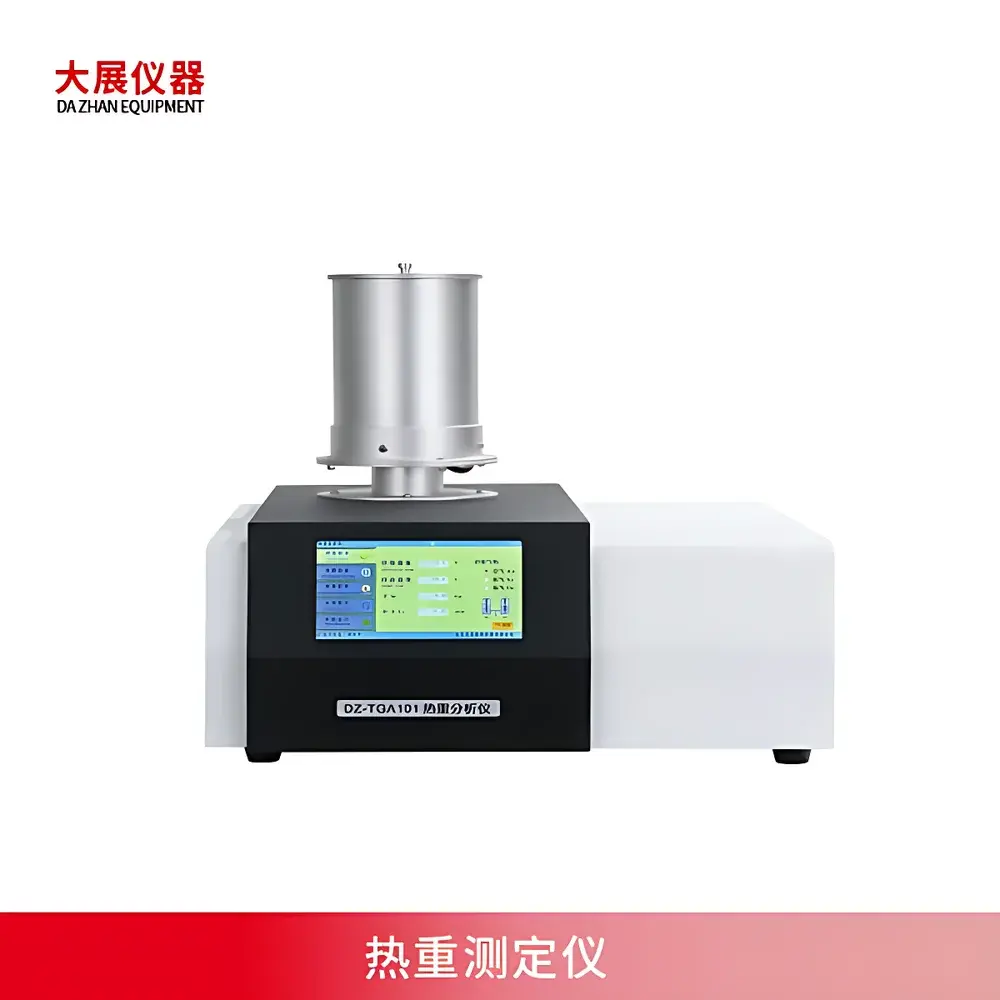
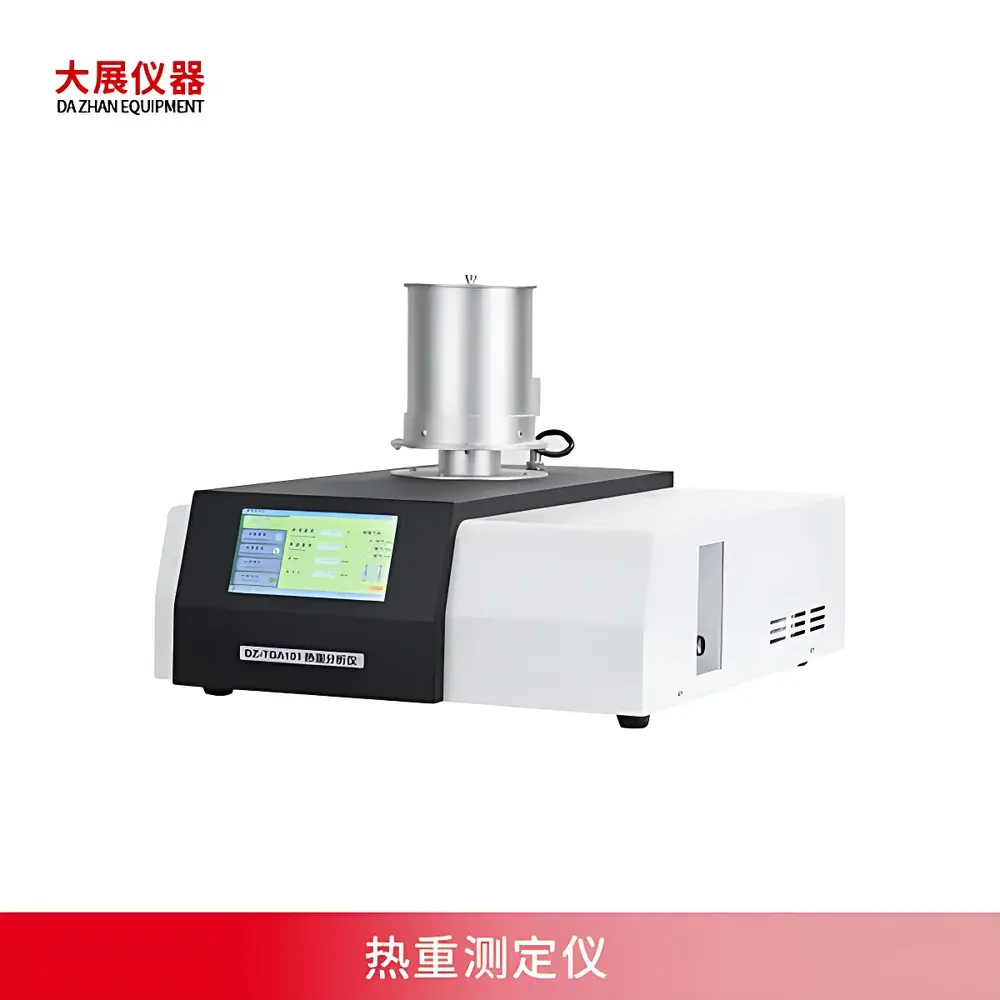
DZHAN DZ-TGA101 Thermogravimetric Analyzer
| Brand | DAZHAN |
|---|---|
| Origin | Jiangsu, China |
| Model | DZ-TGA101 |
| Temperature Range | Ambient to 1250 °C |
| Temperature Resolution | 0.01 °C |
| Temperature Stability | ±0.1 °C |
| Heating/Cooling Rate | 0.1–100 °C/min |
| Mass Range | 0.01 mg–3 g (expandable to 30 g) |
| Mass Sensitivity | 0.01 mg |
| Atmosphere Control | Dual-gas inlet with mass flow regulation (inert, oxidative, reductive, static, dynamic) |
| Data Interface | Standard USB |
| Software | Integrated TGA analysis suite with TG/DTG curve processing, Excel/PDF export, multi-point temperature calibration, and audit-ready reporting |
Overview
The DZHAN DZ-TGA101 Thermogravimetric Analyzer is a precision benchtop instrument engineered for quantitative measurement of mass change as a function of temperature or time under controlled atmospheric conditions. It operates on the fundamental principle of thermogravimetry—monitoring real-time mass loss or gain during thermal treatment—to characterize thermal stability, decomposition kinetics, compositional volatility, moisture content, filler loading, and reaction stoichiometry. Designed for routine and research-grade applications in academic laboratories and industrial QC/QA environments, the DZ-TGA101 delivers high reproducibility across its full operational range from ambient to 1250 °C. Its robust architecture integrates a dual-wound nickel-chromium furnace, a high-stability microbalance with 0.01 mg sensitivity, and active thermal isolation via water-jacketed housing—minimizing thermal drift and mechanical interference between heating zone and weighing mechanism.
Key Features
- Top-opening furnace design enabling rapid, contamination-free sample loading and unloading without disturbing the balance or sensor alignment
- Dual-zone nickel-chromium heating elements with optimized winding geometry for uniform temperature distribution and extended service life at high temperatures
- Water-cooled chassis isolating the microbalance chamber from furnace heat flux—reducing thermal noise and improving baseline stability
- Independent power and cooling circuitry for furnace, electronics, and circulation system—eliminating cross-coupling of vibration and thermal load
- Integrated dual-gas manifold with digital mass flow controllers supporting inert (N₂, Ar), oxidative (air, O₂), reductive (H₂, forming gas), static, and dynamic atmospheres
- 7-inch high-contrast Chinese/English bilingual LCD interface with real-time TG/DTG trace display and local parameter configuration
- Programmable multi-step thermal protocols—including up to five independent segments of ramp, hold, and cool—with dwell times configurable from 0 to 300 minutes per step
Sample Compatibility & Compliance
The DZ-TGA101 accommodates standard ceramic crucibles (Al₂O₃) with optional Pt, graphite, or quartz variants for specialized chemistries. It supports single-sample analysis with maximum capacity of 30 g—suitable for heterogeneous composites, catalysts, polymers, pharmaceutical excipients, and metallurgical powders. The instrument complies with core requirements of ISO 11358 (Plastics — Thermogravimetry), ASTM E1131 (Standard Test Method for Compositional Analysis by Thermogravimetry), and USP (Residual Solvents). While not certified for 21 CFR Part 11 out-of-the-box, its software provides timestamped data logging, user-access logs, and PDF report generation—enabling implementation of GLP/GMP-compliant workflows when paired with institutional SOPs and electronic signature protocols.
Software & Data Management
The included TGA analysis software runs on Windows-based PCs and communicates via standard USB 2.0. It acquires synchronized TG and derivative (DTG) curves at configurable sampling intervals, applies baseline correction, identifies onset/decomposition temperatures, calculates mass loss percentages per step, and computes activation energy via Flynn-Wall-Ozawa or Kissinger methods. Export functions support CSV, Excel (.xlsx), and publication-ready PDF formats with embedded metadata (operator ID, date/time, method file hash, calibration history). The software includes multi-point temperature calibration routines validated across the full 25–1250 °C span, ensuring traceable accuracy for inter-laboratory comparison. Firmware and application updates are provided free of charge through DZHAN’s technical support portal.
Applications
- Quantification of bound water, solvents, plasticizers, and volatile additives in polymer formulations and pharmaceutical tablets
- Thermal degradation profiling of elastomers, thermosets, and flame-retardant composites under nitrogen and air atmospheres
- Calcination behavior and oxide formation kinetics in metal-organic frameworks (MOFs) and battery cathode precursors
- Char yield determination and kinetic modeling of biomass pyrolysis for bioenergy process optimization
- Residue analysis in catalyst regeneration studies—distinguishing coke burn-off from inorganic ash retention
- Stability screening of active pharmaceutical ingredients (APIs) and excipient compatibility testing per ICH Q1 guidelines
- Quality control of inorganic pigments, refractory ceramics, and corrosion-resistant coatings via ash content verification
FAQ
What is the maximum recommended sample mass for optimal resolution?
For highest mass sensitivity (0.01 mg), samples should be ≤100 mg. For compositional quantification requiring statistical representativeness (e.g., filled polymers), masses up to 30 g are supported using the extended-range configuration—though resolution degrades proportionally.
Can the instrument perform simultaneous TGA-DTA or TGA-DSC?
No—the DZ-TGA101 is a dedicated thermogravimetric platform. It does not integrate differential thermal analysis or calorimetric detection. For hybrid measurements, users must couple it externally with a separate DTA/DSC module via synchronized triggering.
Is calibration traceable to NIST or other national standards?
Temperature calibration uses certified reference materials (e.g., Ni, Cu, Al₂O₃ phase transitions) traceable to ISO/IEC 17025-accredited labs. Mass calibration employs certified weights traceable to national metrology institutes; full calibration certificates are issued upon request.
What maintenance intervals are recommended for long-term reliability?
Furnace insulation inspection every 500 operating hours; ceramic crucible replacement after 50 high-temperature cycles (>1000 °C); microbalance zero-check before each session; gas line filter replacement quarterly under continuous use.



