
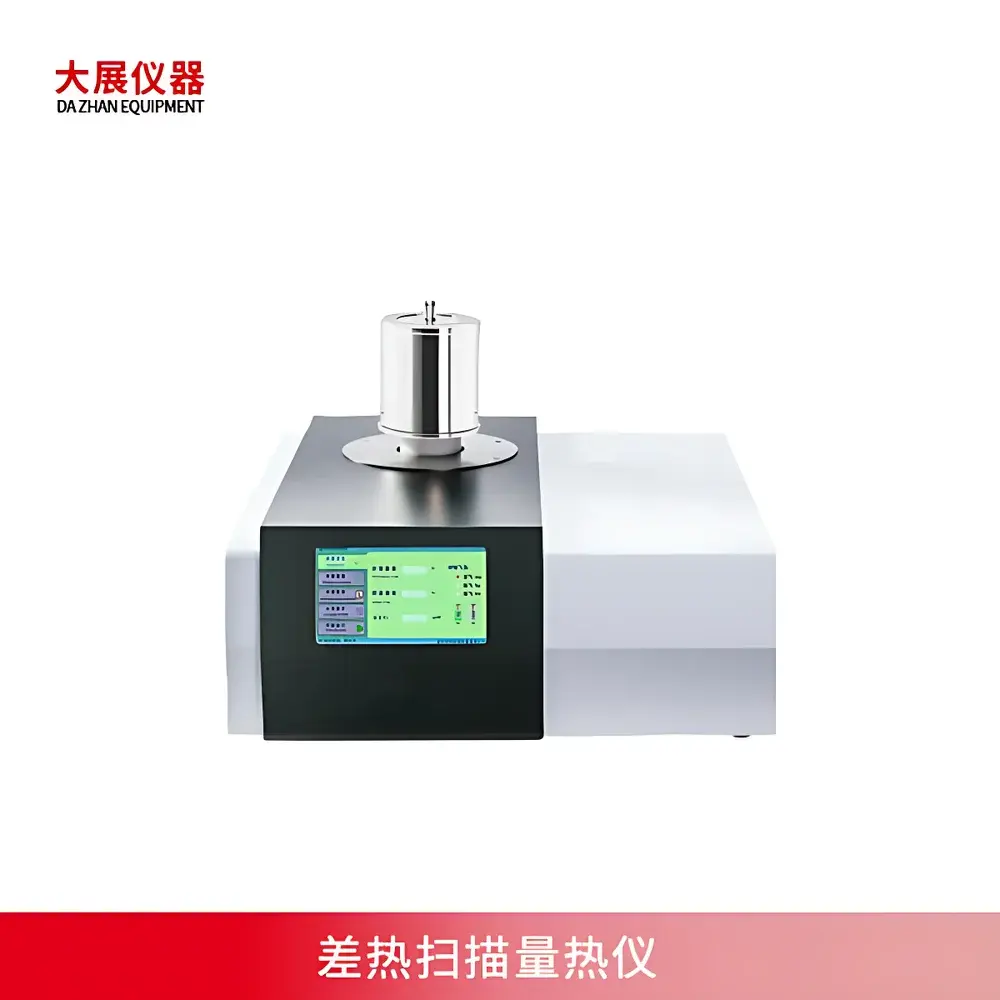
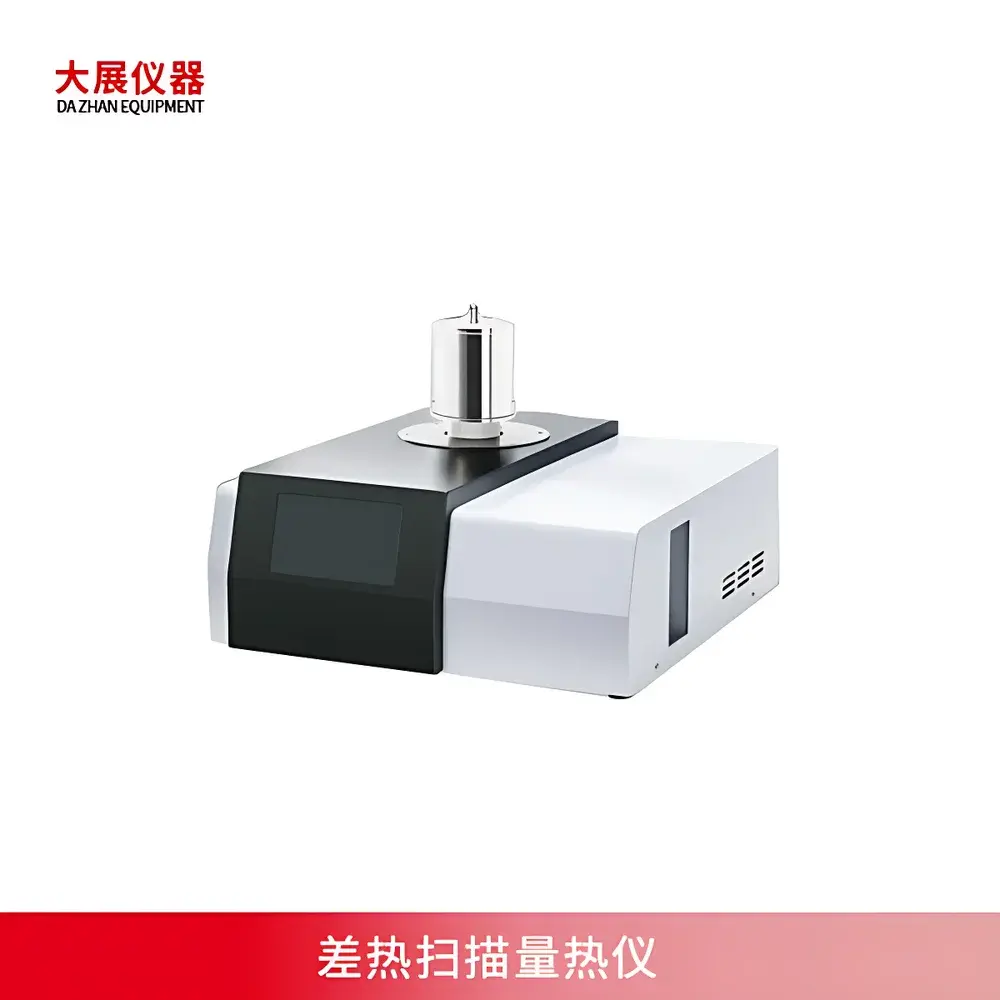
Nanjing Dazhan DZ3320A Differential Thermal Analyzer (DTA)
| Brand | Nanjing Dazhan |
|---|---|
| Origin | Jiangsu, China |
| Manufacturer Type | Manufacturer |
| Country of Origin | China |
| Model | DZ3320A |
| Sample Capacity | Single-sample |
| Instrument Type | Differential Thermal Analyzer (DTA) |
| Temperature Range | Ambient to 1200 °C |
| Temperature Accuracy | ±0.1 °C |
| Heating/Cooling Rate | 0.1–100 °C/min |
| DTA Signal Range | 0–±2000 μV (expandable) |
| Temperature Stability | ±0.1 °C |
| DTA Sensitivity | 0.01 μV |
| Temperature Resolution | 0.01 °C |
| Temperature Repeatability | ±0.1 °C |
| Control Interface | USB bidirectional communication |
| Display | 7-inch 24-bit color LCD touch screen |
| Furnace Design | Top-opening horizontal furnace |
| Sensor Material | Ni-Cr alloy thermocouple pair |
| Power Supply | AC 220 V, 50 Hz (customizable) |
Overview
The Nanjing Dazhan DZ3320A Differential Thermal Analyzer (DTA) is a precision benchtop thermal analysis instrument engineered for quantitative detection of endothermic and exothermic transitions in solid and powdered materials under controlled temperature programs. Unlike Differential Scanning Calorimetry (DSC), which measures heat flow differences between sample and reference, the DZ3320A operates on the classical DTA principle: it records the temperature difference (ΔT) between a sample and an inert reference material as both are subjected to identical heating or cooling profiles. This enables direct identification of transition onset temperatures—such as melting, crystallization, decomposition, oxidation, and solid-state reactions—without requiring absolute enthalpy calibration. Designed for high-temperature stability up to 1200 °C, the instrument features a top-opening horizontal furnace architecture that ensures rapid sample loading, minimal thermal lag, and consistent thermal field homogeneity across the sensor zone. Its ARM-based microcontroller delivers real-time proportional-integral-derivative (PID) temperature regulation with <0.1 °C deviation during dynamic ramping, meeting foundational requirements for ASTM E794 (melting point determination) and ISO 11357-1 (general principles of DSC/DTA).
Key Features
- Top-opening horizontal furnace design eliminates vertical lift mechanisms, reducing mechanical drift and improving long-term baseline stability during extended high-temperature runs.
- Ni-Cr alloy thermocouple sensor pair optimized for thermal shock resistance, oxidation stability, and signal linearity above 1000 °C—critical for ceramic, refractory, and metallurgical applications.
- Programmable heating/cooling rates from 0.1 to 100 °C/min, enabling both slow-scan characterization (e.g., glass transition detection) and rapid screening (e.g., catalyst deactivation kinetics).
- 7-inch full-color capacitive touch display with intuitive icon-driven navigation; supports multi-segment temperature programming, isothermal holds (user-defined duration), and real-time ΔT waveform visualization.
- USB 2.0 bidirectional interface compliant with Windows-based acquisition software, supporting raw data export in CSV and ASCII formats for post-processing in MATLAB, Origin, or Thermo-Calc-compatible platforms.
- Onboard one-button temperature calibration using certified reference materials (e.g., indium, tin, zinc), traceable to NIST SRMs, with adjustable baseline slope and intercept compensation for long-duration experiments.
Sample Compatibility & Compliance
The DZ3320A accommodates standard alumina or platinum crucibles (typically 70–100 µL capacity) and supports ambient-to-1200 °C operation under static air, nitrogen, argon, or synthetic air atmospheres. Optional gas inlet ports enable purging or reactive gas introduction (e.g., O2 for oxidation studies). The system meets essential electrical safety standards per GB 4793.1 (equivalent to IEC 61010-1) and electromagnetic compatibility (EMC) requirements per GB/T 18268.1. While not inherently 21 CFR Part 11-compliant, its data acquisition software includes audit trail logging, user access levels, and electronic signature readiness—facilitating alignment with GLP and GMP documentation workflows when deployed in regulated QC laboratories.
Software & Data Management
Supplied with DZ-Analysis Suite v3.x, the instrument’s native software provides synchronized temperature ramp control, real-time ΔT curve plotting, peak onset/peak maximum/peak area annotation, and derivative (dΔT/dt) calculation. All acquired datasets include embedded metadata: date/time stamp, operator ID, furnace setpoint profile, atmosphere mode, and calibration status. Exported files retain full resolution (24-bit analog-to-digital conversion) and support batch processing for comparative thermal profiling across material lots. Raw data files are non-proprietary and fully compatible with third-party thermal analysis toolkits such as TA Universal Analysis or Netzsch Proteus.
Applications
- Materials Science: Phase transformation mapping in alloys, polymorph screening in pharmaceuticals, thermal stability assessment of battery cathode materials (e.g., LiCoO2, NMC), and sintering behavior analysis of advanced ceramics.
- Chemistry & Catalysis: Quantification of reaction enthalpies in heterogeneous catalysis, decomposition kinetics of metal-organic frameworks (MOFs), and thermal desorption profiling of adsorbed species.
- Geology & Minerals: Identification of dehydroxylation events in clays, calcination thresholds in carbonates, and polymorphic transitions in silicates.
- Quality Control: Batch-to-batch consistency verification of polymer resins, filler dispersion homogeneity in composites, and moisture content estimation via low-temperature endotherm integration.
FAQ
What is the difference between DTA and DSC?
DTA measures the temperature difference (ΔT) between sample and reference under identical thermal conditions, while DSC quantifies the differential heat flow (dQ/dt) required to maintain both at the same temperature. DTA excels in high-temperature qualitative transition detection; DSC provides quantitative enthalpy values.
Can the DZ3320A be upgraded to DSC functionality?
No—the DZ3320A is a dedicated DTA platform with fixed thermocouple geometry and signal conditioning optimized for ΔT measurement. It does not support heat flow calibration or reference pan compensation required for true DSC operation.
Is the instrument suitable for volatile or corrosive samples?
Yes, when used with sealed crucibles and appropriate purge gas selection (e.g., argon for organometallics, dry air for sulfides); however, aggressive halogenated or fluoride-containing compounds require quartz or gold-plated sensor variants not included in the base configuration.
How often must temperature calibration be performed?
Initial calibration is recommended before first use and after any major maintenance; routine verification using indium (156.6 °C) or zinc (419.5 °C) reference standards is advised prior to critical measurements or at least weekly in high-throughput labs.
Does the system support automated sample changers?
No—the DZ3320A is a single-position manual-load instrument. Automation requires external robotic integration via digital I/O triggers, not natively supported by the current firmware.



