
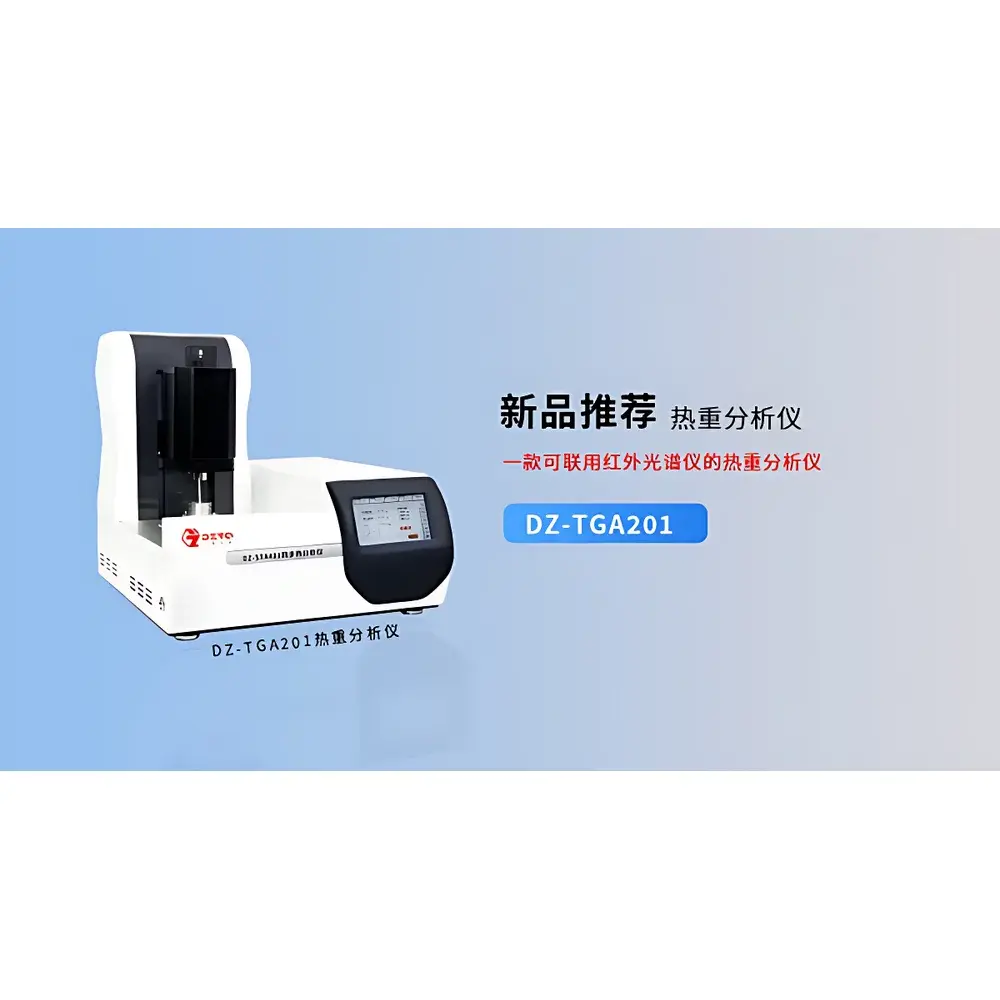
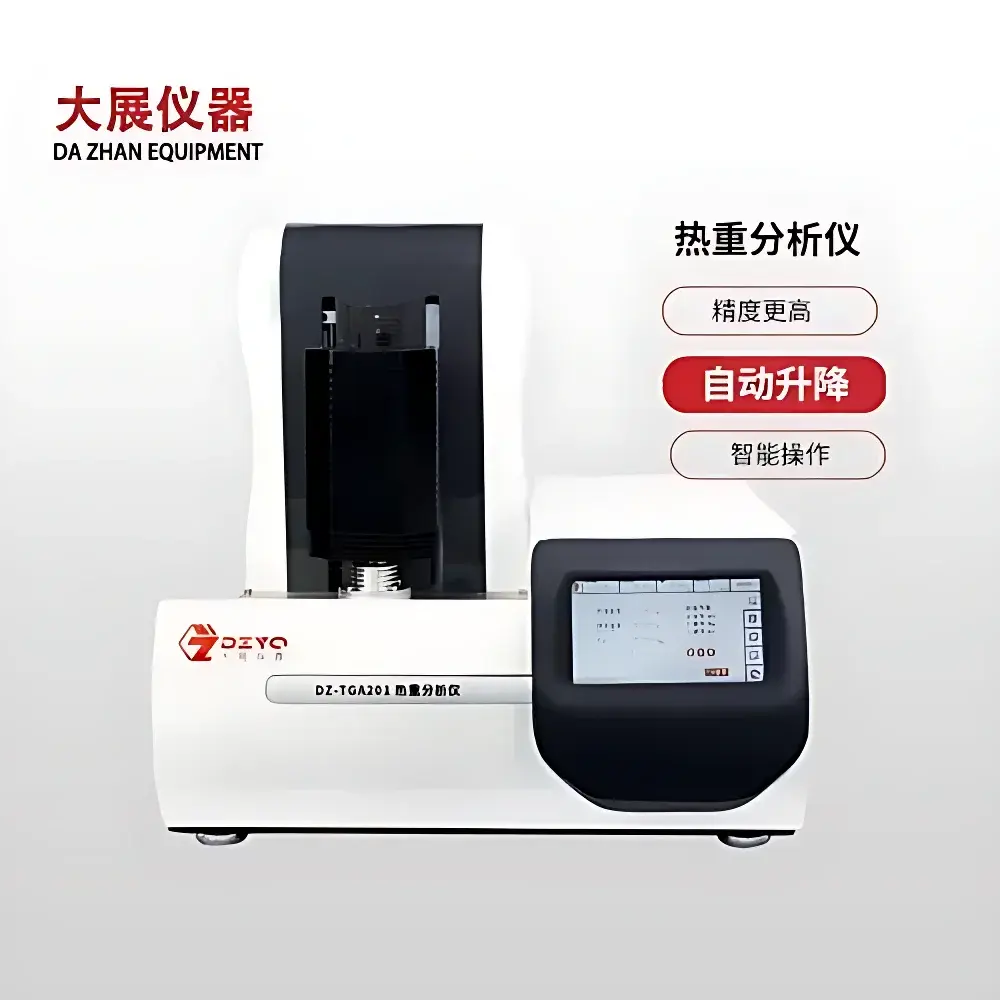
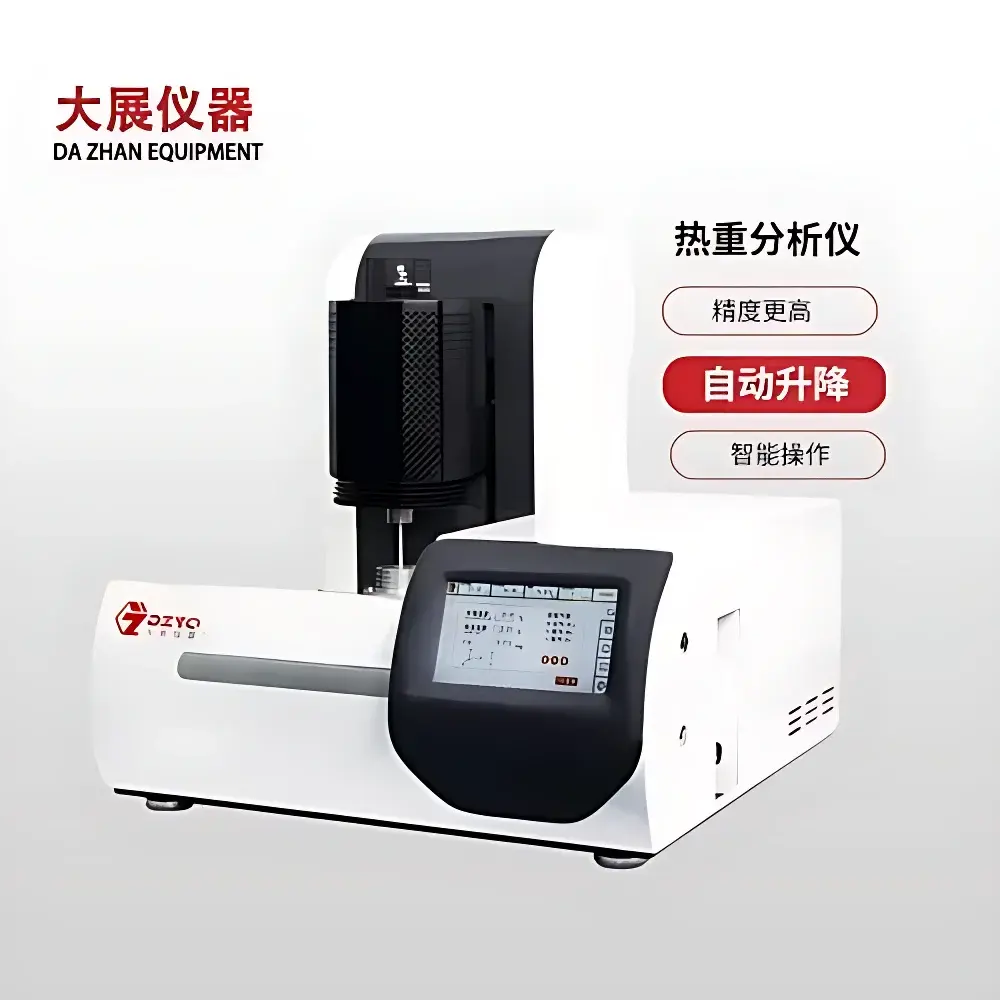
DAZHAN DZ-TGA201 Automatic Lift Thermogravimetric Analyzer
| Brand | DAZHAN |
|---|---|
| Origin | Jiangsu, China |
| Model | DZ-TGA201 |
| Operating Environment | Ambient Pressure |
| Sample Capacity | Single |
| Instrument Type | General-Purpose |
| Temperature Range | Room Temperature to 1250 °C |
| Temperature Resolution | 0.001 °C |
| Temperature Accuracy | ±0.001 °C |
| Dynamic Weighing Range | 0.01 mg to 3 g (expandable to 50 g) |
| Balance Sensitivity | 0.01 µg |
| Mass Accuracy | 0.01 mg |
| Heating Rate | 0.1–100 °C/min |
| Cooling Rate | –0.1 to –40 °C/min |
| Maximum Sample Mass | 30 g |
| Mass Precision | 0.01 mg |
| Temperature Stability | ±0.01 °C |
| Cooling Time (1000 °C → 50 °C) | ≤20 min (standard), ≤15 min with optional cryo-cooling unit |
| Atmosphere Control | Triple-gas mass flow controller |
| Data Acquisition Intervals | Real-time, 2 s, 5 s, or 10 s selectable |
Overview
The DAZHAN DZ-TGA201 is a high-precision, automatic lift thermogravimetric analyzer engineered for rigorous thermal stability and compositional analysis under controlled atmospheric conditions. Based on the fundamental principle of thermogravimetry—continuous monitoring of sample mass as a function of temperature or time under defined gas environments—the DZ-TGA201 delivers quantitative insight into thermal decomposition pathways, oxidative/reductive behavior, desorption/adsorption kinetics, volatile content, filler loading, and residual ash composition. Its integrated furnace-lift mechanism eliminates manual handling during sample loading and enables rapid thermal quenching—critical for preserving metastable intermediates or minimizing thermal history effects between runs. The instrument operates across a broad thermal envelope (RT to 1250 °C), supported by dual-zone platinum-rhodium heating elements and precision PID feedback control capable of bidirectional ramping, isothermal hold, and active cooling—all programmable with sub-millidegree resolution and stability.
Key Features
- Automated furnace lift mechanism for hands-free sample insertion and accelerated cooling (≤15 min from 1000 °C to 50 °C with optional cryogenic heat sink)
- High-stability microbalance system with 0.01 µg sensitivity and 0.01 mg absolute accuracy, thermally isolated via dual insulation layers and physical separation of power supply, cooling circuits, and main chassis
- Platinum-rhodium alloy furnace windings (dual-row configuration) ensuring uniform radial heating, extended service life, and minimal electromagnetic interference
- Corrosion-resistant, high-temperature crucible support sensor fabricated from noble-metal alloy, optimized for oxidative and reducing atmospheres
- Triple-channel mass flow controller supporting independent regulation of purge, protective, and reactive gases (e.g., N₂, O₂, Ar, CO, H₂), compliant with ASTM E1131 and ISO 11358 standards
- Dual thermal shielding architecture minimizes radiative coupling between furnace and balance chamber, reducing thermal drift during long-duration isotherms
Sample Compatibility & Compliance
The DZ-TGA201 accommodates solid powders, granules, thin films, fibers, and small metallic coupons in standard alumina, platinum, or nickel crucibles (up to 30 g gross mass). It supports inert, oxidative, reductive, and dynamic gas-switching protocols—enabling sequential atmosphere experiments per ICH Q5C and USP . The system meets mechanical and electrical safety requirements per IEC 61010-1 and is designed for integration into GLP/GMP environments: audit-trail-enabled software logs all method parameters, operator IDs, calibration events, and raw data timestamps. Full compliance with FDA 21 CFR Part 11 is achievable through optional electronic signature modules and role-based access controls.
Software & Data Management
The proprietary TGAControl Suite provides intuitive method setup, real-time visualization of TG, DTG, and derivative curves, and flexible coordinate switching (mass vs. % mass loss vs. normalized derivative). Automated baseline correction, peak deconvolution, and kinetic modeling (e.g., Kissinger, Ozawa-Flynn-Wall) are embedded. Data export conforms to ASTM E1970 and ISO 14644-1 formats (CSV, TXT, XML), supporting LIMS integration. All acquisitions include metadata tags (operator, date/time, atmosphere, ramp rate, crucible ID), and raw files are write-protected post-acquisition to ensure data integrity. Software supports user-defined report templates aligned with internal SOPs or regulatory submission requirements.
Applications
The DZ-TGA201 serves R&D, QC, and failure analysis laboratories across multiple sectors: polymer degradation onset and char yield quantification; catalyst thermal stability and metal-support interaction studies; pharmaceutical excipient compatibility screening; moisture/volatile content validation per USP ; ash content determination in foodstuffs and fuels; oxidation kinetics of battery cathode materials; filler dispersion efficiency in composites; and thermal aging behavior of construction sealants and fire-retardant coatings. Its reproducible mass tracking at sub-10 µg levels makes it suitable for quantifying low-level additives (e.g., antioxidants, flame retardants) and detecting trace decomposition steps invisible to DSC alone.
FAQ
What is the maximum recommended sample mass for optimal resolution?
For highest mass sensitivity and thermal homogeneity, samples should be limited to 5–20 mg. The 30 g maximum capacity refers to total crucible + sample weight—not analytical mass range.
Can the DZ-TGA201 be coupled to FTIR or MS for evolved gas analysis?
Yes. The integrated exhaust port features a heated transfer line interface (150 °C max) compatible with commercial GC-MS and FTIR gas cells per ASTM E2550 guidelines.
Is calibration traceable to NIST standards?
Temperature calibration uses certified reference materials (e.g., Ni, Cu, Al₂O₃) with uncertainty ≤±0.1 °C; mass calibration employs Class E2 stainless steel weights traceable to national metrology institutes.
Does the system support multi-step temperature programs with gas switching?
Yes. Up to 99 program segments with independent atmosphere selection, ramp rates, and dwell times can be defined and executed without manual intervention.
What maintenance intervals are recommended for routine operation?
Crucible cleaning after each run; furnace zone inspection every 200 cycles; microbalance zero-check daily; full system verification (temperature/mass) quarterly or per 500 operating hours—whichever occurs first.



