
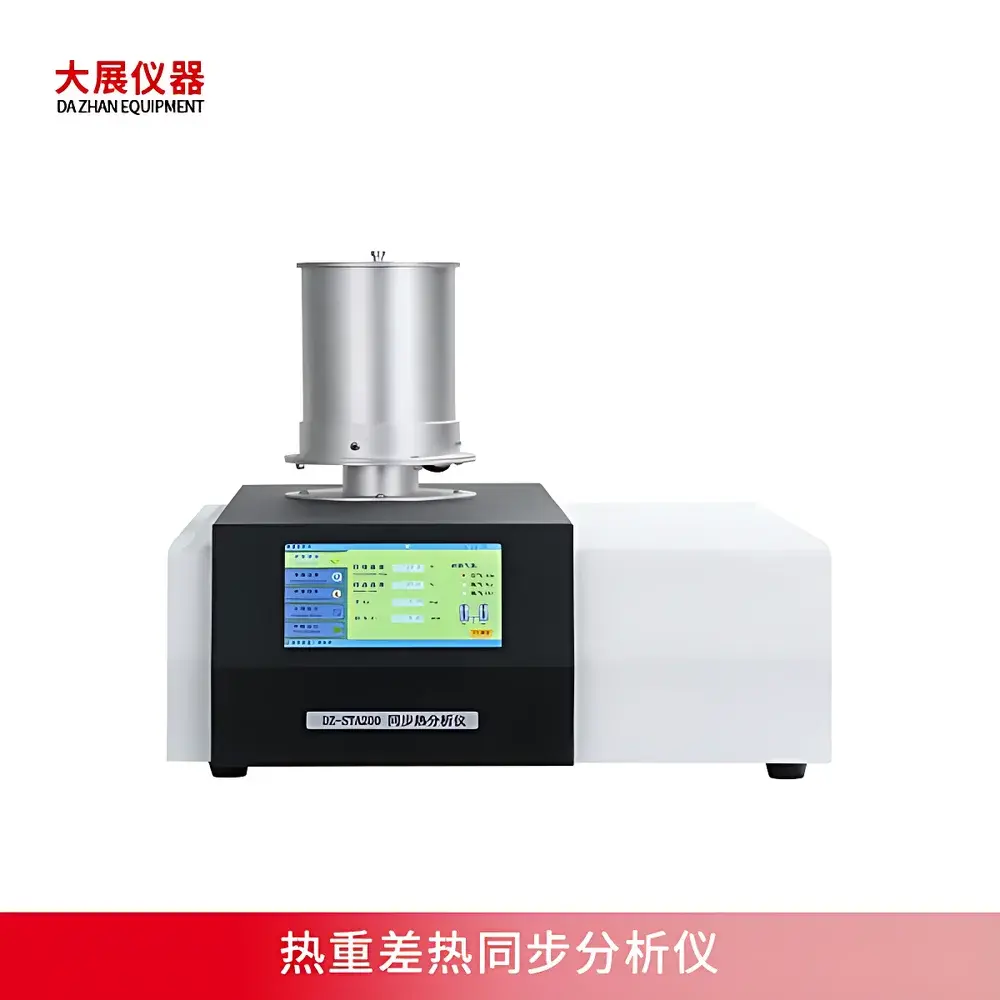
DZ-STA200 Simultaneous Thermal Analyzer (TG-DSC)
| Brand | DAZHAN |
|---|---|
| Origin | Jiangsu, China |
| Model | DZ-STA200 |
| Temperature Range | Ambient to 1250 °C |
| Heating Rate | 0.1–100 °C/min |
| Max Sample Mass | 30 g |
| Atmosphere Control | Inert, Oxidizing, Reducing |
| Balance Resolution | 0.01 mg |
| DSC Range | ±800 mW |
| DSC Sensitivity | 0.001 mW |
| Temperature Accuracy | ±0.1 °C |
| Temperature Resolution | 0.01 °C |
| Display | 7-inch 24-bit color touchscreen |
| Software | Integrated thermal analysis suite with TG, DTG, DSC, and TG-DSC overlay |
Overview
The DZ-STA200 Simultaneous Thermal Analyzer is an engineered solution for concurrent thermogravimetric analysis (TGA) and differential scanning calorimetry (DSC) under controlled atmospheric conditions. Based on the principle of dual-sensor microbalance and heat-flux compensation, it simultaneously records mass change (Δm) and differential heat flow (dH/dt) as a function of temperature or time. This synchronized measurement architecture enables precise correlation between thermal events—such as decomposition, oxidation, phase transitions, or crystallization—and their associated mass-loss kinetics. Designed for laboratory environments requiring reproducible, traceable thermal characterization, the DZ-STA200 supports compliance-driven workflows in R&D, quality control, and regulatory submission contexts—including ISO 11358, ASTM E1131, ASTM E1269, and USP for thermal stability assessment.
Key Features
- Integrated dual-channel measurement system delivering synchronized TGA and DSC signals with time-aligned data acquisition
- High-stability horizontal furnace with uniform heating zone, enabling accurate thermal ramping from ambient to 1250 °C
- Ultra-sensitive microbalance with 0.01 mg resolution and extended dynamic range (0.01 mg–30 g), calibrated across multiple mass points
- Programmable temperature control supporting multi-step ramps, isothermal holds (duration user-defined), and cooling profiles
- Dual-gas manifold with integrated mass flow controllers for precise switching and regulation of inert (N₂, Ar), oxidizing (air, O₂), or reducing (H₂/N₂, CO) atmospheres—configurable for static or dynamic purge modes
- 7-inch capacitive touchscreen interface with intuitive icon-based navigation, real-time curve overlay, and on-device annotation
- Robust ceramic crucible platform compatible with standard alumina, platinum, and graphite sample pans for broad material compatibility
Sample Compatibility & Compliance
The DZ-STA200 accommodates solid powders, granules, thin films, fibers, and small-volume liquids (in sealed crucibles). Its modular design permits direct integration into GLP/GMP-compliant laboratories: software enforces user-level access control, electronic signatures, and full audit trail per FDA 21 CFR Part 11 requirements. Calibration routines include NIST-traceable indium, zinc, and alumina standards for temperature and enthalpy verification at multiple points (e.g., 156.6 °C, 419.5 °C, 1096 °C). All thermal data files retain embedded metadata—including instrument ID, operator, date/time stamp, gas flow rates, and calibration history—ensuring full traceability for regulatory audits.
Software & Data Management
Bundled with DAZHAN Thermal Analysis Suite v3.x, the system provides comprehensive post-acquisition processing: baseline correction, peak deconvolution, derivative (DTG) generation, kinetic modeling (e.g., Kissinger, Ozawa-Flynn-Wall), and comparative overlay of up to 16 curves. Export options include CSV, Excel (.xlsx), and publication-ready PDF reports with customizable templates. Data integrity is maintained via automatic checksum validation, version-controlled file saving, and optional network backup to secure NAS or LIMS endpoints. The software supports IQ/OQ documentation packages and includes built-in validation protocols aligned with ISO/IEC 17025 clause 5.9.
Applications
- Materials Science: Quantification of filler content, decomposition onset in composites, thermal stability of ceramics and refractories
- Polymers & Elastomers: Determination of degradation kinetics, residual solvent content, crosslink density, and oxidative induction time (OIT)
- Pharmaceuticals: Polymorph screening, excipient compatibility studies, desolvation behavior, and amorphous content estimation
- Energy Materials: Cathode/anode thermal runaway profiling, binder decomposition in Li-ion batteries, catalyst thermal sintering analysis
- Metallurgy & Alloys: Solidus/liquidus mapping, phase transformation enthalpies, and oxidation rate modeling under simulated service conditions
- Food & Agriculture: Moisture loss profiling, starch gelatinization, lipid oxidation onset, and ash content quantification
FAQ
What types of atmospheres can be used during analysis?
The DZ-STA200 supports inert (N₂, Ar), oxidizing (air, O₂), and reducing (5% H₂/95% N₂, CO) gases, delivered in either static or dynamic flow mode (0–200 mL/min per channel).
Is the instrument compliant with pharmaceutical regulatory standards?
Yes—the software architecture supports 21 CFR Part 11 compliance, including role-based access, electronic signatures, and immutable audit trails required for FDA submissions.
Can the system perform kinetic analysis on decomposition steps?
Yes. The included software implements model-free (e.g., Friedman, Ozawa-Flynn-Wall) and model-fitting methods (e.g., nth-order, Avrami) using multi-heating-rate datasets.
What is the recommended maintenance schedule for the microbalance and furnace?
Daily zero calibration is advised; full balance recalibration every 3 months; furnace emissivity verification annually using certified reference materials.
Does the system support custom crucible configurations?
Standard configurations include alumina, platinum, and graphite crucibles; custom geometries (e.g., high-volume, suspended, or pressure-rated) are available upon request with engineering review.



