
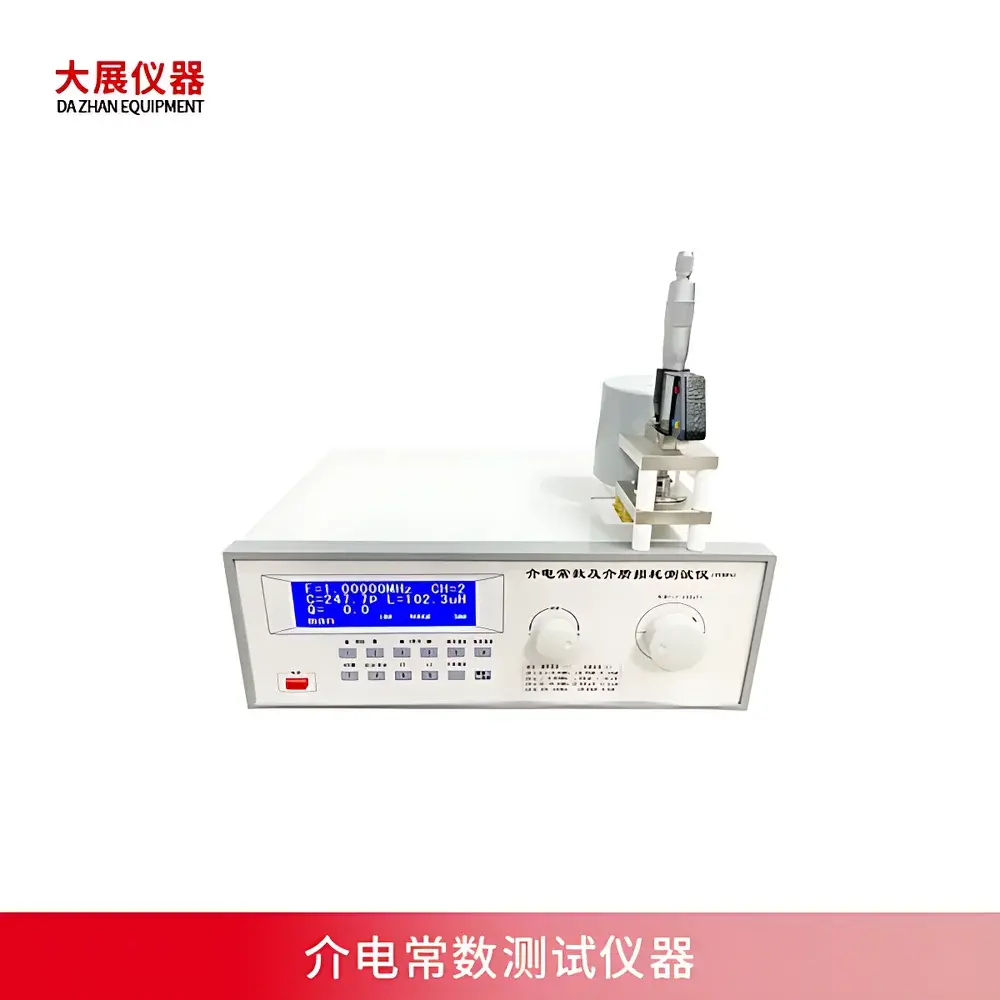
Nanjing Dazhan DZ5001 High-Frequency Dielectric Constant and Loss Tangent Analyzer
| Brand | Nanjing Dazhan |
|---|---|
| Model | DZ5001 |
| Measurement Principle | High-Frequency Resonance Method (Q-factor based) |
| Frequency Range | 10 kHz – 100 MHz |
| Capacitance Measurement Range | 1 pF – 25 nF |
| Capacitance Resolution | 0.1 pF |
| Capacitance Accuracy | ±1 pF or <1% |
| Inductance Measurement Range | 1 nH – 140 mH |
| Inductance Resolution | 0.1 nH |
| Inductance Accuracy | <3% |
| Q Factor Range | 1–1000 |
| Q Resolution | 0.1 (4-digit display) |
| Q Measurement Error | <5% |
| Dielectric Constant (εᵣ) Accuracy | ±0.001 (0.1%) |
| Dissipation Factor (tan δ) Accuracy | ±0.0001 (0.01%) |
| Sample Thickness Range | 0.1 mm – 10 mm |
| Compliance Standard | GB/T 1693–2007 |
| Display | LCD with real-time parameters (F, L, C, Q, Lₜ, Cₜ, εᵣ, Tₙ) |
| Tuning Mechanism | Motorized auto-search capacitance bridge (17–240 pF main capacitor, silver-plated monolithic construction) |
| ADC Resolution | 12-bit |
| Signal Source Stability | 3×10⁻⁵ ±1 digit (6-digit frequency precision) |
Overview
The Nanjing Dazhan DZ5001 High-Frequency Dielectric Constant and Loss Tangent Analyzer is an impedance-based resonant cavity instrument engineered for precise characterization of electrical insulation properties in solid dielectric materials. It operates on the principle of high-frequency series resonance, where a sample-integrated LC circuit is excited by a digitally synthesized signal source (10 kHz–100 MHz), and the resulting resonance behavior—specifically shifts in resonant frequency (F), quality factor (Q), and equivalent capacitance (C)—is used to derive the complex permittivity: ε* = ε′ − jε″. From this, the relative dielectric constant (εᵣ = ε′/ε₀) and dissipation factor (tan δ = ε″/ε′) are calculated directly. Unlike broadband impedance analyzers or time-domain reflectometry systems, the DZ5001 employs a calibrated, motor-driven tuning capacitor (17–240 pF) to actively locate and lock onto the series resonance point, enabling high signal-to-noise ratio measurements even for low-loss materials (tan δ < 10⁻⁴). Its design conforms to the methodology specified in GB/T 1693–2007, which aligns with foundational practices in IEC 60250 and ASTM D150 for dielectric measurement of rigid insulating solids.
Key Features
- Motorized auto-resonance search with step-motor-driven silver-plated tuning capacitor (17–240 pF), eliminating manual nulling and reducing operator-induced error.
- Direct digital synthesis (DDS) signal source with 6-digit frequency resolution (±3×10⁻⁵), ensuring traceable and repeatable excitation across seven decades (10 kHz–100 MHz).
- 12-bit high-stability analog-to-digital conversion for Q and C acquisition, critical for maintaining measurement integrity during low-dissipation testing (e.g., fused quartz, sapphire, polyimide films).
- LCD interface displaying real-time primary and derived parameters: resonant frequency (F), inductance (L), capacitance (C), Q factor, tuned inductance (Lₜ), tuned capacitance (Cₜ), relative permittivity (εᵣ), and sample thickness (Tₙ).
- Integrated residual inductance compensation algorithm, correcting for lead and fixture parasitics without requiring open/short calibration routines.
- Four-digit Q readout with 0.1 resolution and <5% full-scale error; dissipation factor displayed to 0.0001 resolution (0.01%); εᵣ accuracy rated at ±0.001 (0.1%).
Sample Compatibility & Compliance
The DZ5001 is optimized for flat, homogeneous, non-magnetic solid dielectrics with thicknesses between 0.1 mm and 10 mm—including ceramic substrates (alumina, zirconia), polymer films (PET, PTFE, PI), glass plates, mica sheets, and oxide-coated metal specimens. Electrode configuration follows parallel-plate geometry per GB/T 1693–2007, with optional guarded electrodes available for edge-effect mitigation. While not certified to ISO/IEC 17025, its measurement traceability supports internal GLP-compliant workflows when operated with documented procedures, calibrated fixtures, and periodic verification using NIST-traceable reference standards (e.g., air-gap calibration, quartz standard). The instrument meets electromagnetic compatibility (EMC) requirements per GB/T 18268.1–2010 (equivalent to IEC 61326-1) for laboratory use.
Software & Data Management
The DZ5001 operates as a standalone benchtop analyzer with no external PC dependency. All measurement data—including raw F, C, Q values and computed εᵣ/tan δ—are stored in non-volatile memory (100+ test records) and exportable via RS-232 serial interface (ASCII format) for integration into LIMS or statistical process control (SPC) platforms. While it does not include FDA 21 CFR Part 11-compliant audit trail functionality, its deterministic firmware architecture ensures reproducible output under fixed environmental conditions (23 ±2 °C, <60% RH). For regulated environments, users may implement procedural controls—such as dual-operator verification, printed report generation with timestamped signatures, and routine system suitability checks—to satisfy GMP/GLP documentation expectations.
Applications
- Quality control of high-frequency PCB laminates (e.g., Rogers RO4000®, Taconic RF-35) where εᵣ stability across 1–10 GHz bands informs impedance matching design.
- R&D evaluation of ferroelectric thin films and doped ceramics for tunable microwave devices, correlating tan δ with grain boundary resistivity.
- Material screening for aerospace radome composites, verifying εᵣ consistency across batch-manufactured phenolic-glass laminates.
- Process validation of plasma-enhanced chemical vapor deposition (PECVD) SiO₂ coatings, detecting moisture-induced εᵣ drift indicative of incomplete densification.
- Educational laboratories conducting fundamental studies on polarization mechanisms (dipolar, interfacial, ionic) via temperature- and frequency-swept ε*(f,T) analysis.
FAQ
What sample preparation is required for accurate εᵣ measurement?
Flat, parallel surfaces with uniform thickness (measured independently to ±1 µm) and electrode coverage exceeding sample area by ≥10% are mandatory. Surface contamination must be removed via isopropanol wipe and nitrogen dry; vacuum desiccation is recommended for hygroscopic polymers.
Can the DZ5001 measure liquids or powders?
No—it is designed exclusively for solid, self-supporting dielectrics. Liquid or powder measurements require alternative methods (e.g., coaxial probe, cavity perturbation) and are outside the scope of GB/T 1693–2007 compliance.
How is calibration performed?
Factory calibration uses air-gap and reference ceramic standards. End users perform daily verification using a certified alumina tile (εᵣ = 9.8 ±0.05 @ 1 MHz) and confirm resonance stability within ±0.2% frequency deviation.
Is the instrument compatible with automated test systems?
Yes—RS-232 command set supports remote triggering, parameter query, and data dump. SCPI-like syntax enables integration with LabVIEW, Python (pySerial), or custom PLC controllers.
What environmental conditions affect measurement repeatability?
Ambient humidity >65% RH induces surface conduction in hygroscopic samples; temperature fluctuations >±1 °C cause thermal expansion-induced capacitance drift. A temperature-stabilized enclosure (±0.5 °C) is recommended for sub-0.1% εᵣ repeatability.
Related Products



