
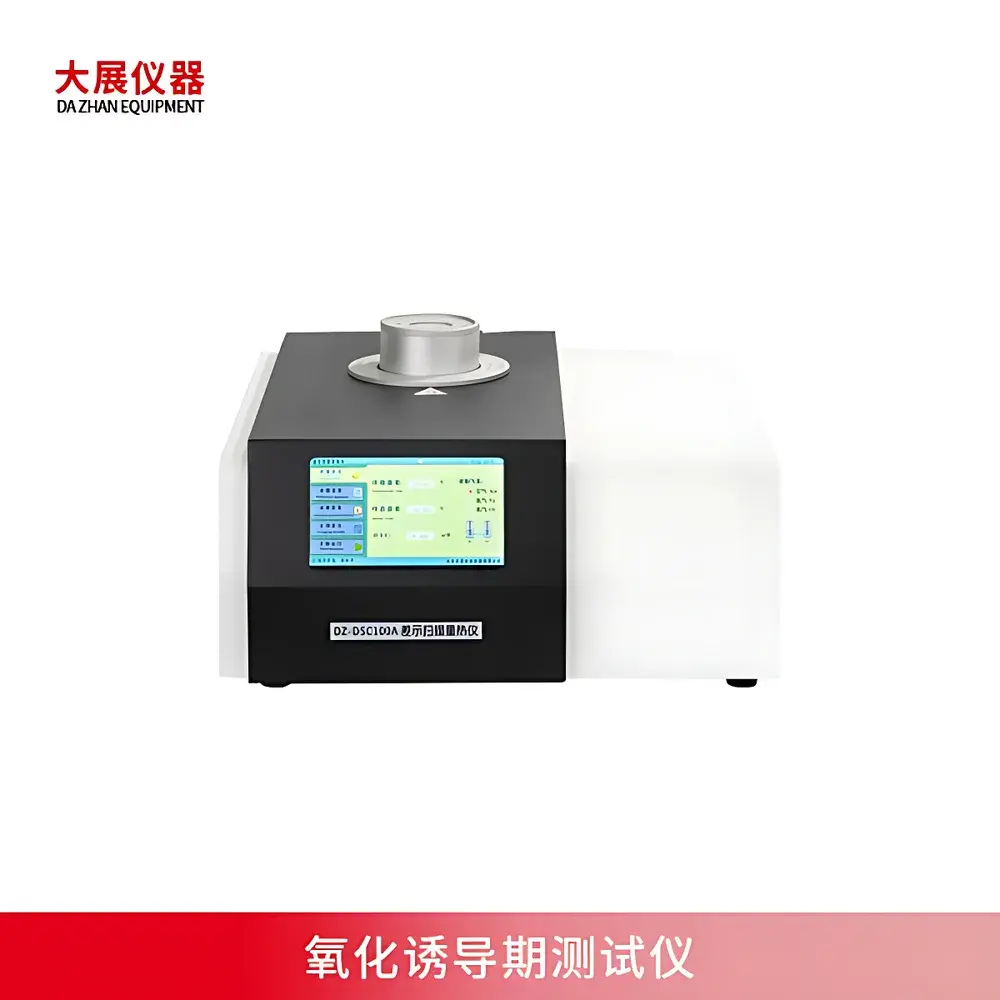
DZHAN DZ-DSC100A Oxidation Induction Time (OIT) Analyzer
| Brand | DZHAN |
|---|---|
| Origin | Jiangsu, China |
| Manufacturer Type | Authorized Distributor |
| Country of Origin | China |
| Model | DZ-DSC100A |
| Price Range | USD 4,200–7,000 (FOB) |
| Sample Capacity | Single-sample |
| Instrument Type | Differential Scanning Calorimeter (DSC) |
| Temperature Range | Ambient to 600 °C |
| Heating/Cooling Rate | 0.1–100 K/min |
| DSC Signal Range | 0 to ±600 mW |
| Temperature Stability | ±0.01 °C |
| Temperature Resolution | 0.01 °C |
| Temperature Repeatability | ±0.1 °C |
| DSC Sensitivity | 0.01 mW |
| Gas Flow Control | Digital Mass Flow Controller (0–200 mL/min) |
| Display | 7-inch 24-bit color capacitive touchscreen LCD |
| Communication Interface | USB 2.0 (bidirectional) |
| Sensor Material | Corrosion-resistant alloy thermopile |
| Calibration | Integrated standard reference materials (e.g., In, Sn, Zn) with one-click auto-calibration for temperature and enthalpy |
| Power Supply | AC 220 V / 50 Hz (customizable for 110 V / 60 Hz) |
Overview
The DZHAN DZ-DSC100A Oxidation Induction Time (OIT) Analyzer is a high-precision differential scanning calorimeter engineered for quantitative thermal stability assessment under controlled oxidative atmospheres. It operates on the fundamental principle of heat flux DSC—measuring the difference in heat flow between a sample and an inert reference as both are subjected to identical, programmable temperature profiles. The instrument is specifically configured and validated for ASTM D3895 (plastics), ISO 11357-6 (polymers), and EN 13423 (rubber) OIT determinations, where time-to-onset exotherm under oxygen or air purge serves as a direct indicator of antioxidant depletion and onset of autoxidation. Its robust furnace architecture—featuring top-opening design, high-efficiency ceramic insulation, and dual-zone thermal shielding—ensures exceptional baseline stability (<0.01 °C drift over 30 min) and minimizes thermal lag during rapid heating/cooling cycles. The system supports both isothermal OIT (at fixed T, e.g., 200 °C) and dynamic OIT (ramped heating under O2), enabling comparative evaluation of stabilization packages across polymer grades, recycled content, or additive formulations.
Key Features
- High-stability furnace with top-access geometry for rapid sample loading, minimal thermal mass, and reproducible crucible positioning—critical for inter-laboratory OIT comparability.
- Digital mass flow controller (MFC) with real-time gas flow monitoring (0–200 mL/min); flow parameters logged synchronously with thermal data in native .dsc format for full audit trail compliance.
- Bidirectional control architecture: local operation via 7-inch 24-bit color capacitive touchscreen (with intuitive icon-driven workflow) or remote PC-based control via USB 2.0 interface—enabling seamless integration into automated QC labs.
- Corrosion-resistant alloy thermopile sensor with extended service life in aggressive oxidative environments; calibrated traceably to NIST-traceable standards (In, Sn, Zn).
- Full-program automatic temperature control with linear, step, or modulated ramp profiles; supports multi-segment methods including hold-and-ramp sequences required by ISO 11357-6 Annex A.
- Onboard one-click calibration routine for simultaneous temperature and enthalpy verification—no external software or hardware required—reducing downtime and operator dependency.
Sample Compatibility & Compliance
The DZ-DSC100A accommodates standard aluminum, gold-plated aluminum, or high-purity platinum crucibles (open or hermetic), supporting solid polymers (pellets, films, powders), elastomers, pharmaceutical excipients, and food-grade lipids. Sample mass range: 1–15 mg (optimized at 5–10 mg for OIT). All measurements comply with GLP documentation requirements: timestamped raw data files include instrument ID, operator ID, method name, gas type/flow, calibration status, and environmental chamber logs. The system meets essential regulatory expectations for thermal analysis in GMP-adjacent environments—including electronic signature readiness, audit trail generation, and data integrity per ALCOA+ principles. While not pre-certified for 21 CFR Part 11, its architecture supports validation protocols for FDA-submitted stability studies when deployed with validated software and procedural controls.
Software & Data Management
Data acquisition and analysis are performed using DZHAN Thermal Analysis Suite (v3.2+), a Windows-based application supporting ICH Q5C thermal stability reporting templates. Raw DSC thermograms are stored in vendor-neutral ASCII (.txt) and proprietary binary (.dsc) formats, with metadata embedded per ASTM E1970. Key analytical functions include automatic OIT onset detection (tangent-intersection method per ASTM D3895), peak deconvolution for overlapping transitions (e.g., cold crystallization + melting), and baseline correction using polynomial or spline algorithms. Export options include CSV, PDF reports with embedded chromatograms, and Excel-compatible summary tables. All data files are digitally signed upon export, and software maintains a tamper-evident activity log (user login/logout, method edits, calibration events) compliant with ISO/IEC 17025 clause 7.7.
Applications
- Polymer science: Quantifying antioxidant efficacy in polyolefins (PP, PE), engineering thermoplastics (PA6, PBT), and biodegradable resins (PLA, PHA) during accelerated aging studies.
- Recycling quality control: Assessing thermo-oxidative degradation in post-consumer recycled (PCR) plastics prior to reprocessing—correlating OIT loss with melt flow index (MFI) shifts.
- Pharmaceutical development: Evaluating excipient compatibility and thermal stability of lipid-based drug delivery systems (e.g., solid lipid nanoparticles) under oxidative stress.
- Food science: Measuring oxidative shelf-life predictors in edible oils, margarines, and encapsulated omega-3 fatty acids—aligned with AOCS Cd 12b-92 methodology.
- Academic research: Investigating catalytic oxidation mechanisms, nanofiller effects on polymer degradation kinetics, and structure–stability relationships in novel copolymers.
FAQ
What standards does the DZ-DSC100A support for OIT testing?
ASTM D3895, ISO 11357-6, EN 13423, and GB/T 19466.6. Method templates are preloaded in the software.
Can the instrument perform both isothermal and dynamic OIT measurements?
Yes—fully programmable temperature profiles support isothermal holds (e.g., 200 °C for 60 min) and dynamic ramps (e.g., 20 °C/min to 300 °C under O2).
Is calibration traceable to international standards?
Yes—factory calibration uses NIST-traceable indium, tin, and zinc standards; users can perform on-site verification with included reference materials.
Does the system meet data integrity requirements for regulated industries?
It provides foundational elements for 21 CFR Part 11 compliance (audit trail, electronic signatures, data backup)—final validation depends on site-specific SOPs and IT infrastructure.
What maintenance is required for long-term OIT accuracy?
Annual sensor sensitivity verification and MFC calibration are recommended; crucible cleaning protocol and purge gas filter replacement every 6 months ensure baseline consistency.



