
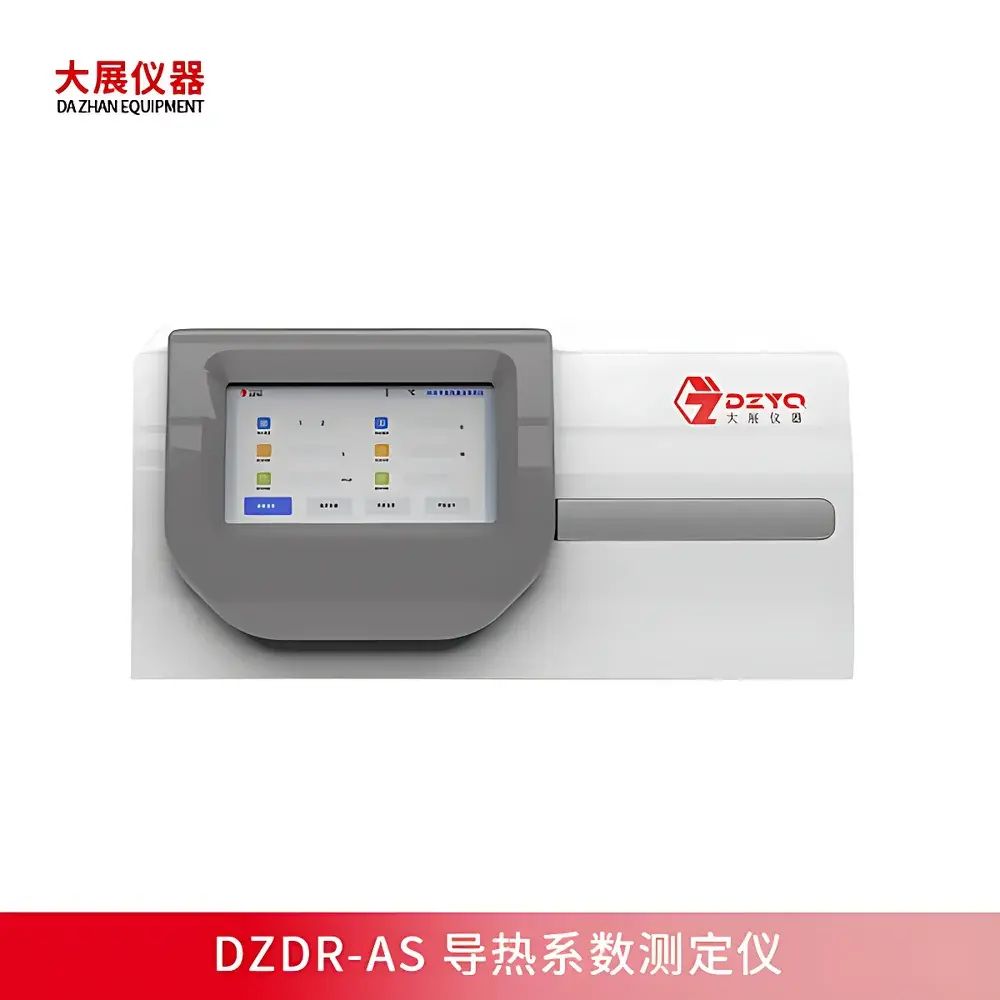
DAZHAN DZDR-AS Transient Plane Source (TPS) Thermal Conductivity Analyzer
| Brand | DAZHAN |
|---|---|
| Origin | Jiangsu, China |
| Manufacturer Type | Authorized Distributor |
| Country of Origin | China |
| Model | DZDR-AS |
| Instrument Type | Transient Plane Source (TPS) Method |
| Sample Throughput | Single sample per test |
| Test Environment | Ambient temperature |
| Thermal Conductivity Range | 0.0001–50 W/(m·K) |
| Resolution | 0.0001 W/(m·K) |
| Repeatability | ≤1% |
| Temperature Range | −40 °C to +200 °C (expandable) |
| Sample Forms | Solid blocks, metals, liquids, powders, pastes, gels, thin films, foams, polymers, alloys, minerals, and thermal insulation materials |
Overview
The DAZHAN DZDR-AS Thermal Conductivity Analyzer is a precision instrument engineered for rapid, high-resolution measurement of thermal conductivity and thermal diffusivity in heterogeneous material systems. It implements the internationally standardized Transient Plane Source (TPS) method—defined in ISO 22007-2 and ASTM D7984—based on one-dimensional transient heat conduction in an infinite medium. A calibrated nickel-based double-spiral sensor acts simultaneously as both heating element and resistance thermometer. Upon application of a constant DC current pulse, the sensor generates a controlled thermal perturbation; its time-dependent resistance change is recorded with microsecond-level temporal resolution. The resulting temperature rise vs. time curve is fitted to the analytical solution of the heat diffusion equation, enabling simultaneous extraction of thermal conductivity (λ), thermal diffusivity (α), and volumetric heat capacity (ρcp). Unlike steady-state techniques, TPS eliminates contact resistance artifacts and requires no pre-conditioning or long equilibration periods—making it ideal for R&D labs, QC environments, and materials certification workflows where throughput and reproducibility are critical.
Key Features
- High-speed measurement: Full thermal property calculation completed within <160 seconds per test cycle
- Dual-probe configuration: Two interchangeable sensors optimized for distinct sample geometries and thermal ranges—one for low-power, high-sensitivity testing (P < 1 W; sample size: 7.5 × 7.5 × 3.75 mm), and another for higher thermal load applications (P < 15 W; sample size: 15 × 15 × 7.5 mm)
- Automated baseline compensation and power optimization algorithms reduce operator dependency and minimize systematic drift
- Integrated 7-inch full-color capacitive touchscreen interface with intuitive dual-direction navigation (English/Chinese firmware selectable)
- Thermal control capability from −40 °C to +200 °C via optional external chiller/heater integration—fully compatible with standard environmental chambers
- Sample temperature rise limited to <20 °C during measurement, preserving structural integrity of thermally sensitive polymers, biological gels, and phase-change materials
- Robust electrical architecture: AC 220 V input, total power consumption <300 W, CE-compliant EMC and safety design
Sample Compatibility & Compliance
The DZDR-AS accommodates an exceptionally broad spectrum of physical states without requiring specialized sample preparation: rigid solids (metals, ceramics, composites), compliant solids (foams, elastomers), granular media (powders, granules), dispersions (colloids, slurries), viscous fluids (oils, molten polymers), and layered structures (thin films, coatings, laminates). Surface flatness and minimal air gaps are the only geometric prerequisites—no pressing, sintering, or vacuum degassing is necessary. All measurements adhere to ISO 22007-2 Annex A (TPS validation protocol) and support GLP/GMP audit readiness through timestamped raw data logging, user-access logs, and configurable electronic signatures. Optional compliance packages include FDA 21 CFR Part 11–enabled software modules for regulated pharmaceutical and biomedical device development.
Software & Data Management
The embedded firmware supports real-time visualization of ΔR(t) and T(t) curves, automatic curve fitting using Levenberg–Marquardt nonlinear regression, and export of ASCII/CSV datasets with metadata (timestamp, probe ID, ambient RH/T, operator ID). PC-based analysis suite (Windows 10/11 compatible) provides advanced post-processing: multi-curve comparison, statistical batch reporting (mean ± SD, CV%), outlier detection per ASTM E691, and customizable report generation (PDF/Excel). Audit trails record all parameter modifications, calibration events, and result approvals—retained for ≥10 years with SHA-256 hashing integrity verification.
Applications
- Thermal interface material (TIM) qualification for electronics cooling systems
- Quality control of insulating aerogels, mineral wool, and vacuum-insulated panels (VIPs)
- Development of battery electrode slurries and solid-state electrolytes
- Characterization of thermally conductive polymer composites for automotive and aerospace components
- Validation of thermal properties in cryogenic insulation for LNG infrastructure
- Research on phase-change materials (PCMs) and nanofluids for thermal energy storage
- Regulatory submission support for ASTM C177, ISO 8302, and IEC 60243-2 compliant documentation
FAQ
What standards does the DZDR-AS comply with?
It conforms to ISO 22007-2 (TPS method), ASTM D7984 (standard guide for thermal conductivity of solids), and supports implementation of ASTM C177, ISO 8302, and IEC 60243-2 for comparative validation.
Can the instrument measure anisotropic materials?
Yes—by orienting the planar sensor parallel or perpendicular to suspected thermal axes and comparing results across multiple sample cuts, directional conductivity can be inferred with appropriate uncertainty propagation.
Is calibration traceable to NIST or other national metrology institutes?
Factory calibration uses reference materials certified by CNAS-accredited laboratories; optional NIST-traceable calibration kits (e.g., Pyroceram 9606, Inconel 600) are available upon request.
How is contact resistance minimized during testing?
The TPS method intrinsically suppresses interfacial resistance effects because the sensor is embedded in the sample volume—not clamped between surfaces—ensuring direct volumetric coupling and eliminating gap-related artifacts.
Does the system support automated batch testing?
While designed for single-sample precision, optional robotic sample changers and API-driven scripting (via TCP/IP or RS-232) enable unattended sequential testing of up to 24 samples per session when integrated into automated lab platforms.



