
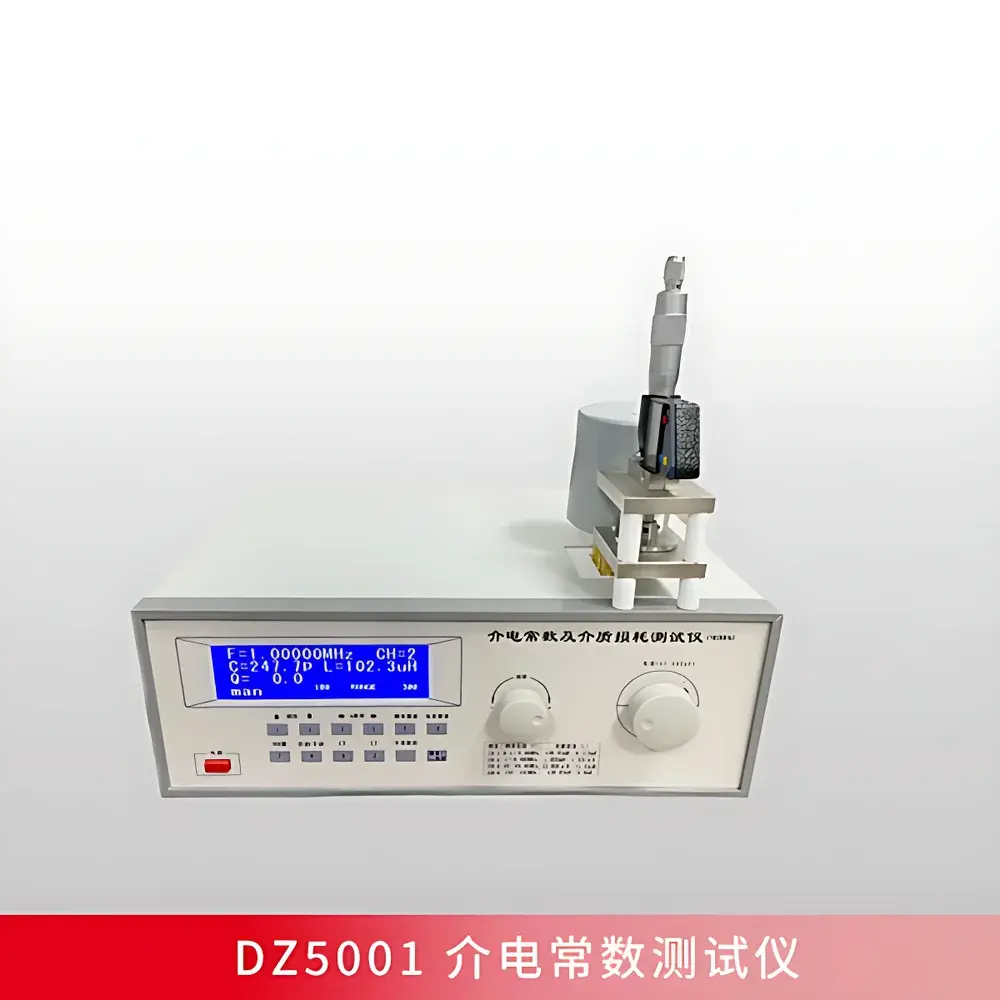
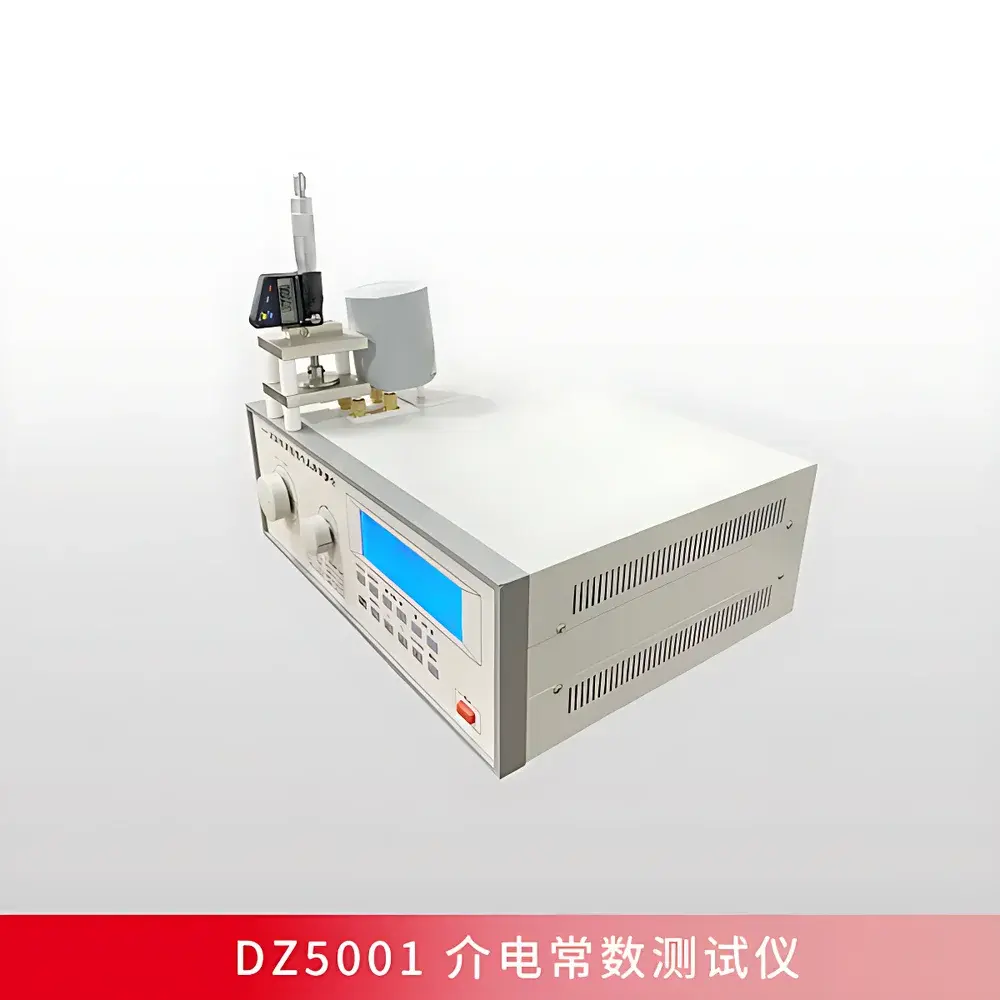
Nanjing Dazhan DZ5001 Dielectric Constant and Loss Tangent Analyzer
| Brand | Nanjing Dazhan |
|---|---|
| Model | DZ5001 |
| Origin | Jiangsu, China |
| Manufacturer Type | Direct Manufacturer |
| Frequency Range | 10 kHz – 100 MHz |
| Frequency Accuracy | ±3×10⁻⁵ (6-digit resolution) |
| Signal Source | DDS Digital Synthesis |
| ADC Resolution | 12-bit |
| Q Factor Range | 1–1000 |
| Q Resolution | 0.1 (4-digit display) |
| Q Measurement Error | <5% |
| Inductance Range | 1 nH – 140 mH |
| Inductance Resolution | 0.1 nH |
| Inductance Error | <3% |
| Main Tuning Capacitance | 17–240 pF (silver-plated monolithic capacitor) |
| Capacitance Direct Measurement Range | 1 pF – 25 nF |
| Capacitance Accuracy | ±1 pF or <1% |
| Capacitance Resolution | 0.1 pF |
| Automatic Capacitance Search | Yes (stepper motor-driven) |
| Resonance Detection | Auto-scan |
| Q Pass/Fail Threshold | Programmable (5–1000) |
| Display | LCD showing F, L, C, Q, Lt, Ct, εᵣ, Tn, etc. |
| Residual Inductance Compensation | Supported |
| Test Lead Inductance Compensation | Supported |
Overview
The Nanjing Dazhan DZ5001 Dielectric Constant and Loss Tangent Analyzer is a precision impedance resonance instrument engineered for the quantitative characterization of dielectric properties in solid and ceramic insulating materials. It operates on the principle of series-resonant cavity measurement, where a sample under test is integrated into a high-Q LC resonant circuit formed by a calibrated air-variable capacitor and a stable inductance standard. By precisely determining the resonant frequency shift and bandwidth change induced by the sample’s permittivity and conductive losses, the system calculates both the relative permittivity (εᵣ) and the dissipation factor (tan δ), which is mathematically derived from the measured Q factor (Q = 1/tan δ). This method delivers high reproducibility for low-loss dielectrics—particularly critical for quality control of alumina substrates, PTFE laminates, ferrite cores, glass-ceramic composites, and high-purity quartz wafers used in RF/microwave component manufacturing and semiconductor packaging.
Key Features
- Wide-frequency DDS signal synthesis (10 kHz to 100 MHz) with 6-digit frequency resolution and ±3×10⁻⁵ absolute accuracy—enabling dispersion analysis across multiple relaxation bands.
- Monolithic silver-plated main tuning capacitor (17–240 pF) with mechanical stability and thermal drift compensation, ensuring long-term calibration integrity.
- Integrated stepper-motor-driven capacitance auto-search function that locates resonance within ±0.1 pF resolution, eliminating manual tuning errors and accelerating throughput.
- 12-bit high-speed ADC acquisition architecture optimized for Q stability—critical when measuring ultra-low-loss materials (tan δ < 10⁻⁴) such as single-crystal sapphire or fused silica.
- Comprehensive parameter display including resonant frequency (F), series inductance (L), tuning capacitance (C), Q factor, loaded/unloaded inductance (Lt), effective capacitance (Ct), relative permittivity (εᵣ), and temperature-normalized readings (Tn).
- Built-in residual inductance and test-lead inductance compensation algorithms, reducing systematic error in fixture-dependent measurements per ASTM D150 and IEC 60250 guidelines.
Sample Compatibility & Compliance
The DZ5001 supports standardized sample geometries defined in ASTM D150-21 (Standard Test Methods for Dielectric and Resistivity Properties of Solid Electrical Insulating Materials) and IEC 60250 (Determination of the Dielectric Constant and Dissipation Factor of Electrical Insulating Materials at Power, Audio and Radio Frequencies). It accommodates disk-shaped specimens (typically 25–50 mm diameter, 1–5 mm thickness) with parallel-electrode contact via adjustable brass electrodes or custom fixtures. The analyzer is compatible with common electrode configurations—including guarded three-terminal setups for surface leakage suppression—and supports both ambient and temperature-controlled chamber integration (with optional external thermocouple input). All measurement data logs include timestamped metadata required for GLP-compliant reporting and internal QA audits.
Software & Data Management
While the DZ5001 operates as a standalone benchtop instrument with full local LCD control, it provides RS-232 and optional USB-to-serial interfaces for automated data export. Raw measurement sequences—including F, C, Q, εᵣ, and tan δ values—are exportable in CSV format for post-processing in MATLAB, Python (NumPy/Pandas), or Excel-based statistical process control (SPC) platforms. The firmware supports user-defined pass/fail thresholds for Q and εᵣ, triggering audible/visual alerts during production-line screening. Audit trail functionality records operator ID, calibration date, and environmental conditions (if external sensors are connected), aligning with basic FDA 21 CFR Part 11 data integrity expectations for non-GMP environments.
Applications
- Quality assurance of ceramic capacitors, piezoelectric transducers, and microwave substrate materials (e.g., Al₂O₃, AlN, LTCC).
- Development and validation of low-k dielectrics for advanced IC interconnects and 5G antenna substrates.
- Research into polarization mechanisms in ferroelectric polymers, relaxor ferroelectrics, and nanocomposite dielectrics.
- Batch consistency testing of polymer films (polyimide, PET, PEN) and epoxy molding compounds used in power electronics encapsulation.
- Educational laboratories requiring hands-on instruction in electromagnetic material characterization fundamentals.
FAQ
What standards does the DZ5001 comply with for dielectric measurements?
It supports test methodologies outlined in ASTM D150, IEC 60250, and GB/T 1409—covering procedures for permittivity and loss tangent determination at audio and radio frequencies.
Can the DZ5001 measure thin-film dielectrics or liquids?
It is optimized for solid, rigid, low-conductivity samples with defined geometry; liquid or flexible film measurements require specialized electrode fixtures not included as standard equipment.
Is calibration traceable to national metrology institutes?
Factory calibration uses NIST-traceable LCR standards; users may perform periodic verification using certified reference capacitors and inductors per ISO/IEC 17025 laboratory practices.
Does the instrument support temperature-dependent measurements?
Yes—via external PT100 or thermocouple input (optional interface module), enabling εᵣ vs. temperature profiling up to 200 °C when paired with a programmable environmental chamber.
How is stray inductance compensated during high-frequency operation?
The firmware applies real-time correction based on open-circuit and short-circuit calibration routines, referencing stored residual L₀ and C₀ values to isolate sample-specific contributions to the resonant loop.



