
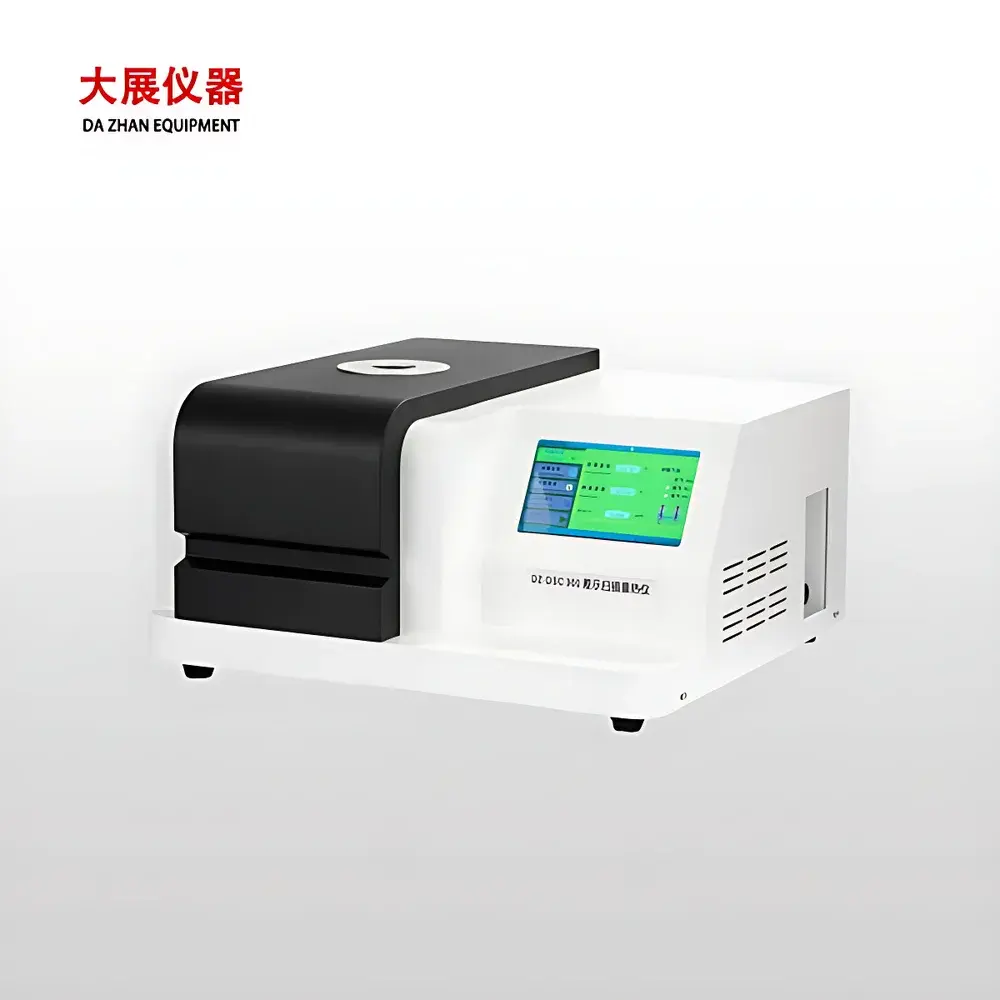
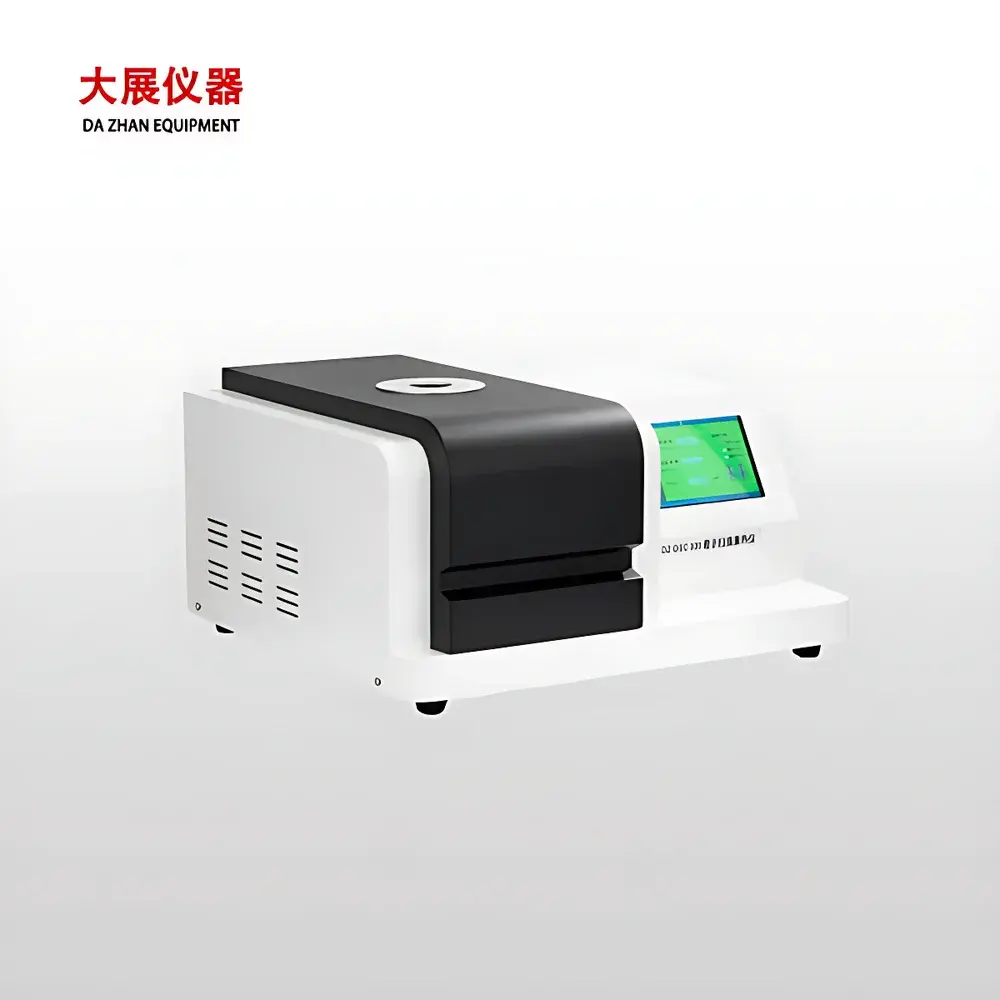
DZ-DSC300 Differential Scanning Calorimeter by NANJING DAZHAN
| Brand | NANJING DAZHAN |
|---|---|
| Origin | Jiangsu, China |
| Manufacturer Type | Direct Manufacturer |
| Instrument Type | DSC |
| Model | DZ-DSC300 |
| Sample Capacity | Single |
| Temperature Range | Ambient to 600 °C |
| Heating/Cooling Rate | 0.1–100 K/min |
| DSC Signal Range | ±600 mW |
| Baseline Stability | ±0.01 °C |
| DSC Resolution | 0.01 µW |
| DSC Sensitivity | 0.001 mW |
| Temperature Accuracy | ±0.001 °C |
| Atmosphere Control | Dual-gas auto-switching (N₂, Air, or custom gas) |
| Flow Rate | 0–300 mL/min |
| Max Pressure | ≤5 MPa |
| Thermal Program | Up to 6 segments (heating/holding/cooling) |
| Display | 7-inch 24-bit color LCD touchscreen |
| Interface | Standard USB |
| Calibration Standards Included | Indium, Tin, Lead |
| Power Supply | AC 220 V / 50 Hz (customizable) |
Overview
The DZ-DSC300 Differential Scanning Calorimeter is a precision thermal analysis instrument engineered for quantitative measurement of heat flow differences between a sample and an inert reference as a function of temperature or time. Operating on the principle of symmetric heat-flux DSC, it delivers high reproducibility in detecting endothermic and exothermic transitions—including glass transition (Tg), cold crystallization, melting (Tm), recrystallization, solid-solid phase changes, oxidative induction time (OIT), and cure kinetics. Designed for routine QC laboratories and R&D environments, the DZ-DSC300 supports ASTM E794, ISO 11357, and USP <1163> thermal characterization protocols. Its robust furnace architecture, thermally isolated sensor design, and dual-gas atmosphere management enable stable baseline performance across extended runs—critical for comparative studies and regulatory submissions.
Key Features
- Optimized symmetric furnace geometry with improved thermal homogeneity, delivering enhanced resolution for closely spaced transitions (e.g., overlapping Tg and cold crystallization peaks in semi-crystalline polymers).
- High-sensitivity micro-calorimetric sensor fabricated using thermal fusion bonding—eliminating mechanical stress from conventional spot welding and improving long-term signal stability and noise floor.
- Full programmability: up to six independent thermal segments (heating, isothermal hold, cooling) with ramp rate control from 0.1 to 100 K/min and hold duration adjustable in 1-second increments.
- Dual-channel gas control system with automatic switching between two pre-configured atmospheres (e.g., N₂ for inert analysis and synthetic air for oxidation studies); flow rate digitally regulated from 0–300 mL/min with pressure monitoring up to 5 MPa.
- Integrated 7-inch capacitive touchscreen interface with real-time thermal curve overlay, event annotation, and local data storage—enabling standalone operation without PC dependency.
- Shielded analog acquisition circuitry with 24-bit ADC resolution and active electromagnetic interference (EMI) suppression, ensuring low-noise DSC signal capture even in shared lab environments.
Sample Compatibility & Compliance
The DZ-DSC300 accommodates standard aluminum, gold-coated aluminum, or hermetic stainless-steel crucibles (40 µL capacity), supporting solids, powders, films, and small-volume liquids (≤20 mg typical). It complies with key international standards for thermal instrumentation validation, including ISO/IEC 17025 traceable calibration procedures. Factory-supplied certified reference materials (indium, tin, lead) allow users to perform multi-point temperature and enthalpy calibration per ASTM E967 and ISO 11357-1. The instrument supports GLP-compliant workflows through audit-trail-enabled software (optional), with electronic signatures, user access levels, and raw data immutability features aligned with FDA 21 CFR Part 11 requirements when paired with validated DSC analysis software.
Software & Data Management
Data acquisition and analysis are supported via optional Windows-based DSC Analysis Suite, which provides peak deconvolution, baseline correction (tangent, linear, polynomial), kinetic modeling (Ozawa-Flynn-Wall, Kissinger), and comparative overlay of multiple curves. All raw data (.dsc binary format) are stored with full metadata—including instrument ID, operator, date/time stamp, gas configuration, and thermal program parameters. Export options include CSV, PDF reports, and ASTM E1461-compliant XML for LIMS integration. Firmware updates and method templates are distributed via encrypted USB drive to maintain version control and prevent unauthorized modification.
Applications
- Thermal stability assessment of pharmaceutical excipients and active ingredients under accelerated aging conditions (ICH Q1A).
- Quantification of degree of cure in thermosetting resins (epoxy, phenolic) via residual enthalpy of reaction.
- Crystallinity determination in polymeric films (e.g., PET, PP) using fusion enthalpy normalization against 100% crystalline references.
- Oxidative induction time (OIT) testing of polyolefins per ASTM D3895 and ISO 11357-6 for antioxidant efficacy evaluation.
- Characterization of phase change materials (PCMs) for thermal energy storage, including latent heat capacity and cycling stability over repeated melt/freeze cycles.
- Quality control of incoming raw materials (e.g., polymer batch consistency, filler dispersion effects) using comparative Tg and Tm fingerprinting.
FAQ
What calibration standards are included with the DZ-DSC300?
Indium (Tm = 156.60 °C), tin (Tm = 231.93 °C), and lead (Tm = 327.46 °C) reference metals are supplied with certified purity ≥99.995%, enabling both temperature and enthalpy calibration per ISO 11357-1.
Can the instrument operate under vacuum or reactive gases?
Vacuum operation is not supported; however, the dual-gas manifold accepts inert (N₂, Ar), oxidizing (air, O₂), or custom gas mixtures (e.g., CO₂, forming gas) with pressure-rated fittings up to 5 MPa—subject to compatible crucible selection.
Is the DZ-DSC300 compliant with 21 CFR Part 11?
The base instrument meets hardware-level requirements (secure data storage, time-stamped logs). Full Part 11 compliance requires deployment of validated third-party DSC software with electronic signature, role-based access, and audit trail modules—available as an optional configuration package.
What is the minimum detectable heat flow change?
With a sensitivity of 0.001 mW and resolution of 0.01 µW, the system reliably resolves transitions with enthalpy changes ≥0.5 J/g in standard 5–10 mg samples under optimal signal-to-noise conditions.
Does the instrument support modulated DSC (MDSC®) or TOPEM® capabilities?
No. The DZ-DSC300 implements conventional single-heating-rate DSC only. Modulated techniques require separate hardware architecture and are not part of this model’s design scope.
Related Products



