
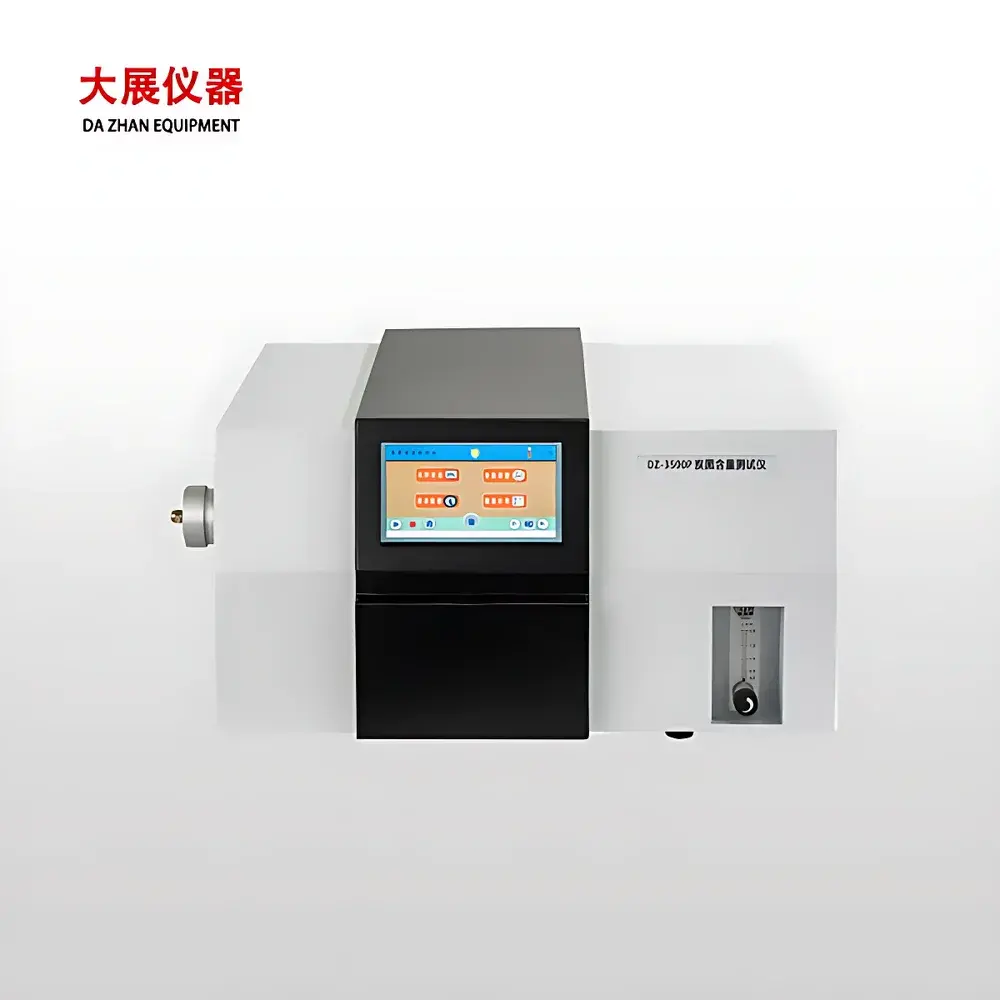
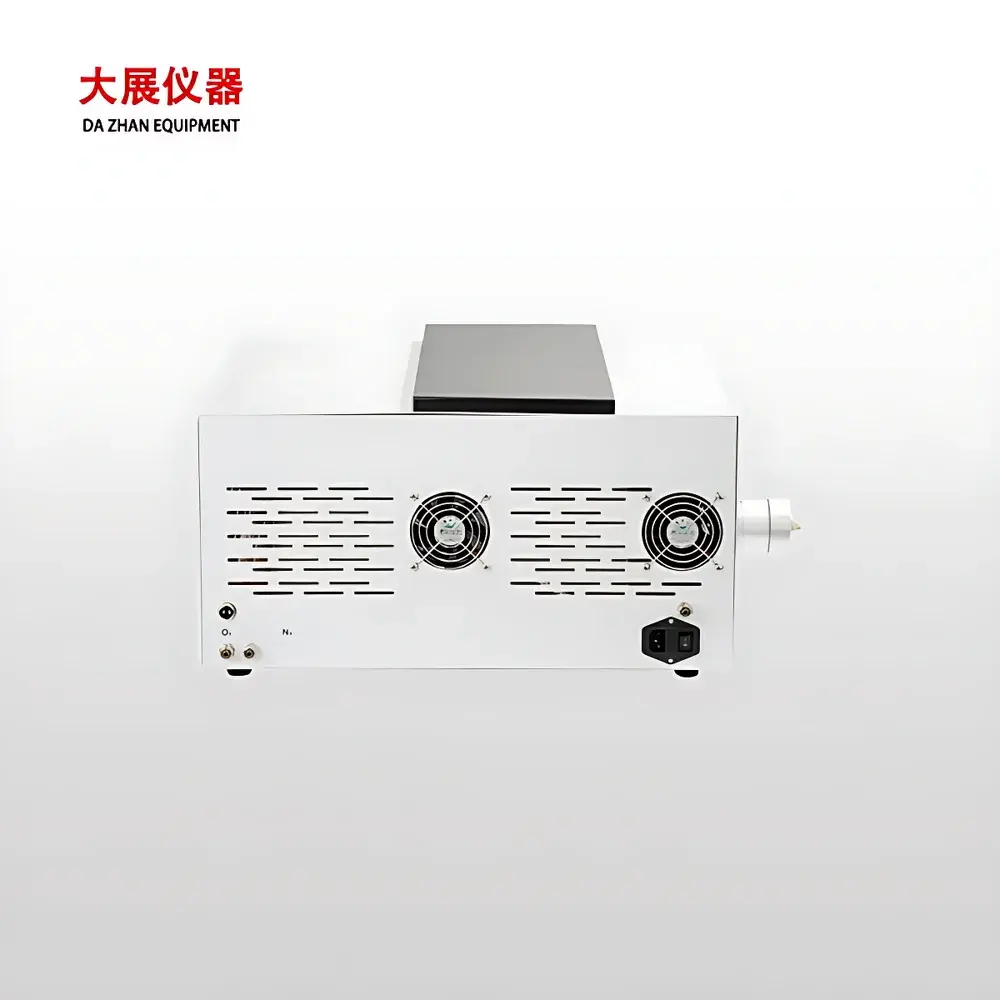
Nanjing Dazhan DZ3500P Carbon Black Content Analyzer
| Brand | Nanjing Dazhan |
|---|---|
| Origin | Jiangsu, China |
| Manufacturer Type | Direct Manufacturer |
| Country of Origin | China |
| Model | DZ3500P |
| Price Range | USD 4,200 – 7,000 |
| Display | 7-inch capacitive touchscreen |
| Quartz Tube Dimensions | φ44 × 600 ± 5 mm |
| Furnace Chamber Dimensions | φ45 × 300 ± 5 mm |
| Heating Element | High-temperature alloy wire |
| Heating Zone Length | 300 mm |
| Uniform Temperature Zone Length | 250 mm |
| Operating Temperature Range | Ambient to 1150 °C |
| Temperature Control | Intelligent programmable multi-segment control |
| Power Supply | AC 220 V / 50 Hz or 60 Hz |
| Temperature Sensor Sensitivity | 0.1 °C |
| Gas Flow Control | Dual-channel, program-automated switching |
| Cooling Method | Rapid cooling (≤20 min from 900 °C to ambient) |
| Sample Capacity | 4 samples per run |
| Data Processing | Onboard calculation engine for carbon black content and ash content |
| Optional Accessories | Exhaust gas scrubber & particulate filter, rail-mounted sample holder |
Overview
The Nanjing Dazhan DZ3500P Carbon Black Content Analyzer is a precision thermal gravimetric instrument engineered for quantitative determination of carbon black loading in polymer matrices—specifically polyethylene (PE), polypropylene (PP), polybutene (PB), cable insulation and jacketing compounds, and elastomeric systems. It operates on the principle of controlled pyrolysis under inert nitrogen atmosphere, where organic polymer components are thermally decomposed at elevated temperatures while carbon black remains as a thermally stable residue. The mass difference before and after pyrolysis—measured via high-resolution weighing—is used to calculate carbon black content (wt%) in strict accordance with standardized test protocols. This method eliminates solvent extraction artifacts and provides direct, gravimetrically traceable results essential for quality assurance in rubber and plastic compounding.
Key Features
- Integrated furnace–controller architecture ensures compact footprint and simplified system management in QC laboratories.
- Intelligent programmable temperature control supports up to 8 independent heating segments, each with user-defined ramp rate, target temperature, and hold duration—enabling full compliance with multi-step thermal profiles specified in ASTM D1606, ISO 6964, and IEC 60811-4-1.
- 7-inch capacitive touchscreen interface delivers intuitive navigation, real-time parameter visualization (setpoint vs. actual temperature, elapsed ramp/hold time), and one-touch run initiation.
- Uniform temperature zone of 250 mm length guarantees consistent thermal exposure across all four sample positions, minimizing inter-sample variability and supporting GLP-compliant replicate analysis.
- Rapid forced-air cooling system reduces cycle time significantly: furnace cools from 900 °C to ambient in ≤20 minutes, enabling ≥6 complete analyses per 8-hour shift.
- Onboard calculation firmware automatically computes carbon black content and ash residue (if applicable) using pre-loaded formulas aligned with GB/T 3515–2005 and GB/T 2951.41–2008 reporting conventions.
- Dual-gas channel manifold enables seamless switching between purge and inert gas flows during thermal cycles, minimizing oxygen ingress and ensuring reproducible char yield.
Sample Compatibility & Compliance
The DZ3500P accommodates standard cylindrical specimens (e.g., ASTM D3182–17 compliant pellets or cut strips) weighing 0.5–2.0 g, compatible with PE, PP, EPR, EPDM, and halogen-free flame-retardant compounds. Its operational methodology satisfies the technical requirements of multiple international standards: GB/T 3515–2005 (Rubber—Determination of carbon black content—Thermogravimetric method), GB/T 13021–1991 (Polyethylene pipes—Determination of carbon black content), GB/T 2951.41–2008 (Electric cables—Test methods for non-metallic materials—Part 41: Procedures for polymeric materials), and IEC 60811-4-1:2004 (Electric and optical fibre cables—Test methods for non-metallic materials—Part 41: General—Measurement of carbon black content). The instrument’s thermal stability, repeatability (<±0.2 wt% RSD for n=6), and documented calibration traceability support audit readiness for ISO/IEC 17025-accredited laboratories.
Software & Data Management
While the DZ3500P operates autonomously via its embedded controller, raw thermal mass-loss data and final carbon black percentages are exportable via USB to CSV format for integration into LIMS or statistical process control platforms. All temperature setpoints, dwell times, and calculated results are timestamped and stored locally with retention configurable up to 1,000 test records. Audit trail functionality logs operator ID (via optional login module), parameter changes, and system alerts—supporting compliance with FDA 21 CFR Part 11 when deployed in regulated GMP environments. No external PC is required for routine operation; however, optional software add-ons provide enhanced graphing, batch report generation, and deviation flagging against user-defined specification limits.
Applications
- Quality control of carbon black–filled polyolefin compounds used in pipe extrusion, geomembrane fabrication, and wire & cable sheathing.
- Validation of masterbatch dispersion efficiency and batch-to-batch consistency in rubber mixing operations.
- Technical service support for compounders verifying formulation adherence to customer-specified carbon black loadings (e.g., 25 ± 1.5 wt% in HDPE conduit).
- Failure analysis of degraded insulation materials where carbon black depletion correlates with UV aging or thermal oxidative breakdown.
- Research and development of conductive polymer composites requiring precise carbon black dosing for percolation threshold studies.
FAQ
What standards does the DZ3500P comply with?
It fully supports GB/T 3515–2005, GB/T 13021–1991, GB/T 2951.41–2008, and IEC 60811-4-1:2004, with thermal performance validated against ASTM D1606 reference procedures.
Can the instrument measure both carbon black and ash content simultaneously?
Yes—the onboard algorithm calculates carbon black content from nitrogen-pyrolyzed mass loss, and optional air-ash step (post-pyrolysis oxidation) enables dual-reporting of residual ash per GB/T 2951.41 Annex A.
Is calibration verification supported?
The system includes built-in temperature calibration offset adjustment and accepts NIST-traceable reference materials (e.g., certified nickel oxide standards) for routine accuracy verification.
What maintenance is required for long-term reliability?
Quartz tube inspection every 200 cycles, periodic cleaning of gas inlet filters, and annual verification of thermocouple drift using fixed-point references (e.g., aluminum melting point at 660.3 °C).
Does the unit support network connectivity or remote monitoring?
Standard configuration is standalone; Ethernet or RS-485 interfaces are available as factory-installed options for integration into plant-wide SCADA or MES systems.





