
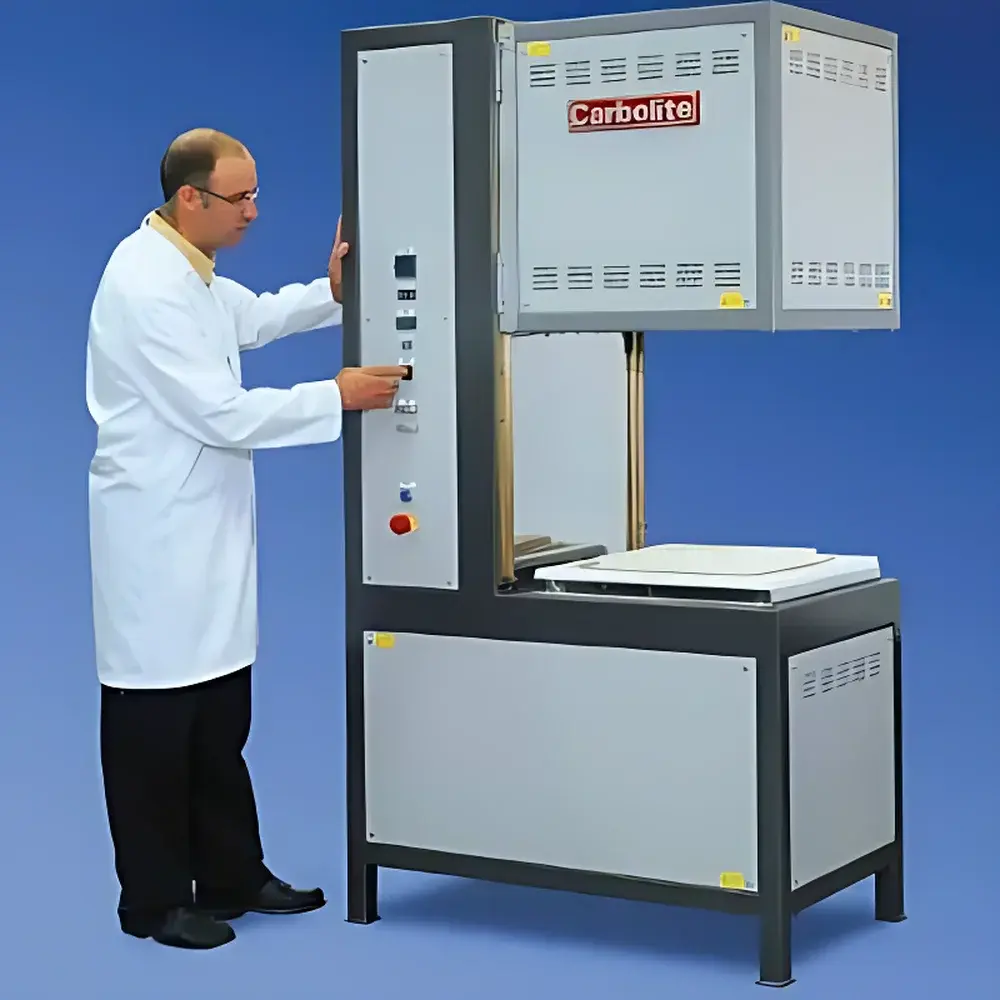
Carbolite-Gero LTH 11/49 Top-Lifting Box Furnace
| Brand | Carbolite-Gero |
|---|---|
| Origin | UK |
| Model | LTH 11/49 |
| Furnace Type | Box Muffle Furnace |
| Max Temperature | 1200 °C |
| Temperature Uniformity | ±5 °C (at setpoint, steady-state) |
| Heating Method | Resistance Wire (FeCrAl alloy) |
| Internal Dimensions | 400 × 350 × 350 mm (L × W × H) |
| Chamber Volume | 49 L |
| Max Power Consumption | 9 kW |
| Insulation | Multi-layer ceramic fiber with low thermal mass |
| Safety | Dual-hand operation interlock, acoustic alarm, emergency stop, automatic heating-element retraction during lid lift |
| Controller | Separate PID controller with 2 m cable (standard) |
Overview
The Carbolite-Gero LTH 11/49 is a top-lifting box muffle furnace engineered for precision thermal processing in research laboratories, materials science facilities, and quality control environments. Designed around a vertically actuated furnace chamber, this model eliminates the need for front-loading access—reducing heat loss, improving operator ergonomics, and enabling rapid sample insertion and retrieval without compromising thermal stability. The furnace operates on resistive heating via high-stability FeCrAl alloy wire elements embedded within a multi-layer ceramic fiber insulation system, delivering rapid thermal response and exceptional energy efficiency. Its maximum operating temperature of 1200 °C conforms to ASTM E1142 and ISO 8573-1 thermal classification standards for Class 1.1 high-temperature laboratory furnaces. The LTH series is fully compliant with IEC 61000-6-3 (EMC) and IEC 61010-1 (safety), supporting GLP and GMP workflows where traceable thermal performance and repeatable ramp-hold profiles are required.
Key Features
- Top-lifting chamber mechanism with motorized actuation—fully retractable to 90° vertical position for unobstructed sample loading; 49 L model achieves full lift in <8 seconds
- Heating elements automatically de-energize and mechanically retract into side walls during chamber elevation—eliminating radiant exposure and ensuring operator safety
- Ceramic fiber insulation (density: 128 kg/m³) minimizes thermal inertia, enabling typical ramp rates of 10–15 °C/min up to 1000 °C (dependent on load mass and atmosphere)
- Uniformity of ±5 °C across the working volume (measured per ISO/IEC 17025-accredited calibration protocol at 1000 °C, 3-point mapping)
- Hard porcelain hearth plate (Al₂O₃ ≥ 95%) rated for continuous use up to 1200 °C, resistant to alkali fluxes and repeated thermal cycling
- Dual-hand safety interlock system requiring simultaneous activation of two independent push-buttons to initiate lift—prevents accidental motion during operation
- Integrated acoustic warning tone and illuminated emergency stop button meeting EN 60204-1 Category 0 requirements
Sample Compatibility & Compliance
The LTH 11/49 accommodates standard crucibles (Pt, Al₂O₃, SiC, graphite), ceramic boats, and custom fixtures up to 380 mm in height. Its sealed chamber design supports inert (N₂, Ar), reducing (H₂/N₂), or vacuum-compatible configurations when fitted with optional gas inlet ports and O-ring-sealed flanges (ISO-KF 40). All models comply with EU Directive 2014/34/EU (ATEX) for use in non-hazardous zones and meet FDA 21 CFR Part 11 data integrity requirements when paired with Carbolite’s validated 20-segment programmable controller (optional). CE marking includes conformity to Machinery Directive 2006/42/EC and Low Voltage Directive 2014/35/EU.
Software & Data Management
The furnace interfaces with Carbolite’s PC-based Thermocouple Logger software via RS232 (standard) or optional RS485/USB adapter. Real-time temperature logging at 1 Hz resolution, alarm-triggered event tagging, and export to CSV or PDF report formats support audit-ready documentation. Optional 20-segment program controller provides slope-controlled ramps, dwell times, and cooling rate modulation—with built-in password protection, electronic signature fields, and change history logs aligned with ALCOA+ principles. Data files include timestamped metadata: ambient temperature, power draw, and thermocouple status flags.
Applications
- Thermal gravimetric analysis (TGA) sample pre-treatment and ashing (ASTM D3174, ISO 1171)
- Sintering of advanced ceramics and metal oxides under controlled atmospheres
- Calcination of catalyst precursors and battery cathode materials (e.g., NMC, LFP)
- Heat treatment of geological samples prior to XRF or ICP-MS digestion
- Residue determination in pharmaceutical excipients (USP ) and food matrices (AOAC 942.05)
- Calibration of secondary temperature sensors using fixed-point cells (e.g., Sn, Zn, Al)
FAQ
Is the LTH 11/49 suitable for use under inert gas flow?
Yes—equipped with dual gas inlet ports (¼” BSP) and a dedicated exhaust outlet, it supports continuous purge or dynamic atmosphere control up to 100 mL/min flow rate.
What type of thermocouple is used for temperature measurement?
Type S (Pt/Pt–10% Rh) reference thermocouple, calibrated to NIST-traceable standards, with cold-junction compensation integrated into the controller.
Can the furnace be integrated into an automated lab system?
Yes—RS232 serial interface enables SCPI command compatibility; Modbus RTU option available for PLC integration.
Does the unit include factory calibration documentation?
Each furnace ships with a UKAS-accredited calibration certificate covering three points (600 °C, 900 °C, 1100 °C) and uncertainty values per ISO/IEC 17025.
What maintenance is required for long-term reliability?
Annual inspection of ceramic fiber integrity, thermocouple drift verification, and mechanical actuator lubrication per Carbolite’s Maintenance Schedule MS-LTH-2023.



