
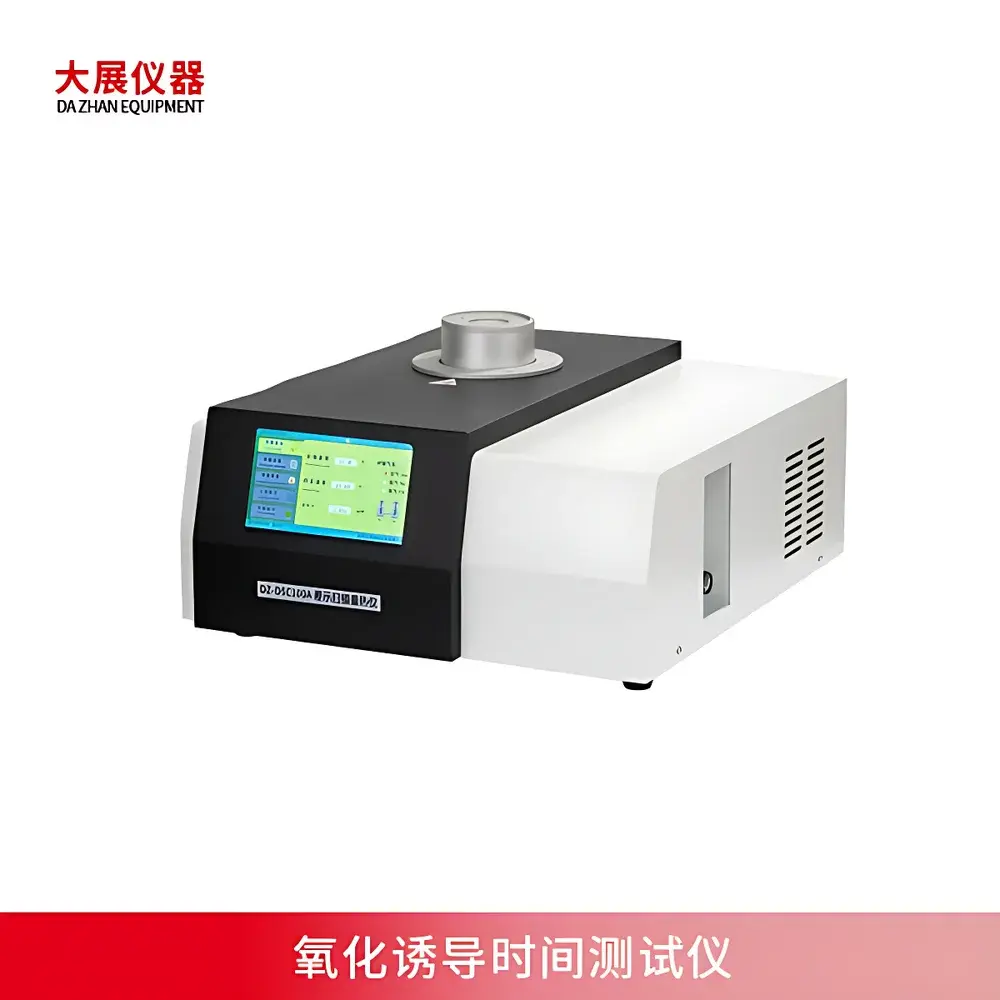
DZHAN DZ-DSC100A Differential Scanning Calorimeter for Oxidation Induction Time (OIT) Testing
| Brand | DZHAN |
|---|---|
| Model | DZ-DSC100A |
| Origin | Jiangsu, China |
| Instrument Type | DSC |
| Temperature Range | Ambient to 600 °C |
| Heating/Cooling Rate | 0.1–100 K/min |
| DSC Signal Range | 0 to ±600 mW |
| Temperature Stability | ±0.01 °C |
| Temperature Resolution | 0.01 °C |
| Temperature Repeatability | ±0.1 °C |
| Gas Flow Control | 0–200 mL/min (digital mass flow meter) |
| DSC Sensitivity | 0.01 mW |
| Interface | USB 2.0 |
| Display | 7-inch 24-bit color TFT touchscreen |
| Power Supply | AC 220 V / 50 Hz |
| Compliance | Includes certified reference materials and one-click calibration for temperature and enthalpy |
Overview
The DZHAN DZ-DSC100A is a high-precision differential scanning calorimeter engineered for quantitative thermal analysis of solid and semi-crystalline materials, with dedicated capability for oxidation induction time (OIT) and oxidation induction temperature (OITT) determination under controlled inert and oxidative atmospheres. Based on the heat-flux DSC principle, the instrument measures the difference in heat flow between a sample and an inert reference as both are subjected to identical, programmable thermal profiles. This enables direct quantification of endothermic and exothermic transitions—including glass transition (Tg), cold crystallization, melting (Tm), crystallization onset, solid-solid phase changes, curing enthalpy, specific heat capacity (Cp), and critically, the onset of rapid oxidative degradation under oxygen or air purge. The DZ-DSC100A meets foundational requirements for thermal stability assessment per ASTM D3895 (OIT of polyolefins), ISO 11357-6, and related polymer aging protocols, serving as a core tool in R&D, quality control, and regulatory documentation workflows.
Key Features
- Optimized furnace architecture with dual-sensor symmetry and low thermal mass design, delivering enhanced baseline stability (±0.01 °C drift over 30 min) and improved peak resolution for closely spaced transitions.
- Digital mass flow controller (0–200 mL/min) with real-time logging—gas type, flow rate, and switching events are timestamped and embedded in raw data files for full traceability.
- Cortex-M3 ARM microcontroller ensures deterministic thermal ramp execution, sub-millisecond sampling synchronization, and robust PID regulation across the full 0.1–100 K/min range.
- Integrated calibration suite includes NIST-traceable indium, tin, and zinc standards; one-click auto-calibration corrects both temperature offset and DSC signal gain with audit-log generation.
- Programmable multi-step thermal protocols support isothermal holds, linear ramps, stepwise temperature jumps, and modulated DSC (MDSC)-compatible sequences—all stored and recalled without external media.
Dual-mode operation: local control via 7-inch 24-bit color capacitive touchscreen (with multi-segment program editor) and remote PC-based control via USB 2.0 interface using compliant Windows software.
Sample Compatibility & Compliance
The DZ-DSC100A accommodates standard aluminum, gold-plated aluminum, and high-pressure stainless-steel crucibles (6–10 µL volume), enabling analysis of polymers, thermosets, pharmaceutical excipients, metallic alloys, ceramics, and composite precursors. Sample mass range: 1–20 mg (optimized at 5–10 mg for OIT reproducibility). The system supports inert (N2, Ar) and reactive (O2, synthetic air) atmospheres with automatic gas switching logic synchronized to thermal events. Data acquisition and processing comply with GLP principles: all method parameters, instrument logs, calibration records, and raw thermograms are saved in vendor-neutral .csv and proprietary binary formats with embedded metadata. While not FDA 21 CFR Part 11-certified out-of-the-box, the software architecture supports audit trail export and user-access-level configuration—facilitating internal validation for ISO/IEC 17025-accredited labs.
Software & Data Management
Bundled Windows-based analysis software provides baseline correction, peak integration (onset, peak, endset), tangent/inflection point detection, Cp calculation via sapphire method, and automated OIT determination per ASTM D3895 Annex A1. All operations generate timestamped project files containing raw heat flow vs. temperature/time, method definitions, calibration history, and operator annotations. Export options include PDF reports (with customizable templates), Excel-compatible .csv, and image exports (PNG, SVG). Data integrity is preserved through checksum-verified file writes and optional password-protected method locking. Software updates are delivered via secure HTTPS download with version-controlled release notes.
Applications
- Polymer stabilization assessment: Quantifying antioxidant depletion kinetics via OIT decay across aging cycles (e.g., PE, PP, EVA).
- Thermal degradation profiling: Identifying onset temperatures for oxidative decomposition in elastomers, composites, and bio-based plastics.
- Curing and crosslinking analysis: Monitoring enthalpy evolution and vitrification during epoxy, silicone, or acrylate resin cure.
- Phase behavior characterization: Mapping Tg, cold crystallization, and melting hysteresis in semicrystalline thermoplastics and copolymers.
- Inorganic material screening: Evaluating dehydration, polymorphic transitions, and redox reactions in metal oxides and battery cathode precursors.
- Pharmaceutical solid-state analysis: Detecting polymorphic interconversion, desolvation, and amorphous content via modulated heating protocols.
FAQ
What standards does the DZ-DSC100A support for OIT testing?
ASTM D3895, ISO 11357-6, and GB/T 19466.6 are directly supported through preconfigured methods and reporting templates.
Can the instrument perform heat capacity (Cp) measurements?
Yes—using the sapphire reference method with isothermal or dynamic protocols, Cp accuracy is ±2% within 50–250 °C for homogeneous solids.
Is nitrogen purging mandatory for baseline stability?
No—high-stability baselines are achieved in static air; however, inert purge is required for OIT and moisture-sensitive samples to prevent interference.
How is temperature calibration verified during routine use?
The one-click calibration function uses onboard indium (156.6 °C) and zinc (419.5 °C) references; results are logged with pass/fail criteria per ISO 11357-1.
Does the system support multiple users with role-based access?
User accounts are managed at the OS level; method editing and calibration functions require administrator privileges, supporting basic lab access control.



