
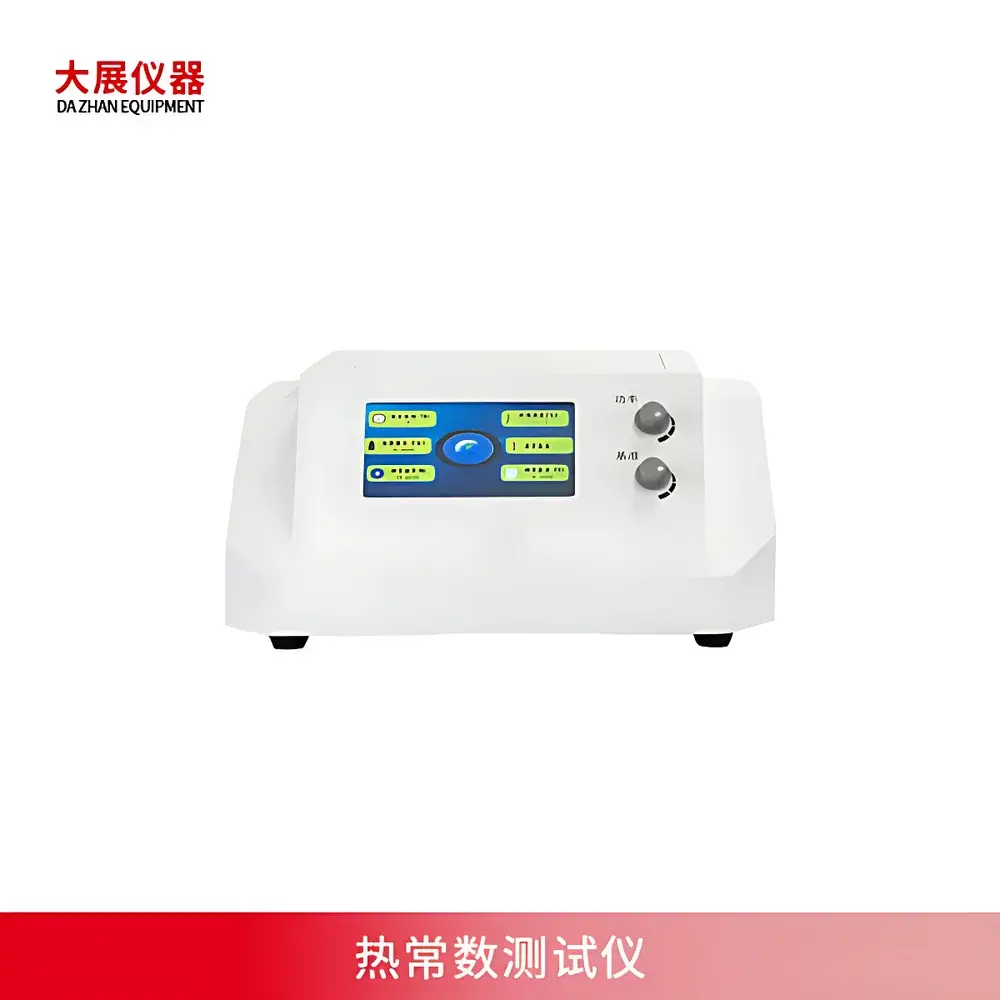
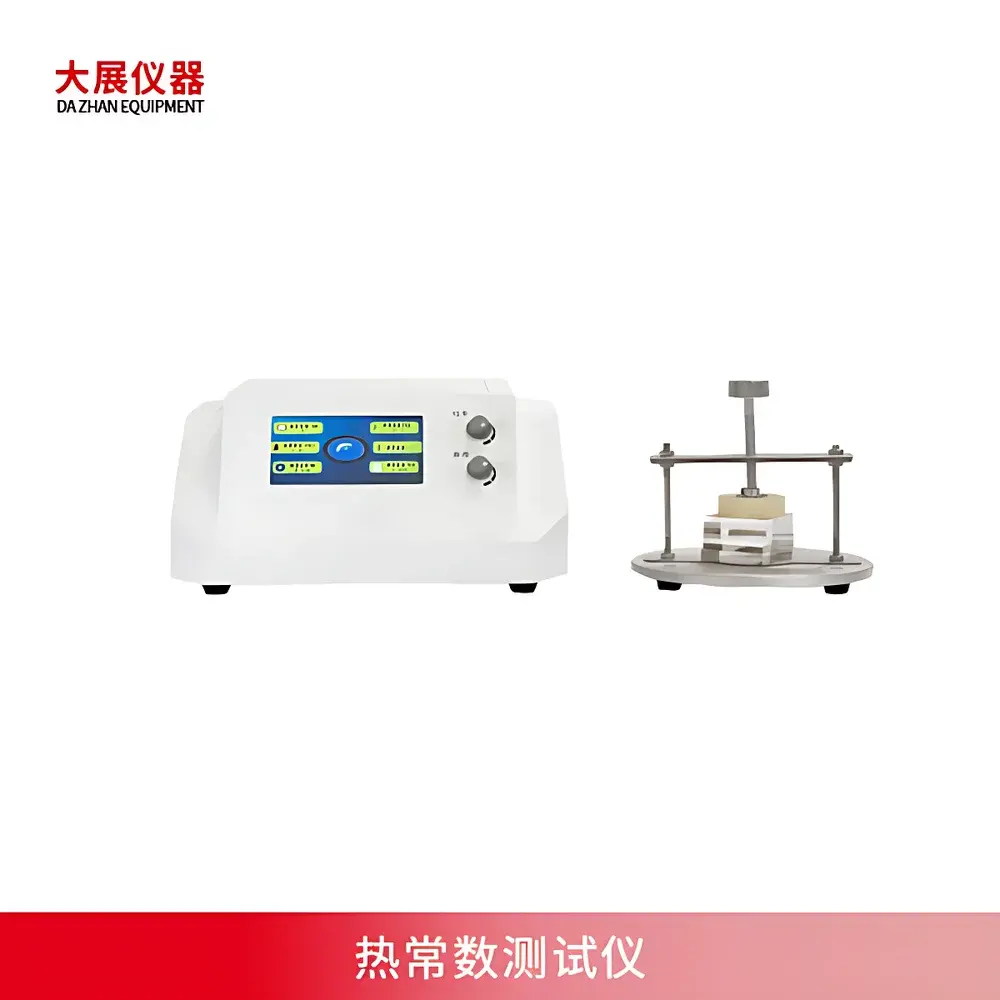
Nanjing Dazhan DZDR-S Transient Plane Source (TPS) Thermal Conductivity Analyzer
| Brand | Nanjing Dazhan |
|---|---|
| Origin | Jiangsu, China |
| Manufacturer Type | Manufacturer |
| Country of Origin | China |
| Model | DZDR-S |
| Instrument Type | Transient Plane Source (TPS) Method |
| Sample Throughput | Single sample per test |
| Test Environment | Ambient temperature (standard) |
| Thermal Conductivity Range | 0.0001–300 W/(m·K) |
| Accuracy | ±3% |
| Repeatability | ≤3% |
| Sample Forms | Solid blocks, pastes, granular solids, gels, liquids, powders, coatings, thin films, and thermal insulation materials |
| Probe Diameters | 7.5 mm (Probe #1), 15 mm (Probe #2), 50 mm (Probe #3, optional/customizable) |
| Sample Dimensions (min.) | ≥15×15×3.75 mm (Probe #1), ≥30×30×7.5 mm (Probe #2), ≥50×50×7.5 mm (Probe #3) |
| Measurement Duration | 5–160 s (user-configurable) |
| Power Supply | AC 220 V, <500 W |
| Data Acquisition | Integrated high-resolution ADC chip |
| Control Core | ARM-based microprocessor |
| Interface | Color TFT touchscreen, embedded HMI |
Overview
The Nanjing Dazhan DZDR-S Transient Plane Source (TPS) Thermal Conductivity Analyzer is an engineered solution for rapid, non-destructive measurement of thermal conductivity and thermal diffusivity across a broad spectrum of material classes. Based on the ISO 22007-2 standard-compliant transient plane source method, the instrument applies a known amount of electrical energy to a dual-spiral sensor embedded in a thin, electrically insulated film. This sensor acts simultaneously as both heat source and resistance thermometer. As the sensor heats the surrounding material, the time-dependent temperature rise is recorded with high temporal resolution. Using analytical solutions to the heat diffusion equation for an infinite medium, the system computes thermal conductivity (λ), thermal diffusivity (α), and volumetric heat capacity (ρcp) from a single transient measurement—without requiring steady-state equilibrium or complex calibration against reference standards.
Key Features
- Direct, absolute measurement of thermal conductivity in 5–160 seconds—no pre-conditioning or thermal equilibration required
- Non-invasive testing: samples remain physically intact and reusable post-measurement
- Minimal sample preparation: flat surface required only for solid blocks; no machining, coating, or vacuum enclosure needed
- Triple-probe configuration (7.5 mm, 15 mm, 50 mm diameters) enables optimized contact area selection for heterogeneous, low-conductivity, or geometrically constrained samples
- ARM-based real-time control architecture ensures deterministic data acquisition timing and robust signal processing
- High-resolution analog-to-digital conversion (ADC) captures subtle thermal transients with sub-millisecond sampling fidelity
- Integrated touchscreen HMI with intuitive workflow navigation—no external PC required for basic operation
- Modular sample stage accommodates variable thicknesses and includes dedicated powder test cell (supplied)
Sample Compatibility & Compliance
The DZDR-S supports diverse physical forms—including rigid and flexible solids, viscoelastic pastes, colloidal gels, Newtonian and non-Newtonian liquids, loose powders, porous insulators, and thin-layer coatings (≥100 µm). Its TPS methodology complies with ISO 22007-2:2015 (“Plastics — Determination of thermal conductivity and thermal diffusivity — Part 2: Transient plane heat source (hot disc) method”) and aligns with ASTM D5470 for thermal transmission properties of thermally conductive materials. While designed for ambient-temperature operation, optional environmental chambers extend validated performance to −40 °C and up to 300 °C—enabling characterization under service-relevant thermal conditions. All firmware and data handling routines support audit-ready operation per GLP and GMP principles, including timestamped metadata logging and user-access-controlled parameter locking.
Software & Data Management
Built-in firmware provides full-cycle test automation: probe selection, power pulse definition, transient capture, curve-fitting, outlier rejection, and uncertainty estimation per ISO/IEC Guide 98-3 (GUM). Exportable data files (CSV, XML) retain raw voltage-time traces, fitted parameters, confidence intervals, and operator annotations. Optional PC software adds advanced features: multi-sample statistical comparison (ANOVA), temperature-dependent λ(θ) modeling, batch report generation compliant with FDA 21 CFR Part 11 (electronic signatures, audit trails), and integration with LIMS via OPC UA or RESTful API. All calculations apply proprietary inverse modeling algorithms validated against NIST-traceable reference materials (e.g., SRM 1450c, Pyroceram 9606).
Applications
- Quality control of thermal interface materials (TIMs), phase-change pads, and encapsulants in electronics packaging
- R&D of aerogels, foams, and nanocomposite insulation for building and aerospace sectors
- Characterization of battery electrode slurries, cathode/anode composites, and thermal management gels
- Validation of thermal transport models in polymer blends, filled elastomers, and biopolymer hydrogels
- Regulatory submission support for medical device thermal safety assessments (ISO 10993-5)
- Teaching laboratories: hands-on demonstration of Fourier’s law, thermal contact resistance, and phonon-dominated conduction
FAQ
What standards does the DZDR-S comply with?
It conforms to ISO 22007-2:2015 and is compatible with ASTM D5470 test protocols. Calibration traceability follows ISO/IEC 17025 requirements.
Can the instrument measure anisotropic materials?
Yes—by orienting the probe normal to principal axes and performing orthogonal measurements, directional thermal conductivity can be inferred when combined with microstructural data (e.g., SEM, XRD).
Is vacuum or inert gas purging supported?
The base configuration operates in air; optional vacuum/test chamber accessories are available for controlled-atmosphere testing.
How is probe calibration maintained?
Each probe undergoes factory calibration using certified reference materials. Users may perform periodic verification with supplied calibration standards (e.g., graphite, stainless steel, glycerol).
Does the system support automated sequential testing?
With optional PC software and robotic sample handling integration, up to 24 samples per unattended run can be processed with full metadata logging.
Related Products



