
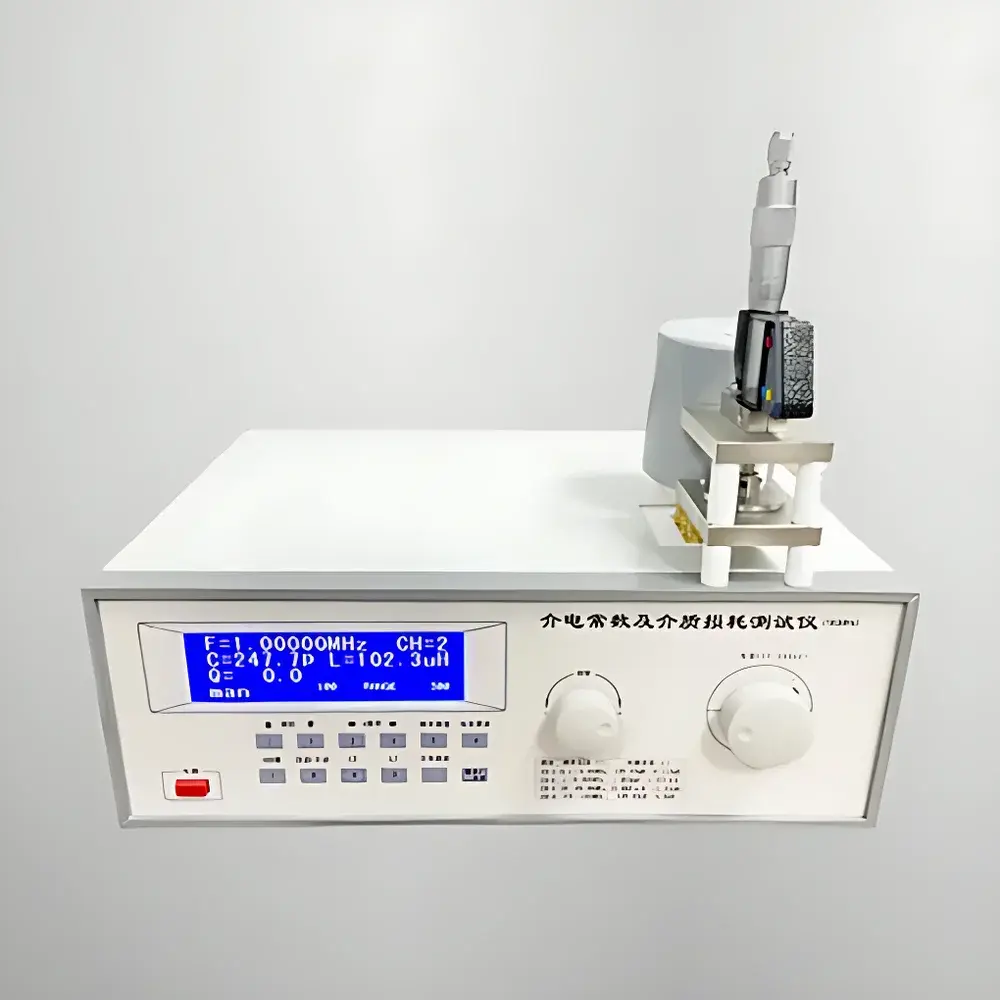
Nanjing Dazhan DZ5001 Dielectric Constant and Loss Tangent Analyzer
| Brand | Nanjing Dazhan |
|---|---|
| Origin | Jiangsu, China |
| Manufacturer Type | Direct Manufacturer |
| Country of Origin | China |
| Model | DZ5001 |
| Price Range | USD 2,800 – 7,000 |
| Measurement Principle | Resonant Cavity / Series Resonance Method with Automatic Q-Factor Tracking |
| Frequency Range | 10 kHz – 100 MHz (DDS Synthesized, 7000:1 Sweep Ratio) |
| Frequency Accuracy | ±3×10⁻⁵ ±1 digit (6-digit resolution) |
| ADC Resolution | 12-bit |
| Q Factor Range | 1–1000 (Auto/Manual Range, 4-digit display, 0.1 resolution) |
| Q Measurement Error | <5% |
| Inductance Range | 1 nH – 140 mH (0.1 nH resolution, <3% error) |
| Main Tuning Capacitor | 17–240 pF (monolithic silver-plated, high-stability) |
| Capacitance Direct Measurement | 1 pF – 25 nF (±1 pF or <1%, 0.1 pF resolution) |
| Capacitance Auto-Search | Stepper-motor-driven |
| Dielectric Constant (εᵣ) Accuracy | ±0.001 (LCD direct readout) |
| Dissipation Factor (tan δ) Accuracy | ±0.0001 (LCD direct readout) |
| Sample Thickness Range | 0.1 mm – 10 mm |
| Compliance | GB/T 1693–2007 |
Overview
The Nanjing Dazhan DZ5001 Dielectric Constant and Loss Tangent Analyzer is a precision impedance-based measurement system engineered for the quantitative characterization of dielectric properties in solid insulating materials. It operates on the principle of series resonance in a high-Q LC circuit, where the sample—positioned as a parallel-plate capacitor between calibrated electrodes—modifies the resonant frequency and bandwidth of the tuned circuit. By precisely tracking the shift in resonance frequency (fr) and the quality factor (Q), the instrument calculates both the relative permittivity (εr) and the dissipation factor (tan δ) using fundamental electromagnetic relationships derived from Maxwell’s equations. This method ensures high reproducibility for low-loss dielectrics such as ceramics, glass, polymer films, mica, and oxide-based substrates. Designed for laboratory environments requiring traceable, repeatable measurements under controlled temperature and humidity conditions, the DZ5001 supports material development workflows aligned with ISO/IEC 17025-compliant testing practices.
Key Features
- DDS digital frequency synthesis with continuous 10 kHz–100 MHz coverage and 7000:1 sweep ratio for broad-spectrum dielectric profiling
- Integrated stepper-motor-driven tuning capacitor (17–240 pF) enabling fully automated resonance search and drift compensation
- 12-bit high-resolution ADC ensuring stable Q-factor acquisition—even for ultra-low-loss materials (tan δ < 10−4)
- Real-time LCD display of primary parameters: fr, L, C, Q, Lt, Ct, εr, tan δ, and sample thickness (Tn)
- Automatic residual inductance and lead capacitance compensation algorithm to eliminate parasitic contributions
- Direct 1 pF–25 nF capacitance measurement capability without external bridge configuration
- Pre-set Q pass/fail thresholds (5–1000) with audible and visual alerts for rapid screening of batch consistency
Sample Compatibility & Compliance
The DZ5001 accommodates flat, homogeneous solid specimens with thicknesses ranging from 0.1 mm to 10 mm and surface area sufficient to fully cover the electrode aperture (standard 25 mm diameter). Compatible material classes include alumina, zirconia, silicon nitride, borosilicate glass, polyimide, PTFE, epoxy laminates, and fired ceramic tiles. Electrode contact is achieved via spring-loaded brass plates with gold-plated surfaces to minimize interfacial resistance and oxidation effects. All measurement protocols conform to GB/T 1693–2007 (“Determination of Dielectric Constant and Dissipation Factor of Solid Electrical Insulating Materials at Power, Audio and Radio Frequencies”), which aligns closely with ASTM D150 and IEC 60250 methodologies. Data output supports GLP documentation requirements, including timestamped parameter logs and operator ID fields.
Software & Data Management
While the DZ5001 operates as a standalone benchtop instrument with full local control, optional RS-232 or USB-C interface enables bidirectional communication with host PCs running Windows-based data acquisition software. Exported datasets include CSV-formatted records containing fr, Q, εr, tan δ, and environmental metadata (date, time, user ID). The firmware implements audit-trail functionality compliant with FDA 21 CFR Part 11 Annex 11 principles: all parameter changes, calibration events, and test executions are logged with immutable timestamps. No cloud connectivity or proprietary cloud platform dependencies are required—data sovereignty remains fully under lab control.
Applications
- Quality assurance of dielectric substrates used in RF/microwave PCB fabrication (e.g., Rogers RO4000®, Taconic RF-35)
- R&D evaluation of high-k gate dielectrics and low-k interlayer insulators in semiconductor process development
- Characterization of piezoelectric ceramic formulations (PZT, BaTiO3) for actuator and sensor design
- Batch verification of polymer film uniformity in capacitor manufacturing (e.g., metallized polypropylene, PET)
- Academic research on ferroelectric phase transitions and relaxor behavior in perovskite thin films
- Validation of coating integrity and moisture ingress in encapsulated optoelectronic modules
FAQ
What sample preparation is required prior to measurement?
Flat, parallel surfaces with minimal roughness (Ra < 0.8 µm) and absence of surface contaminants (oils, oxides, dust) are essential. Specimens must be conditioned at 23 °C ±2 °C and 50% RH ±5% for ≥24 h before testing.
Can the DZ5001 measure liquid or powder samples?
No—the instrument is designed exclusively for solid, self-supporting dielectrics. Liquids require coaxial probe or cavity perturbation methods; powders necessitate pelletization under controlled pressure and binder-free sintering.
Is calibration traceable to national standards?
Yes—factory calibration uses NIST-traceable LCR standards (IET Labs SR104, GenRad 1482) across the full frequency range. A calibration certificate with uncertainty budget is provided with each unit.
How does the system handle temperature-dependent measurements?
The DZ5001 does not include integrated thermal control. For variable-temperature studies, it is compatible with third-party environmental chambers (e.g., ESPEC SU-241) when paired with shielded feedthroughs and thermal isolation mounts.
What maintenance intervals are recommended?
Annual verification of frequency accuracy and Q-factor linearity is advised. Electrode surfaces should be cleaned with anhydrous ethanol and lint-free wipes after every 50 measurements to prevent charge buildup and contact resistance drift.



