
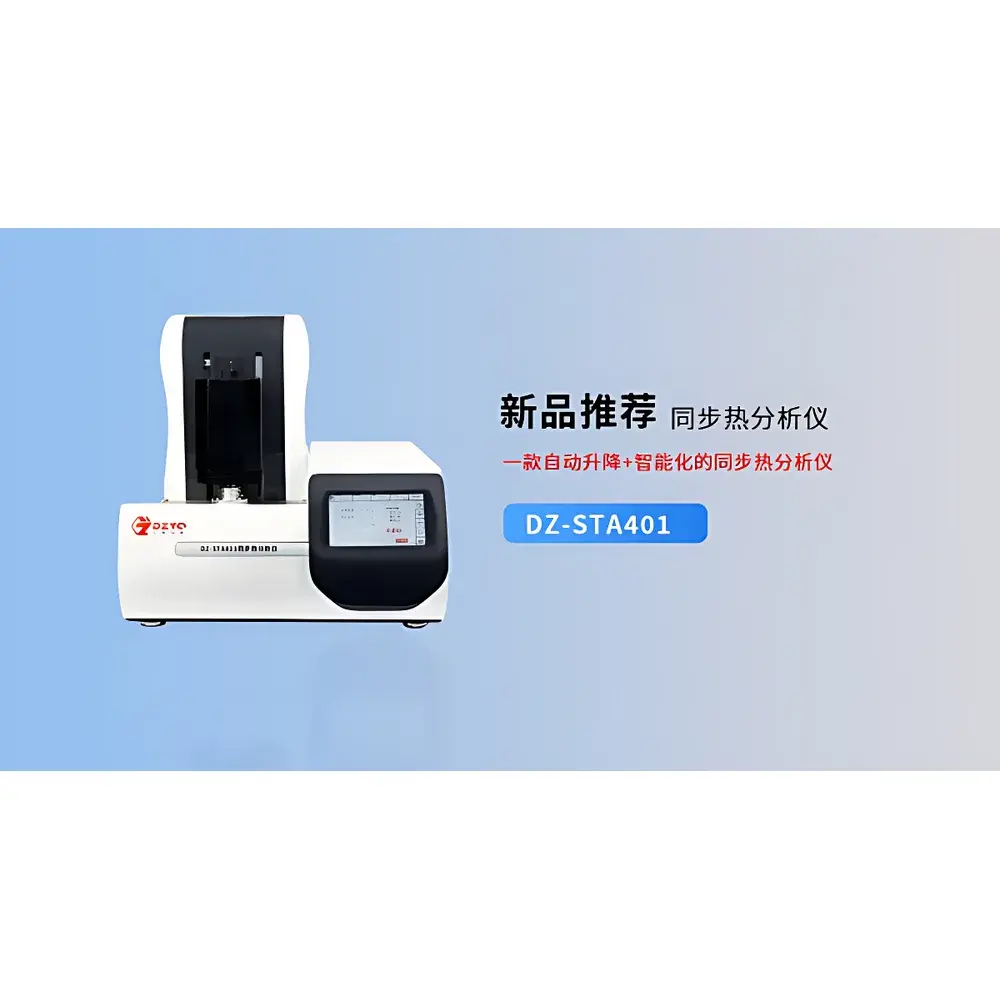
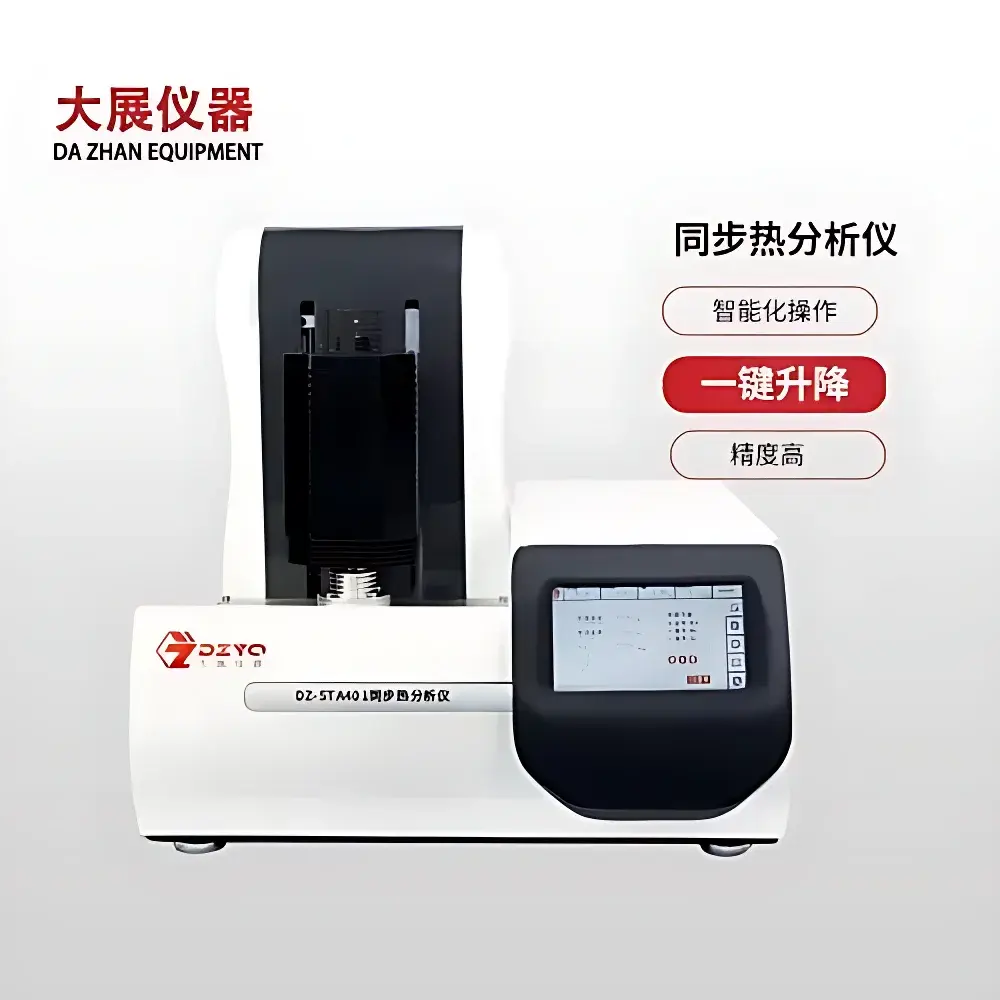
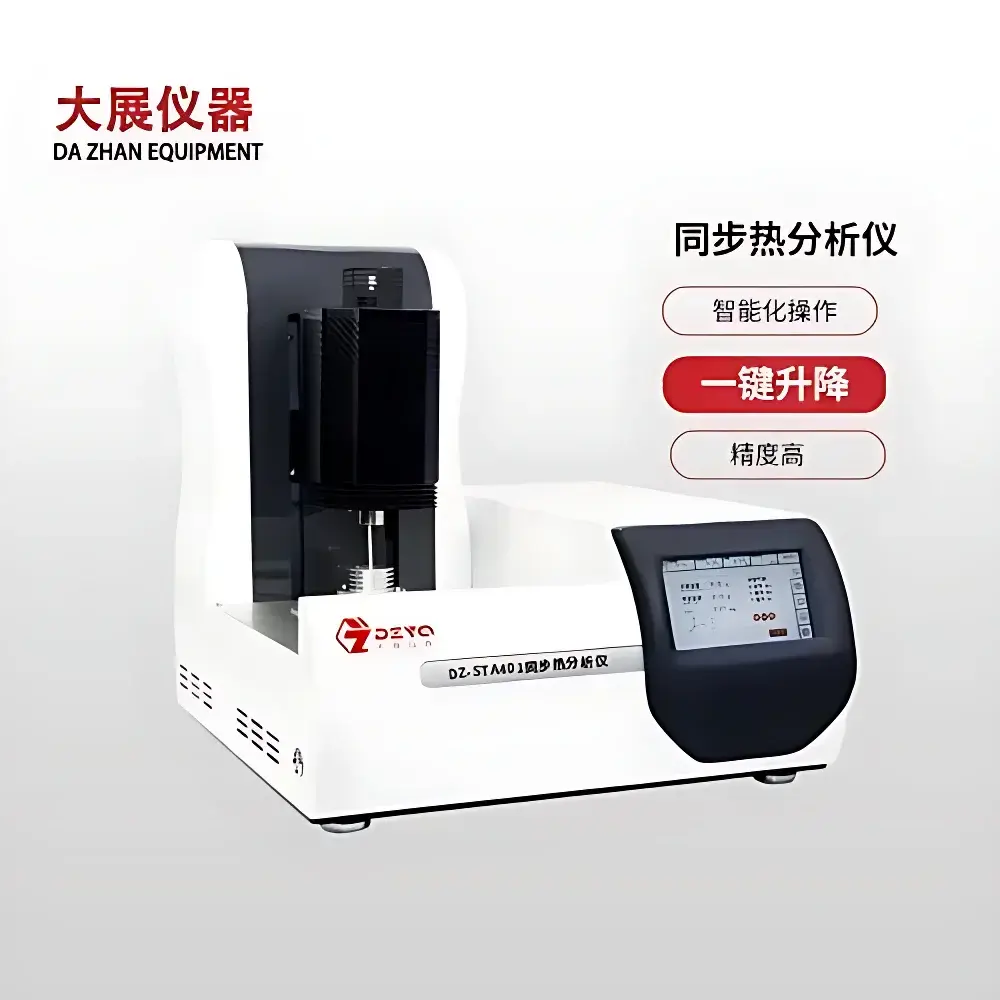
DAZHAN DZ-STA401 Automated Lift Simultaneous Thermal Analyzer (TG-DSC)
| Brand | DAZHAN |
|---|---|
| Origin | Jiangsu, China |
| Manufacturer Type | Authorized Distributor |
| Country of Origin | China |
| Model | DZ-STA401 |
| Price Range | USD 21,000–28,000 |
| Temperature Range | Ambient to 1250 °C |
| Heating/Cooling Rate | 0.1–100 °C/min (heating), −0.1 to −40 °C/min (cooling) |
| Temperature Stability | ±0.01 °C |
| Temperature Resolution | 0.001 °C |
| Maximum Sample Mass | 30 g (expandable to 50 g) |
| Mass Resolution | 0.01 mg |
| Mass Accuracy | ±1 mg |
| DSC Sensitivity | ±1000 mW |
| Atmosphere Control | Triple-gas mass flow control (digital MFCs) |
| Data Acquisition Interval | Real-time, 2 s, 5 s, or 10 s selectable |
| Cooling Time | ≤15 min (1000 °C → 50 °C) |
| External Water Cooling | Integrated chiller interface (−10 °C to 60 °C) |
Overview
The DAZHAN DZ-STA401 Automated Lift Simultaneous Thermal Analyzer is a high-precision, dual-signal thermogravimetric-differential scanning calorimetry (TG-DSC) instrument engineered for rigorous materials characterization under controlled thermal and atmospheric conditions. It operates on the fundamental principles of simultaneous mass change detection (via microbalance) and heat flow measurement (via differential thermocouple sensor) as a function of temperature or time. The system employs a vertically actuated furnace assembly—mechanically driven via precision linear lift mechanism—to enable rapid thermal equilibration, minimize thermal lag during cooling cycles, and reduce operator intervention during sample loading/unloading. This architecture supports reproducible baseline stability and high signal-to-noise ratio across extended temperature sweeps (ambient to 1250 °C), making it suitable for academic research, quality control laboratories, and industrial R&D environments requiring compliance with ASTM E1131, ISO 11358, and USP <1221> thermal analysis guidelines.
Key Features
- Automated vertical furnace lift mechanism enabling fast cooldown (≤15 min from 1000 °C to 50 °C) and improved thermal isolation between heating zone and weighing module;
- Dual-zone insulation design with double-layer ceramic fiber shielding, optimizing temperature linearity and reducing radial thermal gradients;
- Pt-Rh alloy dual-wound heating element ensuring uniform thermal distribution and long-term stability at temperatures up to 1250 °C;
- High-stability microbalance with 0.01 mg resolution and ±1 mg accuracy, decoupled from furnace vibration and thermal drift via independent power supply and active water-cooling interface (−10 °C to 60 °C);
- Triple-channel digital mass flow controllers (MFCs) for precise, programmable gas switching and blending (e.g., N2, O2, Ar, synthetic air) with real-time monitoring and logging;
- Modular software architecture supporting PID-controlled heating/cooling/holding profiles, including ramp-hold-ramp sequences, isothermal dwell (up to 600 min), and multi-step dynamic protocols;
- Integrated exhaust port compatible with FTIR, MS, or GC-MS coupling for evolved gas analysis (EGA) in decomposition or oxidation studies.
Sample Compatibility & Compliance
The DZ-STA401 accommodates solid, powder, granular, and thin-film samples up to 30 g (expandable to 50 g with optional crucible configuration). Standard alumina, platinum, and nickel crucibles are supported; custom crucibles (e.g., gold, silica, sapphire) may be integrated per application requirements. The instrument meets mechanical and electrical safety standards per IEC 61010-1 and complies with electromagnetic compatibility (EMC) directives EN 61326-1. Its software architecture supports audit trail functionality, electronic signature, and data integrity controls aligned with FDA 21 CFR Part 11 and GLP/GMP documentation frameworks when deployed with validated installation and operational qualification (IQ/OQ) packages.
Software & Data Management
DAZHAN’s proprietary STAControl™ software provides full instrument control, real-time visualization of TG, DTG, and DSC signals, and post-run analysis tools including peak deconvolution, derivative calculation (DTG), enthalpy integration, kinetic modeling (e.g., Kissinger, Ozawa-Flynn-Wall), and baseline correction algorithms. Data export is supported in ASCII, CSV, and universal .tdf formats for third-party analysis (e.g., OriginLab, MATLAB, Thermo-Calc). All acquisition parameters—including gas flow rates, temperature setpoints, dwell times, and data sampling intervals—are timestamped and stored with metadata in a relational database structure. Software updates are delivered via secure HTTPS channel with version-controlled release notes and backward-compatible file handling.
Applications
- Thermal stability and decomposition kinetics of polymers, pharmaceuticals, and energetic materials;
- Oxidation onset temperature and reaction enthalpy determination in metals, catalysts, and battery electrode materials;
- Phase transition analysis (melting, crystallization, glass transition Tg) in amorphous and semi-crystalline systems;
- Hydration/dehydration behavior and volatile content quantification in ceramics, clays, and hydrates;
- Corrosion mechanism studies under reactive atmospheres (e.g., SO2, H2S) with synchronized mass loss and exothermic event correlation;
- Quality assurance of raw materials and finished products per ISO 17892-12 (soil testing), ASTM D3850 (polymer degradation), or ICH Q5C (protein stability).
FAQ
What is the maximum operating temperature and certified temperature accuracy?
The DZ-STA401 is rated for continuous operation up to 1250 °C. Temperature accuracy is traceably calibrated to NIST-certified reference materials (e.g., Ni, Al, In, Zn), with uncertainty ≤±0.5 °C across the full range.
Can the instrument perform cooling scans below ambient temperature?
No—the system supports active cooling only down to ambient temperature. Sub-ambient operation requires external cryogenic accessories not included in standard configuration.
Is the software compliant with 21 CFR Part 11 for regulated laboratories?
Yes—when installed with validated user access controls, electronic signatures, and audit trail activation, the software satisfies core requirements of 21 CFR Part 11 for electronic records and signatures.
How is thermal crosstalk between furnace and balance minimized?
Through physical separation of power circuits, dedicated water-cooled thermal barrier, dual-stage furnace insulation, and mechanical lift-based decoupling during non-measurement phases.
What sample pans are included, and are they reusable?
Standard delivery includes five high-purity alumina crucibles (φ6.7 × 2.5 mm) and one Pt/Rh reference pan. All pans are reusable after appropriate cleaning (e.g., ultrasonic ethanol rinse, low-temperature ashing), subject to material compatibility verification.



