
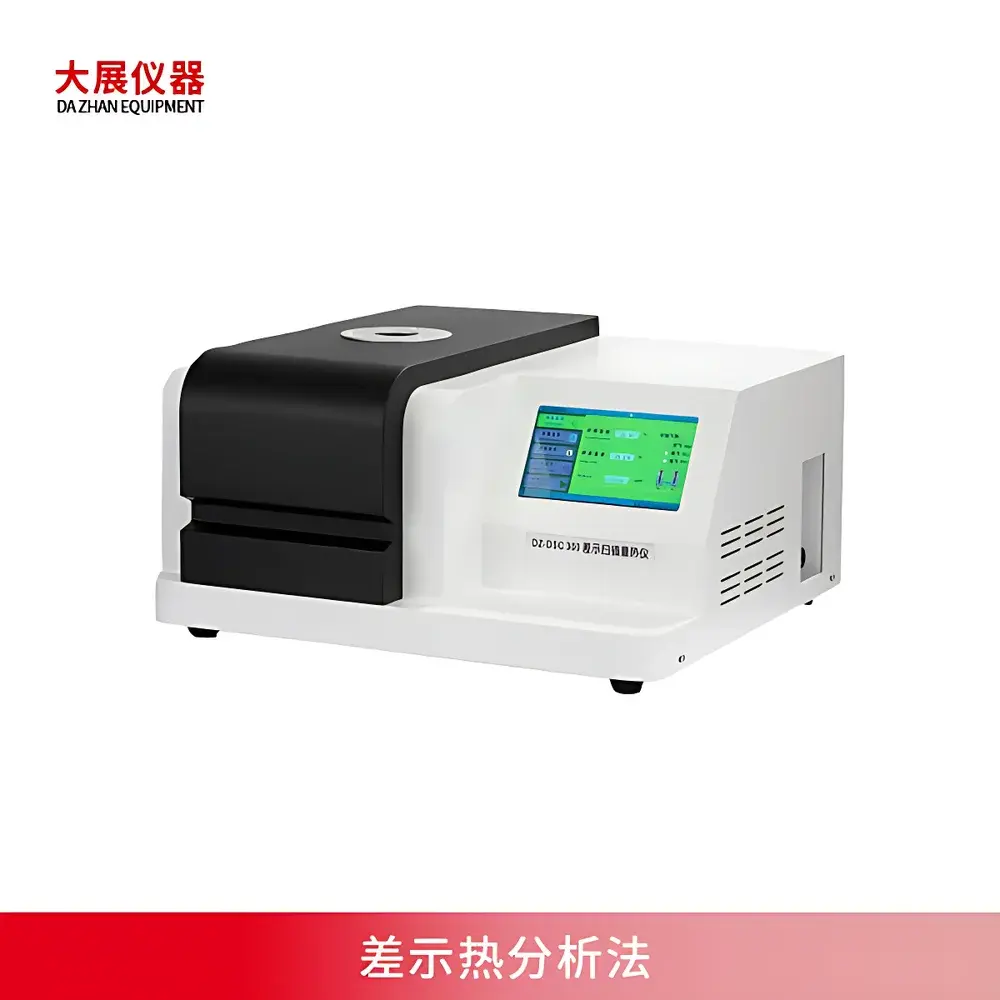
DZHAN DZ-DSC300 Differential Scanning Calorimeter
| Brand | DAZHAN |
|---|---|
| Origin | Jiangsu, China |
| Manufacturer Type | Authorized Distributor |
| Country of Origin | China |
| Model | DZ-DSC300 |
| Sample Capacity | Single-sample |
| Instrument Type | Heat-Flux DSC |
| Temperature Range | Ambient to 600 °C |
| Heating/Cooling Rate | 0.1–100 K/min |
| DSC Signal Range | 0–±800 mW (expandable) |
| Temperature Stability | ±0.01 °C |
| Temperature Resolution | 0.001 °C |
| DSC Sensitivity | 0.001 mW |
| Isothermal Hold Duration | Up to 24 h |
| Atmosphere Control | Dual-gas automatic switching (N₂, Air, Ar, or custom), 0–200 mL/min flow, ≤0.5 MPa pressure |
| Control Mode | Fully programmable 6-segment heating/holding/cooling sequences with PID regulation |
| Display | 7-inch 24-bit color LCD touchscreen |
| Interface | Standard USB |
| Calibration Standards Included | Indium, Tin, Lead |
| Software Features | Multi-point temperature calibration, real-time baseline correction, GLP-compliant data logging |
Overview
The DZHAN DZ-DSC300 is a precision heat-flux differential scanning calorimeter engineered for quantitative thermal characterization of solid and semi-crystalline materials across a broad operational range (ambient to 600 °C). Based on the fundamental principle of measuring differential heat flow between a sample and inert reference under controlled temperature programs, the instrument delivers high-resolution thermograms suitable for determining phase transitions, enthalpic events, and kinetic parameters. Its design adheres to core ISO 11357 and ASTM E794 standards for DSC methodology, supporting reproducible measurement of glass transition temperature (Tg), melting point (Tm), crystallization onset (Tc), heat capacity (Cp), and reaction enthalpy (ΔH). The furnace architecture integrates a symmetric dual-sensor configuration and optimized thermal mass distribution to minimize thermal lag and ensure baseline stability—critical for detecting subtle endothermic or exothermic events in polymers, pharmaceuticals, and inorganic compounds.
Key Features
- High-stability temperature control via adaptive PID algorithm, enabling precise ramp, hold, and cooling profiles across six user-defined segments;
- Thermal resolution of 0.001 °C and signal sensitivity down to 0.001 mW, facilitating detection of low-energy transitions such as secondary relaxations in amorphous polymers;
- Dual-gas atmosphere management system with automated switching between two independent gas lines (e.g., N₂ and synthetic air), adjustable flow rate (0–200 mL/min) and regulated pressure (≤0.5 MPa);
- Robust thermal insulation achieved through triple-layer lid design and low-thermal-conductivity furnace housing, reducing ambient interference and improving temperature uniformity;
- Integrated 7-inch full-color capacitive touchscreen with intuitive icon-driven navigation, eliminating dependency on external PCs for basic operation;
- Comprehensive calibration suite including certified reference materials (indium, tin, lead) and software-supported multi-point temperature calibration to meet ISO/IEC 17025 traceability requirements.
Sample Compatibility & Compliance
The DZ-DSC300 accommodates standard aluminum, gold-plated aluminum, or hermetic stainless-steel crucibles (20–50 µL volume), compatible with powders, films, fibers, granules, and small-volume liquid samples (<5 mg typical mass). It supports routine compliance workflows aligned with USP , ICH Q5E, and FDA 21 CFR Part 11 when used with optional audit-trail-enabled software modules. All thermal data files include embedded metadata (operator ID, timestamp, method name, calibration status), satisfying GLP/GMP documentation prerequisites for quality control laboratories in pharmaceutical, medical device, and advanced materials manufacturing.
Software & Data Management
Bundled DSCControl v3.x software provides real-time curve visualization, automated peak integration (onset, peak, endset), baseline subtraction algorithms, and comparative overlay functions. Raw data are stored in ASCII-compatible .csv and proprietary .dsc formats, ensuring long-term readability and third-party analysis compatibility (e.g., TA Instruments Universal Analysis, Netzsch Proteus). The system supports export of reports compliant with ISO 14644 cleanroom validation templates and ASTM E1952 thermal stability assessment frameworks. Optional password-protected user roles and electronic signature functionality enable deployment in regulated environments requiring documented operator accountability.
Applications
- Polymer science: Quantification of Tg shifts induced by plasticizers; determination of degree of crystallinity via fusion enthalpy normalization; oxidative induction time (OIT) testing per ASTM D3895;
- Pharmaceutical development: Polymorph screening, amorphous content estimation, excipient compatibility studies, and lyophilized product stability assessment;
- Food science: Starch gelatinization kinetics, fat crystallization behavior, and shelf-life prediction via Arrhenius modeling;
- Electronics materials: Thermal reliability evaluation of encapsulants, solder pastes, and die-attach adhesives under thermal cycling conditions;
- Energy materials: Phase-change material (PCM) enthalpy mapping, battery electrode binder decomposition profiling, and cathode thermal runaway onset analysis.
FAQ
What types of calibration standards are supplied with the DZ-DSC300?
Indium (Tm = 156.6 °C), tin (Tm = 231.9 °C), and lead (Tm = 327.5 °C) reference metals are included for temperature calibration; high-purity sapphire is recommended for Cp calibration (not supplied).
Can the DZ-DSC300 operate under vacuum or reactive atmospheres?
The standard configuration supports inert and oxidizing gases only. Vacuum operation requires optional vacuum-rated furnace modification and sealing upgrade; reactive gases (e.g., H₂, Cl₂) necessitate corrosion-resistant sensor and crucible materials—contact technical support for feasibility assessment.
Is the instrument compliant with 21 CFR Part 11 for electronic records?
Out-of-the-box compliance requires installation of the validated DSCControl Secure Edition package, which adds electronic signatures, audit trails, and role-based access controls—validated per Annex 11 and GAMP 5 guidelines.
What is the minimum detectable heat flow change?
Under optimal conditions (low noise environment, stable base temperature, 10 mg Al₂O₃ reference), the instrument achieves a noise floor of ≤0.002 mW, corresponding to ~0.1 J/g for a 5 mg sample at 10 K/min heating rate.
How is baseline drift corrected during extended isothermal holds?
The software applies dynamic baseline interpolation using pre- and post-transition regions, supplemented by real-time thermal offset compensation derived from reference sensor thermal lag modeling.



