
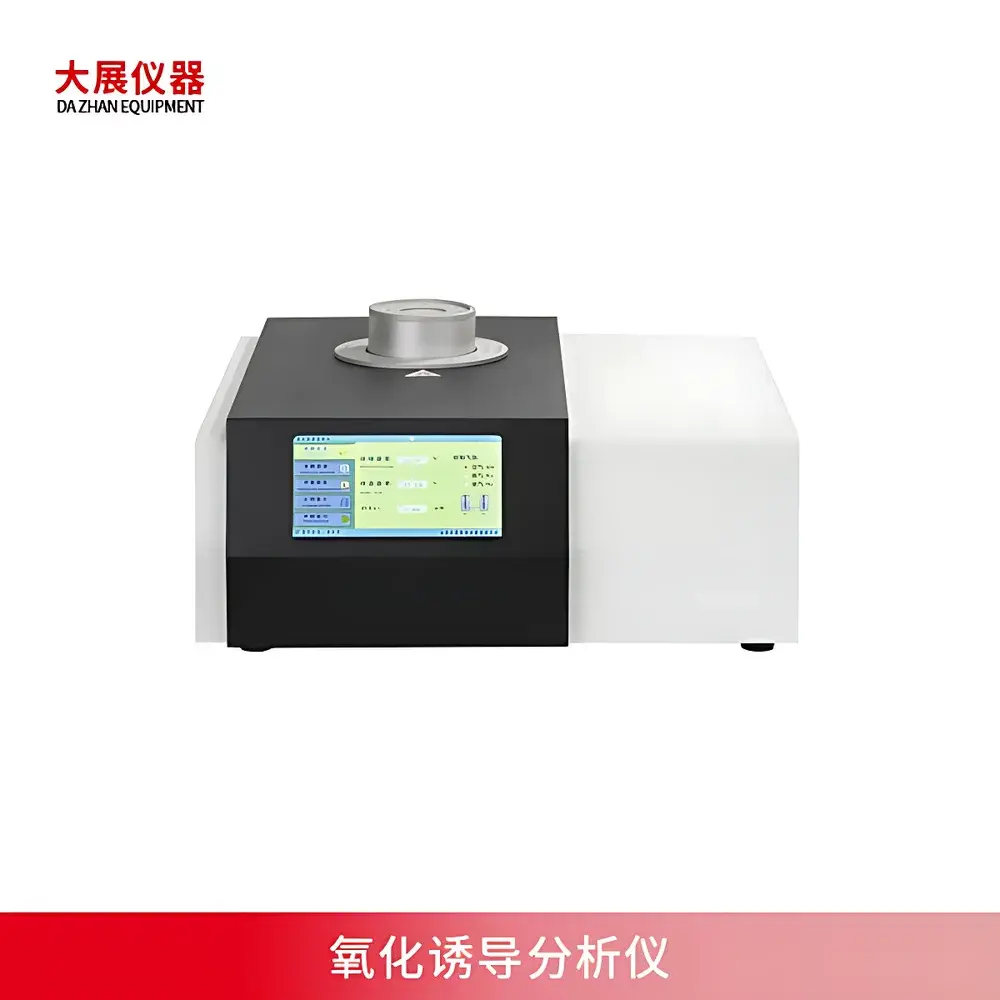
DZ-DSC100A Differential Scanning Calorimeter (Oxidation Induction Time Analyzer)
| Brand | DAZHAN |
|---|---|
| Origin | Jiangsu, China |
| Model | DZ-DSC100A |
| Instrument Type | Heat-Flux DSC |
| Temperature Range | Ambient to 600 °C |
| Heating/Cooling Rate | 0.1–100 K/min |
| DSC Signal Range | 0 to ±600 mW |
| Temperature Stability | ±0.01 °C |
| Temperature Resolution | 0.01 °C |
| Temperature Repeatability | ±0.1 °C |
| Gas Flow Control | 0–200 mL/min (digital mass flow meter) |
| DSC Sensitivity | 0.01 mW |
| Display | 7-inch 24-bit color capacitive touchscreen |
| Interface | USB 2.0 bidirectional communication |
| Control Architecture | ARM Cortex-M3 microcontroller |
| Calibration | Integrated standard reference materials with one-click temperature & enthalpy calibration |
| Power Supply | AC 220 V / 50 Hz |
Overview
The DZ-DSC100A is a high-stability heat-flux differential scanning calorimeter engineered for precise determination of oxidation induction time (OIT), oxidation induction temperature (OITT), and fundamental thermal transitions in solid and semi-crystalline materials. Based on the principle of measuring differential heat flow between a sample and an inert reference under controlled temperature programs, the instrument quantifies endothermic and exothermic events—including glass transition (Tg), cold crystallization, melting (Tm), recrystallization, solid-solid phase transitions, crosslinking enthalpy, and thermal decomposition onset. Its primary application domain centers on oxidative stability assessment under inert (e.g., N2) and oxidative (e.g., air or O2) atmospheres, fulfilling ASTM D3895, ISO 11357-6, and GB/T 19466.6 requirements for polymer stabilization evaluation, metal powder reactivity screening, and ceramic precursor decomposition kinetics.
Key Features
- Optimized furnace architecture with top-access lid design—enabling rapid sample loading, minimized thermal lag, and enhanced thermal homogeneity across the crucible zone;
- High-efficiency thermal insulation combined with dual-stage PID temperature control ensures baseline stability better than ±0.01 °C over extended isothermal holds required for OIT measurement;
- Digital mass flow controller (0–200 mL/min) with real-time logging—supports automated gas switching between purge and reaction atmospheres, with flow data timestamped and embedded in raw DSC files;
- ARM Cortex-M3 embedded controller delivering deterministic response time (<50 ms loop cycle) for accurate ramp-rate fidelity and dynamic thermal compensation;
- 7-inch capacitive touchscreen interface with 24-bit color resolution—providing intuitive navigation, live thermogram preview, parameter validation, and on-device calibration workflow;
- Bidirectional USB 2.0 interface enabling full instrument control from external PC software while retaining standalone operation capability;
- Integrated calibration suite including certified indium, zinc, and tin standards—supporting traceable one-click verification of temperature accuracy (±0.1 °C) and enthalpy sensitivity (0.01 mW).
Sample Compatibility & Compliance
The DZ-DSC100A accommodates standard aluminum, gold-plated aluminum, or high-purity alumina crucibles (60 µL capacity), compatible with powders, granules, thin films, and small metallic specimens (≤20 mg). It meets essential regulatory expectations for thermal analysis instrumentation used in quality control laboratories operating under GLP or ISO/IEC 17025 frameworks. While not FDA 21 CFR Part 11–certified out-of-the-box, its data acquisition system records immutable timestamps, operator IDs (via optional login module), and full audit trails—including all parameter changes, calibration events, and gas flow logs—facilitating internal validation and inspection readiness. The instrument supports method-defined atmospheric protocols compliant with ASTM E1269 (heat capacity), ASTM D3418 (Tg, Tm), and ISO 11357 series standards.
Software & Data Management
Data acquisition and analysis are performed via Windows-based DSC Analysis Suite (v3.2+), supporting multi-step temperature programs, peak deconvolution, baseline subtraction, and quantitative kinetic modeling (e.g., Ozawa-Flynn-Wall, Kissinger). Raw data are stored in vendor-neutral ASCII format (.ASC) with embedded metadata (instrument ID, date/time, operator, method name, gas composition). All calibration certificates, reference material lot numbers, and system suitability test results are exportable as PDF reports. The software includes built-in templates aligned with ISO 11357-6 for OIT determination: isothermal hold at specified temperature (e.g., 200 °C) under nitrogen followed by automatic switch to oxygen atmosphere, with automated detection of exotherm onset defined by first derivative threshold crossing.
Applications
- Oxidative stability screening of polyolefins, polyesters, and engineering thermoplastics for automotive and packaging applications;
- Thermal degradation kinetics of battery cathode precursors (e.g., LiCoO2, NMC) under controlled oxygen partial pressures;
- Quantification of antioxidant depletion profiles in lubricants and elastomers;
- Phase behavior characterization of shape-memory alloys (NiTi) and ferroelectric ceramics;
- Enthalpy of fusion and crystallinity calculation for semicrystalline polymers per ASTM D3417;
- Quality assurance testing of metal injection molding (MIM) feedstocks and additive manufacturing powders;
- Evaluation of curing kinetics and degree of conversion in epoxy and phenolic resin systems.
FAQ
What standards does the DZ-DSC100A support for oxidation induction time testing?
It complies with ASTM D3895 (plastics), ISO 11357-6 (polymers), and GB/T 19466.6 (Chinese national standard) for OIT and OITT determination under defined heating/isothermal protocols.
Can the instrument perform heat capacity measurements?
Yes—using sapphire calibration and multi-rate methods per ASTM E1269, it delivers Cp values with typical repeatability <±1.5% for inorganic references and <±2.5% for polymers.
Is remote operation supported?
The USB interface enables full host PC control; Ethernet or Wi-Fi modules are available as factory-installed options for networked lab environments.
How is temperature calibration verified?
Certified reference materials (indium, zinc, tin) are included. One-click calibration validates both onset temperature accuracy and enthalpy response against NIST-traceable values.
What crucible types are recommended for oxidative stability tests?
Sealed high-purity alumina crucibles are preferred for OIT tests above 300 °C; open aluminum pans are suitable for lower-temperature polymer transitions under inert gas.



