
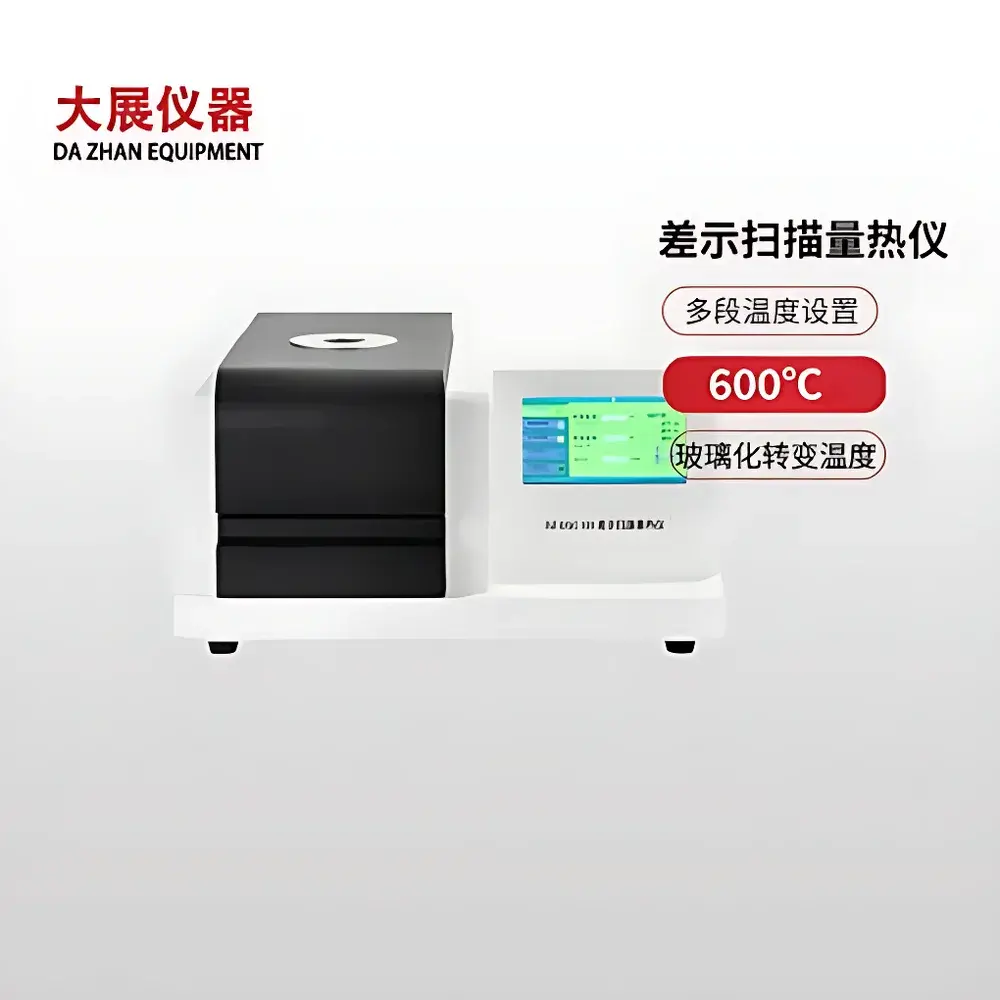
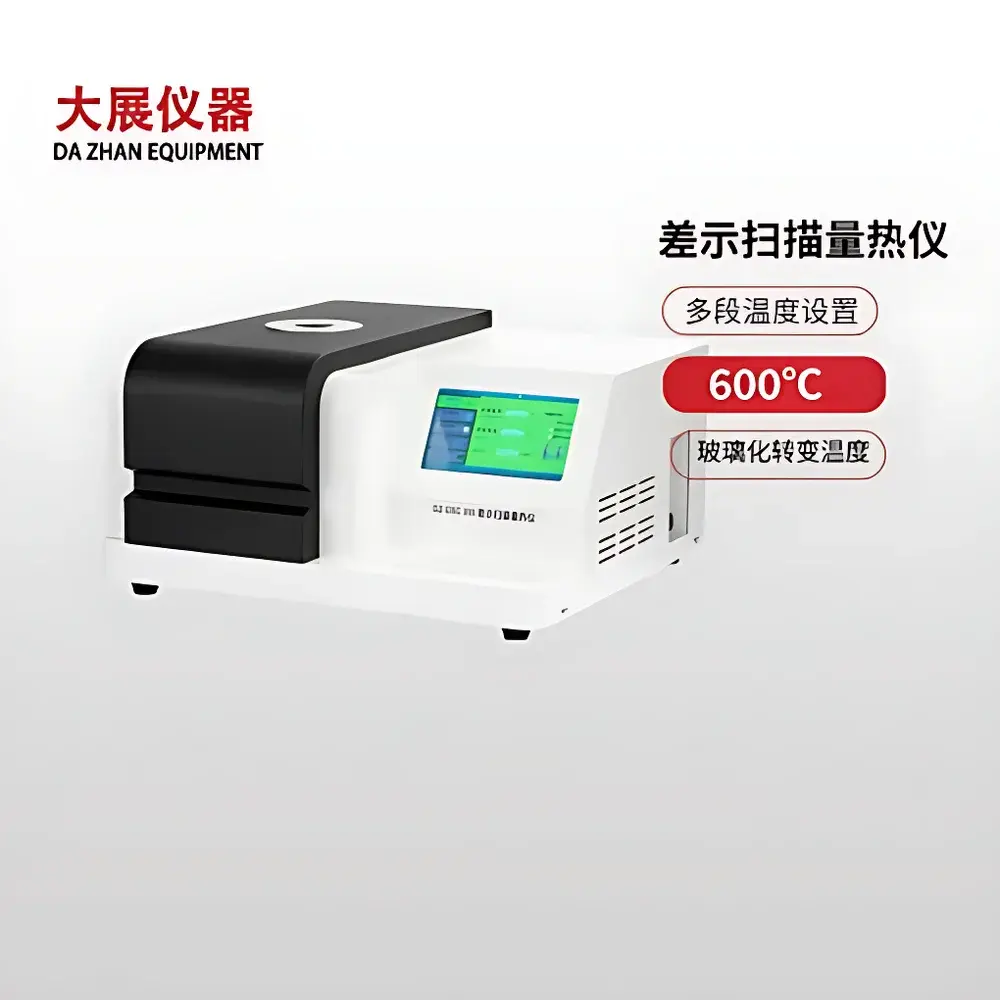
Nanjing Dazhan DSC300 Differential Scanning Calorimeter
| Brand | Nanjing Dazhan |
|---|---|
| Origin | Jiangsu, China |
| Manufacturer Type | Direct Manufacturer |
| Instrument Type | Differential Scanning Calorimeter (DSC) |
| Model | DSC300 |
| Sample Capacity | Single-sample |
| Temperature Range | Ambient to 600 °C |
| Temperature Accuracy | ±0.001 °C |
| Heating/Cooling Rate | 0.1–100 K/min |
| DSC Heat Flow Range | 0 to ±600 mW |
| Temperature Stability | ±0.01 °C |
| DSC Resolution | 0.01 µW |
| DSC Sensitivity | 0.001 mW |
| Gas Control | Dual-channel automated switching (N₂, air, or custom gases) |
| Gas Flow Rate | 0–300 mL/min (customizable) |
| Gas Pressure Rating | ≤5 MPa |
| Thermal Control Modes | Programmable multi-step heating, isothermal hold, and cooling |
| Max Program Segments | 6 |
| Display | 7-inch 24-bit color LCD touchscreen |
| Data Interface | Standard USB |
| Calibration Standards Included | Indium, Tin, Lead |
| Software Features | Multi-point temperature calibration, baseline correction, peak integration, ASTM/ISO-compliant reporting templates |
Overview
The Nanjing Dazhan DSC300 Differential Scanning Calorimeter is a precision thermal analysis instrument engineered for quantitative measurement of heat flow differences between a sample and inert reference as a function of temperature or time. Based on the heat-flux DSC principle, it detects endothermic and exothermic transitions—including glass transition temperature (Tg), cold crystallization, melting, solid-solid phase changes, crystallization kinetics, oxidative induction time (OIT), and crosslinking enthalpy—under controlled atmospheric conditions. Designed for R&D laboratories, quality control departments, and materials science facilities, the DSC300 delivers high reproducibility in polymer characterization, pharmaceutical solid-state analysis, composite development, and battery material thermal stability assessment. Its robust furnace architecture, thermally shielded sensor design, and dual-gas manifold support compliance-driven workflows in regulated environments.
Key Features
- Advanced furnace geometry with optimized thermal mass distribution, delivering superior baseline stability (±0.01 °C drift over 30 min) and enhanced signal-to-noise ratio for low-enthalpy transitions.
- Thermally fused sensor assembly—replacing conventional spot-welded junctions—ensures higher thermal coupling efficiency and long-term sensitivity retention (0.001 mW detection limit).
- Programmable six-segment thermal protocol engine supporting complex ramp-hold-cool sequences, including dynamic heating rates from 0.1 to 100 K/min with sub-millidegree temperature resolution.
- Dual independent gas lines with solenoid-valve-based automatic switching, enabling seamless transition between inert (N₂), oxidative (air/O₂), or specialty atmospheres during a single run.
- Embedded 7-inch capacitive touchscreen interface with real-time thermogram display, local data storage, and USB export—fully synchronized with PC-based acquisition software.
- Comprehensive hardware-level electromagnetic shielding across analog signal paths and digital control circuits, minimizing environmental noise interference in shared lab infrastructure.
Sample Compatibility & Compliance
The DSC300 accommodates standard aluminum, gold-plated aluminum, and high-pressure stainless-steel crucibles (up to 150 bar optional), supporting solids, powders, films, gels, and small-volume liquids (≤30 mg typical). It meets core requirements for ISO 11357 (Plastics — DSC), ASTM E794 (Melting and Crystallization Temperatures), ASTM E1356 (Assignment of Glass Transition), and USP (Thermal Analysis in Pharmaceutical Development). Optional audit-trail-enabled software modules support 21 CFR Part 11 compliance for electronic records and signatures, while built-in calibration routines—validated using certified indium (Tm = 156.598 °C), tin (231.928 °C), and lead (327.494 °C)—facilitate GLP/GMP traceability.
Software & Data Management
The DSC300 is supplied with proprietary ThermalPro™ analysis suite (Windows 10/11 compatible), offering baseline subtraction, peak deconvolution, kinetic modeling (Ozawa-Flynn-Wall, Kissinger), Tg inflection/derivative determination per ASTM E1356, and customizable report generation. Raw data are stored in vendor-neutral ASCII format with full metadata (time stamp, gas flow, purge rate, PID settings). The software supports multi-point temperature calibration across the full operating range (ambient to 600 °C), automatic sensitivity verification via reference material enthalpy checks, and batch processing of up to 99 sequential runs with auto-naming and folder-based archiving.
Applications
- Quantification of glass transition onset, midpoint, and endpoint temperatures in amorphous polymers, thermosets, and pharmaceutical amorphous dispersions.
- Crystallinity assessment in semi-crystalline materials (e.g., PP, PET, PEEK) via fusion enthalpy normalization against 100% crystalline references.
- Oxidative stability evaluation of lubricants, elastomers, and bio-based resins using OIT and Oxidative Onset Temperature (OOT) protocols under flowing air.
- Cure kinetics modeling of epoxy, silicone, and UV-curable systems via isothermal and dynamic DSC scans.
- Thermal degradation profiling of nanocomposites and flame-retardant formulations using multi-step TGA-DSC coupling-ready output formats.
- Polymorph screening and hydrate/anhydrate transition mapping in active pharmaceutical ingredients (APIs) under controlled humidity gas streams (optional add-on).
FAQ
What standards does the DSC300 comply with for pharmaceutical thermal analysis?
The system supports methodologies outlined in USP , Ph. Eur. 2.2.42, and ICH Q5C, particularly for Tg assignment, polymorph identification, and excipient compatibility studies.
Can the DSC300 perform modulated DSC (MDSC®) measurements?
No—the DSC300 is a conventional heat-flux DSC platform; MDSC functionality requires specialized oscillatory temperature control not implemented in this model.
Is remote operation supported via Ethernet or Wi-Fi?
Standard configuration includes only USB communication; Ethernet connectivity and remote desktop control are available via optional industrial-grade interface module (order code: DSC300-ETH-01).
How often must the temperature calibration be performed?
Initial calibration is required before first use; subsequent verification is recommended before each analytical campaign or at least daily for GLP-regulated work, using included certified reference metals.
Does the instrument support purge gas flow rate ramping during a single scan?
Yes—gas flow profiles can be programmed synchronously with temperature ramps via the ThermalPro™ software, enabling dynamic atmosphere control (e.g., N₂ → air switch at Tg).



