
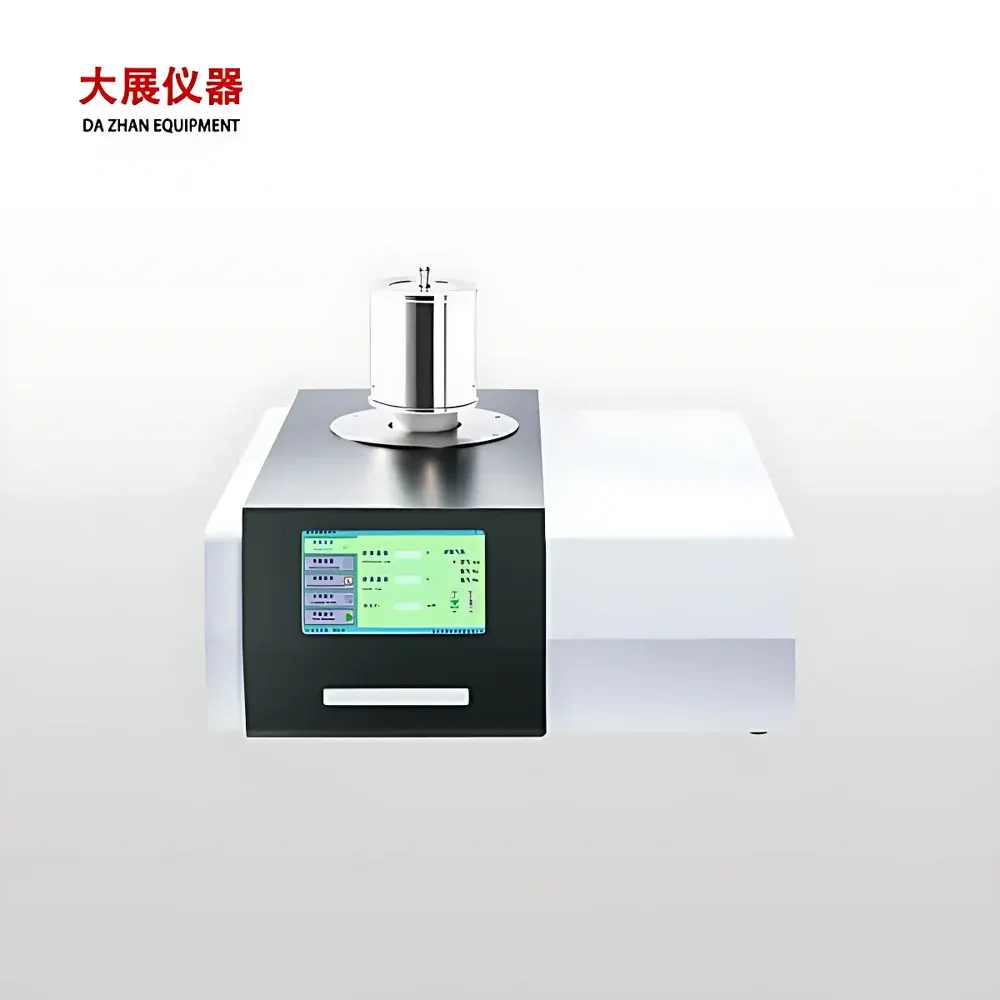
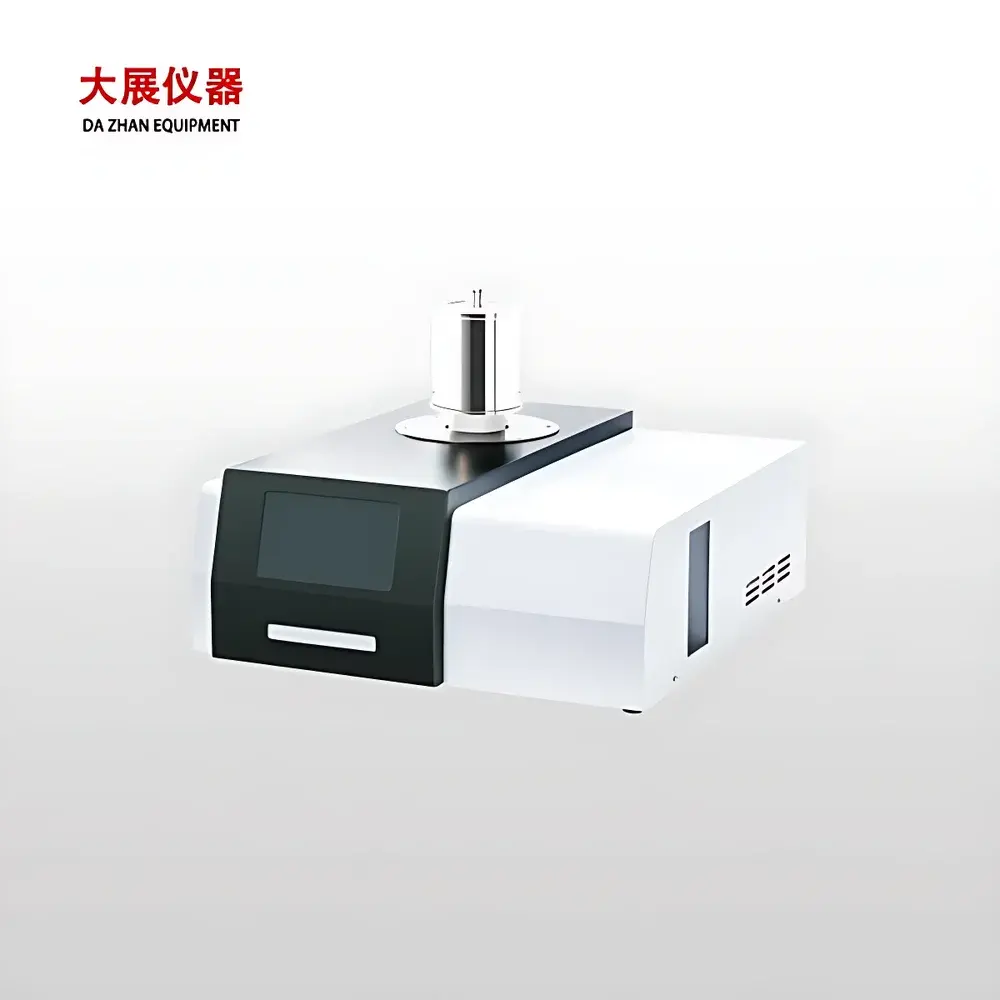
Nanjing Dazhan DZ-DSC1000 High-Temperature Differential Scanning Calorimeter
| Brand | Nanjing Dazhan |
|---|---|
| Origin | Jiangsu, China |
| Manufacturer Type | Direct Manufacturer |
| Country of Origin | China |
| Model | DZ-DSC1000 |
| Sample Capacity | Single-sample |
| Instrument Type | Differential Scanning Calorimeter (DSC) |
| Temperature Range | Ambient to 1050 °C |
| Temperature Resolution | 0.01 °C |
| Temperature Stability | ±0.01 °C |
| Temperature Repeatability | ±0.1 °C |
| Heating/Cooling Rate | 0.1–100 °C/min |
| DSC Signal Range | 0–±800 mW |
| DSC Resolution | 0.01 µW |
| DSC Sensitivity | 0.001 mW |
| Atmosphere Control | Dual-gas auto-switching (N₂/O₂), plus dedicated purge gas inlet |
| Gas Flow Range | 0–300 mL/min |
| Max Gas Pressure | ≤1 MPa |
| Control Method | PID-based automated temperature programming |
| Interface | Standard USB 2.0 with auto-reconnect capability |
| Display | 7-inch industrial-grade LCD touchscreen |
| Calibration Standards Included | Indium and Tin reference materials |
Overview
The Nanjing Dazhan DZ-DSC1000 is a high-temperature differential scanning calorimeter engineered for precision thermal characterization across demanding research and quality control environments. Operating on the heat-flux DSC principle, it measures the difference in heat flow between a sample and an inert reference as both are subjected to identical, programmable temperature profiles. This enables quantitative determination of endothermic and exothermic transitions—including glass transition (Tg), crystallization onset (Tc), melting point (Tm), enthalpy changes (ΔH), oxidative induction time (OIT), decomposition kinetics, and specific heat capacity (Cp). With a certified operational range from ambient to 1050 °C, the DZ-DSC1000 supports thermally robust materials such as advanced ceramics, refractory metals, high-performance polymers, and inorganic composites—making it suitable for applications in materials science R&D, aerospace component validation, battery electrode development, and pharmaceutical solid-state stability assessment.
Key Features
- Ceramic furnace architecture with indirect conductive heating ensures superior baseline flatness, enhanced temperature uniformity across the sensor platform, and minimized thermal radiation pulsation—critical for high-fidelity signal resolution at elevated temperatures.
- Industrial 7-inch capacitive touchscreen interface provides intuitive navigation, real-time curve visualization, and on-device parameter editing without external PC dependency.
- PID-controlled temperature programming supports multi-segment ramp-hold-cool sequences with user-defined heating/cooling rates from 0.1 to 100 °C/min, enabling precise simulation of processing or service thermal histories.
- Dual-gas automatic switching system manages N₂ and O₂ supply with sub-second actuation and <5 s stabilization time; an independent purge gas channel maintains inert integrity during sensitive oxidation studies.
- USB 2.0 interface implements robust error-handling protocols, including automatic reconnection after transient communication loss—ensuring uninterrupted data acquisition during extended runs.
- Integrated calibration suite includes traceable indium (Tm = 156.6 °C) and tin (Tm = 231.9 °C) standards, supporting routine temperature and energy calibration per ISO 11357-1 and ASTM E794 guidelines.
Sample Compatibility & Compliance
The DZ-DSC1000 accommodates standard aluminum, platinum, or ceramic crucibles (e.g., 70 µL Al pans), supporting solids, powders, thin films, and small-volume viscous samples up to 50 mg. Its sealed furnace design and dual-gas management comply with ISO 11357 series requirements for thermal analysis methodology. The instrument’s thermal stability (±0.01 °C) and repeatability (±0.1 °C) meet the performance thresholds specified in USP for thermal property verification in pharmaceutical excipient qualification. Optional GLP-compliant software modules support audit trails, electronic signatures, and 21 CFR Part 11–aligned data archiving for regulated laboratories.
Software & Data Management
The embedded firmware and optional PC-based analysis suite support full ICH Q5E-aligned thermal event identification, peak deconvolution, kinetic modeling (e.g., Ozawa-Flynn-Wall), and Cp calculation via step-heating or modulated DSC methods. Raw data are stored in vendor-neutral ASCII format (.csv) with timestamped metadata (operator ID, atmosphere, ramp rate, crucible type). All calibration records, method files, and report templates are version-controlled and exportable for internal SOP documentation or regulatory submission packages.
Applications
- Thermal stability screening of Li-ion cathode materials under air vs. inert atmospheres
- Quantification of residual cure enthalpy in epoxy composites post-autoclave processing
- Polymorph screening and amorphous content analysis in active pharmaceutical ingredients (APIs)
- Oxidative induction time (OIT) measurement per ASTM D3895 for polyolefin stabilization assessment
- High-temperature phase diagram construction for metal-ceramic intermetallic systems
- Specific heat capacity mapping of thermal barrier coatings (TBCs) used in gas turbine blades
FAQ
What reference materials are supplied for calibration?
Indium and tin standards are included for temperature calibration; users may add certified sapphire for specific heat calibration per ISO 11357-4.
Is the instrument compatible with nitrogen and oxygen switching under GLP conditions?
Yes—the dual-gas manifold features solenoid valves with position feedback and integrated flow monitoring, supporting validated gas protocol execution in auditable workflows.
Can the DZ-DSC1000 perform modulated DSC (MDSC) measurements?
No—this model implements conventional heat-flux DSC only; MDSC functionality requires separate hardware configuration not supported by the DZ-DSC1000 platform.
What is the maximum recommended sample mass for high-temperature runs above 800 °C?
For optimal resolution and furnace longevity, limit sample mass to ≤25 mg when operating above 800 °C using platinum crucibles.
Does the system support remote monitoring or network integration?
Local USB operation is standard; Ethernet or Wi-Fi connectivity is not natively integrated but may be enabled via third-party industrial gateways compliant with Modbus TCP or OPC UA protocols.



