
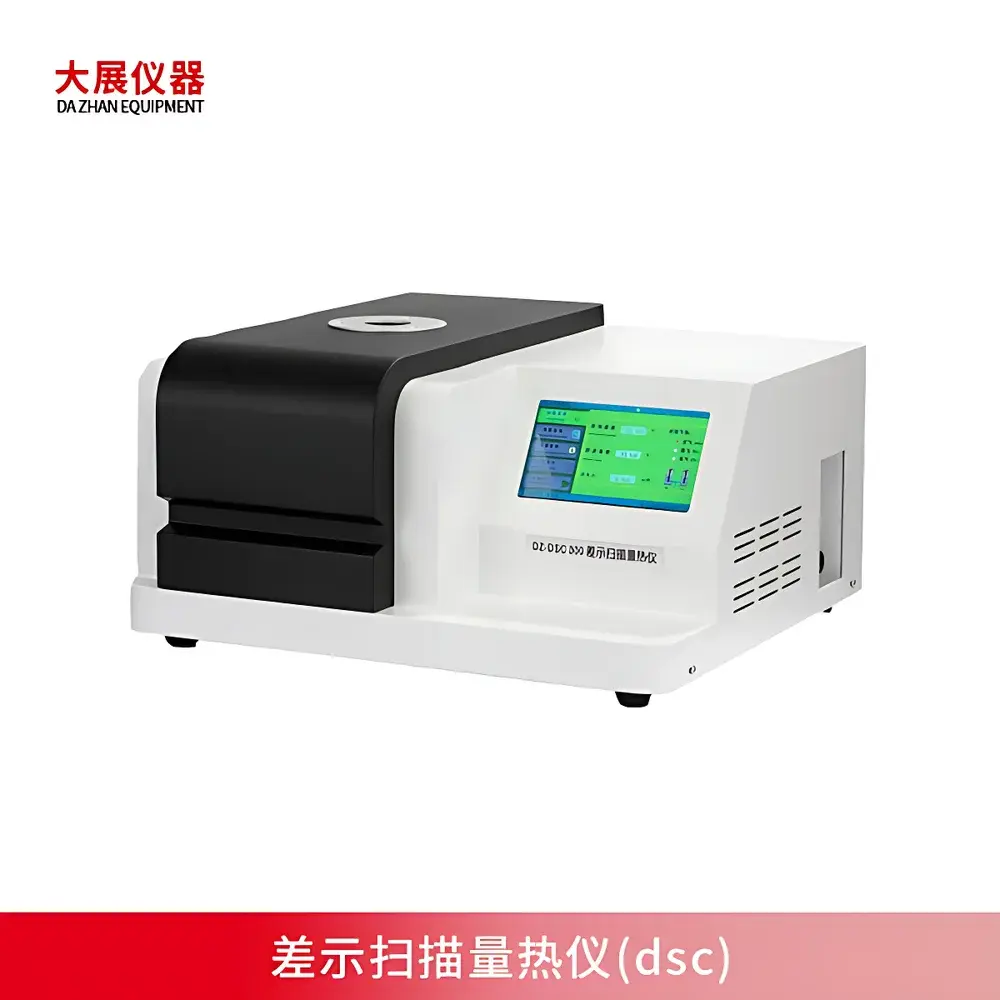
DZHAN DZ-DSC300 Differential Scanning Calorimeter
| Brand | DZHAN |
|---|---|
| Origin | Jiangsu, China |
| Model | DZ-DSC300 |
| Sample Capacity | Single |
| Instrument Type | DSC |
| Temperature Range | Ambient to 600 °C |
| Temperature Resolution | 0.001 °C |
| Temperature Stability | ±0.01 °C |
| Heating/Cooling Rate | 0.1–100 °C/min |
| DSC Signal Range | 0–±800 mW |
| DSC Sensitivity | 0.001 mW |
| Temperature Control | PID-based Automatic Programmed Control |
| Thermal Environment | Triple-layer insulated furnace lid |
| Atmosphere Control | Dual-gas inlet with automatic switching (0–200 mL/min, ≤0.5 MPa) |
| Data Interface | Standard USB |
| Display | 7-inch 24-bit color capacitive touchscreen |
| Calibration Standards Included | Indium, Tin, Lead |
| Software Features | Multi-point temperature calibration, six-segment programmable thermal profiles, real-time bidirectional control (instrument + PC) |
Overview
The DZHAN DZ-DSC300 Differential Scanning Calorimeter is a precision thermal analysis instrument engineered for quantitative measurement of heat flow differences between a sample and an inert reference as a function of temperature or time. Based on the heat-flux DSC principle, it employs a high-stability dual-sensor design with thermally fused junctions—replacing conventional spot-welded thermocouples—to deliver enhanced signal-to-noise ratio and long-term baseline reproducibility. The instrument operates across a wide thermal range from ambient to 600 °C, supporting controlled heating, isothermal hold, and active cooling protocols under programmable PID regulation. Its triple-layer insulated furnace assembly minimizes thermal lag and improves temperature homogeneity, enabling reliable detection of subtle thermal events—including glass transitions (Tg), melting endotherms, crystallization exotherms, solid-solid transitions, and decomposition kinetics—with high thermal resolution and repeatability.
Key Features
- High-fidelity thermal sensing architecture: Thermally fused sensor junctions ensure superior sensitivity (0.001 mW) and reduced drift over extended operation cycles.
- Programmable multi-segment thermal profiling: Supports up to six independent temperature segments—each configurable for ramp rate, target temperature, and dwell duration—enabling complex protocols such as modulated DSC (MDSC)-compatible sequences.
- Bidirectional operational interface: Real-time synchronization between embedded 7-inch capacitive touchscreen and PC-based acquisition software allows seamless method transfer, live parameter adjustment, and remote monitoring.
- Robust environmental control: Dual-gas manifold with automated switching supports inert (N2, Ar), oxidative (air, O2), or reducing atmospheres; flow rate adjustable from 0 to 200 mL/min at pressures ≤0.5 MPa.
- Electromagnetic interference mitigation: Fully shielded analog acquisition circuitry and grounded thermal enclosure reduce noise susceptibility in shared laboratory environments.
- Traceable calibration framework: Supplied with certified reference materials (Indium, Tin, Lead) and software-enabled multi-point temperature calibration compliant with ISO 11357-1 and ASTM E794 guidelines.
Sample Compatibility & Compliance
The DZ-DSC300 accommodates standard aluminum, gold-coated aluminum, or hermetic stainless-steel crucibles (typically 25–50 µL capacity), supporting solid powders, films, fibers, granules, and small-volume liquids (≤20 mg typical mass). It meets fundamental requirements for GLP-compliant thermal characterization workflows and supports audit-ready data generation per FDA 21 CFR Part 11 when used with validated third-party software packages. While not inherently GMP-certified, its hardware architecture—including non-volatile method storage, electronic signature support, and full audit trail logging capability—facilitates integration into regulated QC/QA laboratories adhering to ISO/IEC 17025 or USP standards.
Software & Data Management
The instrument ships with DZHAN Thermal Analysis Suite v3.x—a Windows-based application supporting real-time visualization, peak deconvolution, kinetic modeling (e.g., Ozawa-Flynn-Wall, Kissinger), and comparative overlay of multiple runs. Raw data are stored in vendor-neutral ASCII format (.txt) with metadata headers, ensuring compatibility with MATLAB, OriginLab, or Thermo Scientific™ OMNIC™ for secondary analysis. All thermal events are timestamped and annotated with instrument configuration parameters, gas environment logs, and calibration history. Export options include CSV, PDF reports, and image snapshots (PNG/JPEG) suitable for inclusion in regulatory submissions or peer-reviewed publications.
Applications
- Materials Science: Quantification of crystallinity in polymers (e.g., PET, PP), determination of Tg shifts induced by plasticizers, assessment of crosslink density via enthalpy recovery, and evaluation of thermal stability in composites and nanofillers.
- Pharmaceutical Development: Polymorph screening, excipient compatibility studies, detection of amorphous content in APIs, and validation of lyophilization cycle endpoints.
- Food Science: Measurement of starch gelatinization enthalpy, fat crystallization kinetics, protein denaturation temperatures, and shelf-life prediction based on oxidative onset.
- Chemical Synthesis: Reaction enthalpy determination for catalytic processes, purity estimation via van’t Hoff analysis, and thermal hazard assessment per UN GHS criteria.
- Academic Research: Teaching platform for thermodynamics labs; widely adopted in university materials engineering departments for undergraduate and graduate coursework on phase equilibria and reaction calorimetry.
FAQ
What reference materials are included for calibration?
Indium (melting point 156.6 °C), Tin (231.9 °C), and Lead (327.5 °C) are supplied as primary calibration standards, traceable to NIST SRMs.
Can the DZ-DSC300 operate under vacuum conditions?
No—the system is designed for controlled gas-atmosphere operation only; vacuum compatibility requires optional furnace retrofitting not provided by default.
Is the software compatible with Windows 11 and 64-bit systems?
Yes—Thermal Analysis Suite v3.x supports Windows 10 and 11 (64-bit), with driver certification verified through Microsoft WHQL testing.
What is the maximum recommended sample mass for optimal resolution?
For most organic and polymeric samples, 5–15 mg is optimal; larger masses may reduce transition sharpness and increase thermal lag, particularly near 600 °C.
Does the instrument support modulated DSC (MDSC) mode?
The DZ-DSC300 implements standard heat-flux DSC only; MDSC functionality requires proprietary hardware modulation not available in this model.



