
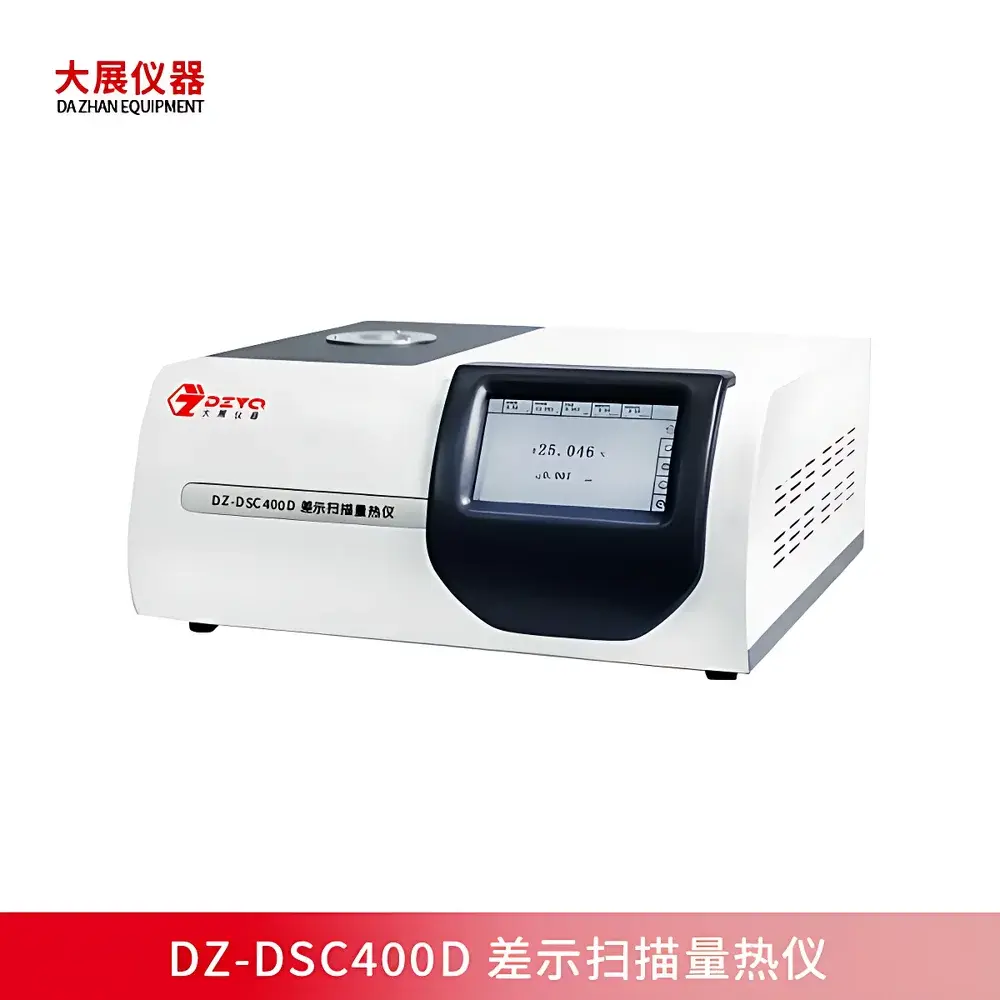
DAZHAN DZ-DSC400C Semiconductor-Cooled Differential Scanning Calorimeter
| Brand | DAZHAN |
|---|---|
| Origin | Jiangsu, China |
| Manufacturer Type | Authorized Distributor |
| Origin Category | Domestic (China) |
| Model | DZ-DSC400C |
| Sample Capacity | Single-sample |
| Instrument Type | Differential Scanning Calorimeter (DSC) |
| Temperature Range | −50 °C to 600 °C |
| Programmable Temperature Control | Intelligent PID with Self-Tuning & Adaptive Optimization |
| Temperature Accuracy | ±0.001 °C |
| Heating/Cooling Rate | 0.1–100 K/min (heating), −0.1 to −40 K/min (cooling) |
| Temperature Precision | ±0.001 °C |
| DSC Signal Range | ±1000 mW |
| Temperature Stability | ±0.001 °C |
| Cooling Method | Integrated Thermoelectric (Peltier) Module |
| Gas Flow Control | Triple-channel Mass Flow System (0–200 mL/min per channel), Dual Atmosphere Switching with <3 s stabilization time, plus Dedicated Inert Purge Line |
| Temperature Resolution | 0.001 °C |
Overview
The DAZHAN DZ-DSC400C is a high-stability, semiconductor-cooled differential scanning calorimeter engineered for precise quantification of heat flow differences between a sample and inert reference as a function of temperature or time. It operates on the principle of heat-flux DSC, where thermal energy exchange is measured via a symmetric, multi-zone furnace architecture coupled with a thermopile-based sensor array. The instrument delivers exceptional baseline reproducibility and dynamic response across an extended operational range—from cryogenic conditions (−50 °C) to high-temperature transitions (600 °C)—making it suitable for characterizing both low-Tg polymers and high-melting inorganic compounds. Its thermoelectric cooling system eliminates reliance on liquid nitrogen for sub-ambient operation, reducing operational complexity and cost while maintaining rapid thermal ramp reversibility and tight temperature stability (<±0.001 °C drift over 30 min at isothermal hold).
Key Features
- Optimized furnace design with indirect conductive heating—minimizes radiant thermal gradients and improves temperature uniformity across the sensor platform.
- Intelligent PID temperature control with embedded self-tuning and adaptive optimization algorithms, dynamically adjusting control parameters based on real-time thermal load and ambient fluctuations.
- Triple-gas manifold system: two independently programmable atmosphere channels (e.g., N2/O2) with fast-switching solenoid valves (<3 s stabilization), plus a dedicated inert purge line for oxidation-sensitive measurements.
- High-resolution thermoelectric cooling module enabling controlled cooling rates up to 40 K/min without cryogen consumption—ideal for accelerated thermal cycling and crystallization kinetics studies.
- Thermal baseline stability enhanced by symmetrical mechanical design, low-drift sensor calibration, and active thermal shielding against environmental perturbations.
Sample Compatibility & Compliance
The DZ-DSC400C accommodates standard aluminum, gold, or hermetic stainless-steel crucibles (40 µL and 70 µL volumes) and supports quantitative analysis of solids, powders, films, and semi-crystalline gels. It meets core requirements for thermal characterization under ISO 11357 (Plastics — Differential Scanning Calorimetry), ASTM E794 (Melting and Crystallization Temperatures by DSC), and USP (Thermal Analysis in Pharmaceutical Development). Data acquisition and reporting comply with GLP documentation standards; audit trail functionality—including user log, parameter change history, and raw data integrity timestamps—is supported through optional 21 CFR Part 11-compliant software modules.
Software & Data Management
The instrument is operated via DAZHAN Thermal Analysis Suite (DTAS v4.2), a Windows-based platform supporting real-time visualization, multi-step method programming, and post-run deconvolution of overlapping transitions. Key analytical tools include baseline correction (tangent, step, or polynomial), peak integration with onset/onset-derivative detection, enthalpy normalization per mass or mole, and kinetic modeling (Ozawa-Flynn-Wall, Kissinger). All raw data are stored in vendor-neutral .dtas binary format with embedded metadata (instrument ID, operator, calibration date, gas settings), and export options include CSV, Excel, and universal ASCII for third-party analysis (e.g., OriginLab, MATLAB). Data backups are automated to network locations with versioned file naming and SHA-256 checksum verification.
Applications
- Determination of glass transition (Tg), melting point (Tm), crystallization onset (Tc), and solid-solid phase transitions in thermoplastics, elastomers, and biopolymers.
- Oxidation induction time (OIT) and oxidative onset temperature (OOT) assessment under controlled O2 flow for polymer stabilization studies.
- Enthalpy of fusion/crystallization for purity estimation (van’t Hoff method) and degree of crystallinity calculation (using reference standards).
- Thermal stability profiling of pharmaceutical APIs and excipients, including dehydration, polymorphic conversion, and amorphous content evaluation.
- Reaction enthalpy and curing kinetics analysis of thermosetting resins, adhesives, and composite precursors.
- Quality control testing of industrial materials such as PVC pipe compounds, food-grade packaging films, and medical device polymers per ISO/IEC 17025-accredited protocols.
FAQ
What cooling methods does the DZ-DSC400C support?
The instrument integrates a high-capacity thermoelectric (Peltier) cooling module as its primary sub-ambient cooling mechanism. Optional add-on modules for forced-air or mechanical refrigeration are available for extended low-temperature performance, but liquid nitrogen is not required for operation within the specified −50 °C to 600 °C range.
Is the system compliant with regulatory data integrity requirements?
Yes—the DTAS software supports configurable audit trails, electronic signatures, and data encryption when deployed with the optional 21 CFR Part 11 compliance package. All method files and result reports include immutable metadata and digital fingerprints.
Can the DZ-DSC400C perform simultaneous multi-atmosphere experiments?
No—it supports sequential atmosphere switching between two reactive gases (e.g., N2 → O2) with rapid stabilization (<3 s), plus continuous inert purge. True simultaneous dual-gas flow is not implemented; however, programmed gas ramps (e.g., linear O2 concentration increase) are achievable via custom method scripting.
What is the minimum detectable heat flow change?
While absolute sensitivity depends on crucible type, sample mass, and scan rate, the system achieves typical noise levels ≤0.1 µW under standard operating conditions (40 µL Al crucible, 10 K/min, 50–150 °C), corresponding to a practical detection limit of ~0.5 J/g for enthalpic transitions in well-characterized reference materials.
Does the instrument require annual recalibration?
Yes—routine calibration using certified reference materials (e.g., high-purity indium, tin, zinc per ASTM E967) is recommended every 12 months or after major maintenance. The DTAS software includes built-in calibration wizards and traceable certificate generation aligned with ISO/IEC 17025 calibration hierarchy requirements.



