
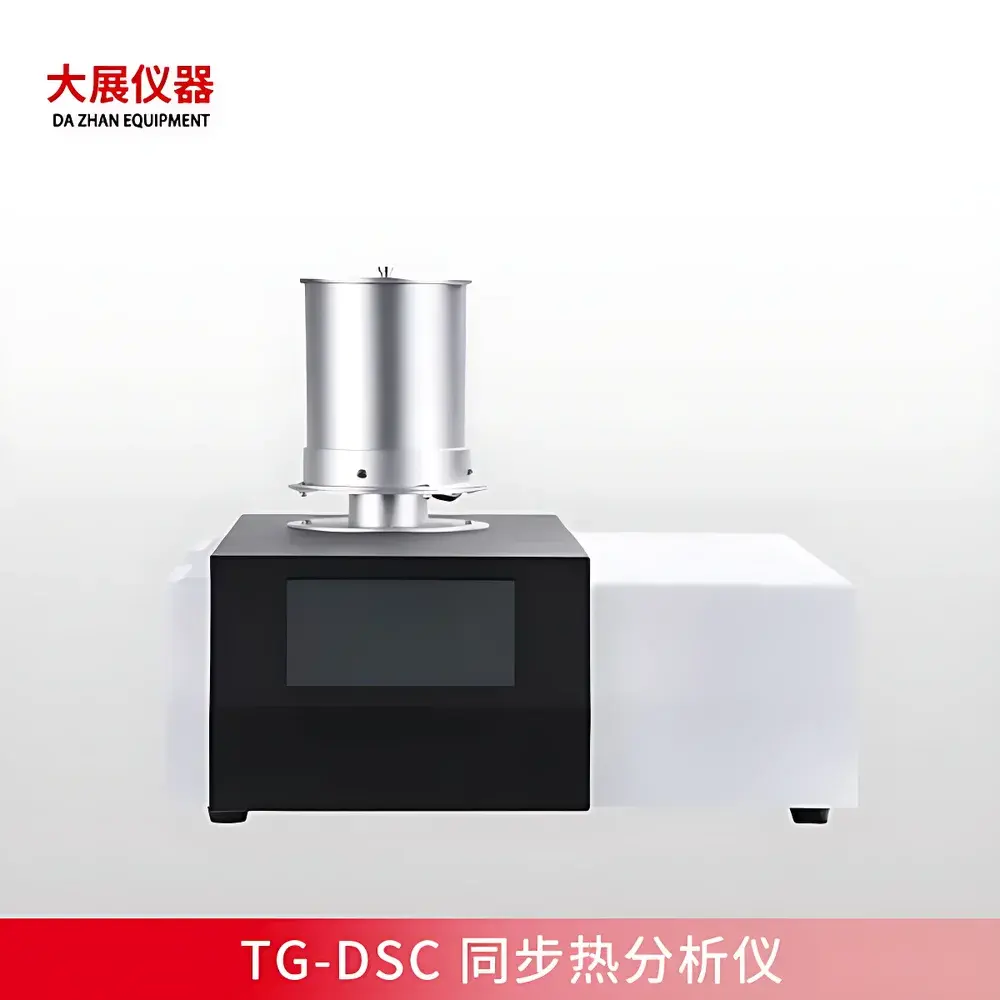
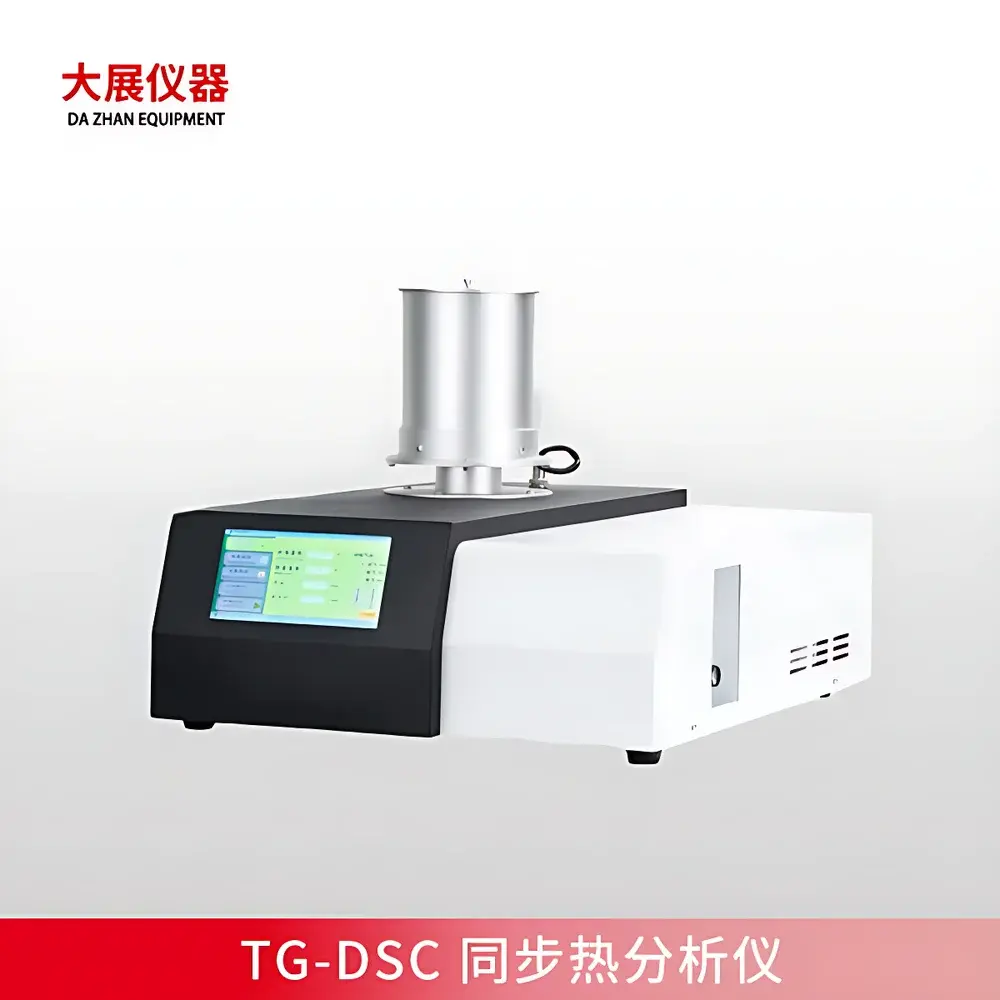
Nanjing Dazhan DZ-STA300 Simultaneous Thermal Analyzer (TG-DSC)
| Brand | Nanjing Dazhan |
|---|---|
| Origin | Jiangsu, China |
| Manufacturer Type | Direct Manufacturer |
| Country of Origin | China |
| Model | DZ-STA300 |
| Temperature Range | Ambient to 1550 °C |
| Heating Rate | 0.1–100 °C/min |
| Maximum Sample Mass | 5 g |
| Atmosphere Options | Inert, Oxidizing, Reducing |
Overview
The Nanjing Dazhan DZ-STA300 Simultaneous Thermal Analyzer integrates thermogravimetric analysis (TG) and differential scanning calorimetry (DSC) into a single, synchronized measurement platform. By subjecting one sample to concurrent thermal and calorimetric monitoring under precisely controlled temperature programs, the instrument delivers correlated mass-loss (TG), derivative thermogravimetry (DTG), and heat-flow (DSC) data in real time. This dual-signal acquisition is grounded in high-stability microbalance architecture coupled with a calibrated heat-flux sensor, enabling rigorous quantification of endothermic/exothermic transitions (e.g., melting, crystallization, solid-state reactions) alongside decomposition kinetics, oxidative stability, dehydration steps, and compositional stoichiometry. Designed for laboratories requiring trace-level mass resolution and thermal event fidelity—particularly in materials science, polymer R&D, pharmaceutical solid-state characterization, and inorganic compound validation—the DZ-STA300 operates across an extended temperature range up to 1550 °C, supporting high-temperature ceramic, refractory, and metallurgical applications.
Key Features
- High-temperature furnace with dual-row wound precious-metal alloy heating elements, ensuring uniform thermal distribution and minimizing electromagnetic interference during sensitive microgram-level mass detection.
- Ceramic push-rod sensor assembly connecting sample pan to balance mechanism—resistant to oxidation, corrosion, and thermal creep up to 1550 °C.
- Physically isolated power supply and forced-air cooling module, decoupled from the main instrument chassis to suppress mechanical vibration and thermal crosstalk to the microbalance system.
- Top-opening furnace design for rapid sample loading/unloading and direct visual alignment—reducing operator error and thermal shock to the sensor.
- Multi-layer passive thermal shielding between furnace core and instrument housing, limiting conductive/convective heat transfer to the microbalance chamber and electronics.
- Modular furnace configuration: interchangeable high-temp (1550 °C) and standard (1200 °C) furnace units available per application-specific requirements.
Sample Compatibility & Compliance
The DZ-STA300 accommodates standard crucibles including high-purity alumina, platinum, and graphite—compatible with both inert (N₂, Ar), oxidizing (air, O₂), and reducing (H₂/N₂ mixtures) atmospheres under static or dynamic flow conditions (dual-channel mass flow control with integrated digital flowmeters). The system supports ASTM E1131 (standard test method for compositional analysis by TG), ISO 11358 (polymer thermal degradation), and USP (thermal analysis of pharmaceutical excipients). All thermal calibration points (temperature and enthalpy) are traceable to NIST-certified reference materials (e.g., indium, zinc, alumina), and software includes multi-point correction routines across the full operating range. Data integrity complies with GLP/GMP documentation standards via audit-trail-enabled software logging.
Software & Data Management
The embedded intelligent thermal analysis software runs on a 7-inch 24-bit color touchscreen interface with intuitive workflow navigation. It acquires, displays, and processes TG, DTG, and DSC curves in real time, supporting baseline subtraction, peak integration, kinetic modeling (e.g., Ozawa-Flynn-Wall), and multi-step decomposition fitting. Export formats include CSV, Excel (.xlsx), and PDF report generation with customizable templates—including header metadata (operator ID, instrument SN, calibration date), annotated curve overlays, and statistical summaries. Raw data files are timestamped and stored with SHA-256 checksums; USB 2.0 interface enables secure offline backup and third-party data import (e.g., into OriginLab or MATLAB). Software supports temperature and enthalpy calibration at ≥5 user-defined points per run.
Applications
- Quantitative determination of hydrate/water-of-crystallization content and decomposition onset in APIs and excipients.
- Thermal stability profiling of battery cathode/anode materials under air or argon.
- Decomposition kinetics and residue composition analysis of polymers, composites, and carbon-filled systems.
- Oxidation induction time (OIT) assessment per ASTM D3895 for polyolefins and stabilizer efficiency screening.
- Phase transition mapping (glass transition, cold crystallization, melting) in semi-crystalline thermoplastics.
- High-temperature sintering behavior and weight loss evolution in ceramic precursors and metal oxides.
FAQ
What is the maximum operating temperature supported by the standard DZ-STA300 configuration?
The base configuration supports up to 1550 °C using the high-temperature furnace option; a 1200 °C variant is also available for routine polymer and pharmaceutical testing.
Does the system meet regulatory requirements for GMP-compliant environments?
Yes—the software provides electronic signatures, full audit trail, user access levels, and 21 CFR Part 11–compliant data handling when deployed with validated IT infrastructure.
Can the instrument perform isothermal holds and multi-segment heating programs?
Yes—programmable temperature profiles support up to 32 segments, including ramp, hold, and cooling steps, with hold durations configurable from 0 to 72 hours.
What is the mass resolution and repeatability specification for TG measurements?
The microbalance achieves 0.1 µg resolution with ±0.01 mg accuracy over the 0.1 mg–5 g dynamic range; typical intraday repeatability is ≤0.5% RSD for 10 mg standard samples.
Is external PC connectivity required for data acquisition?
No—full standalone operation is enabled via the built-in touchscreen; however, optional Ethernet or Wi-Fi modules support remote monitoring and centralized lab data management systems.



