
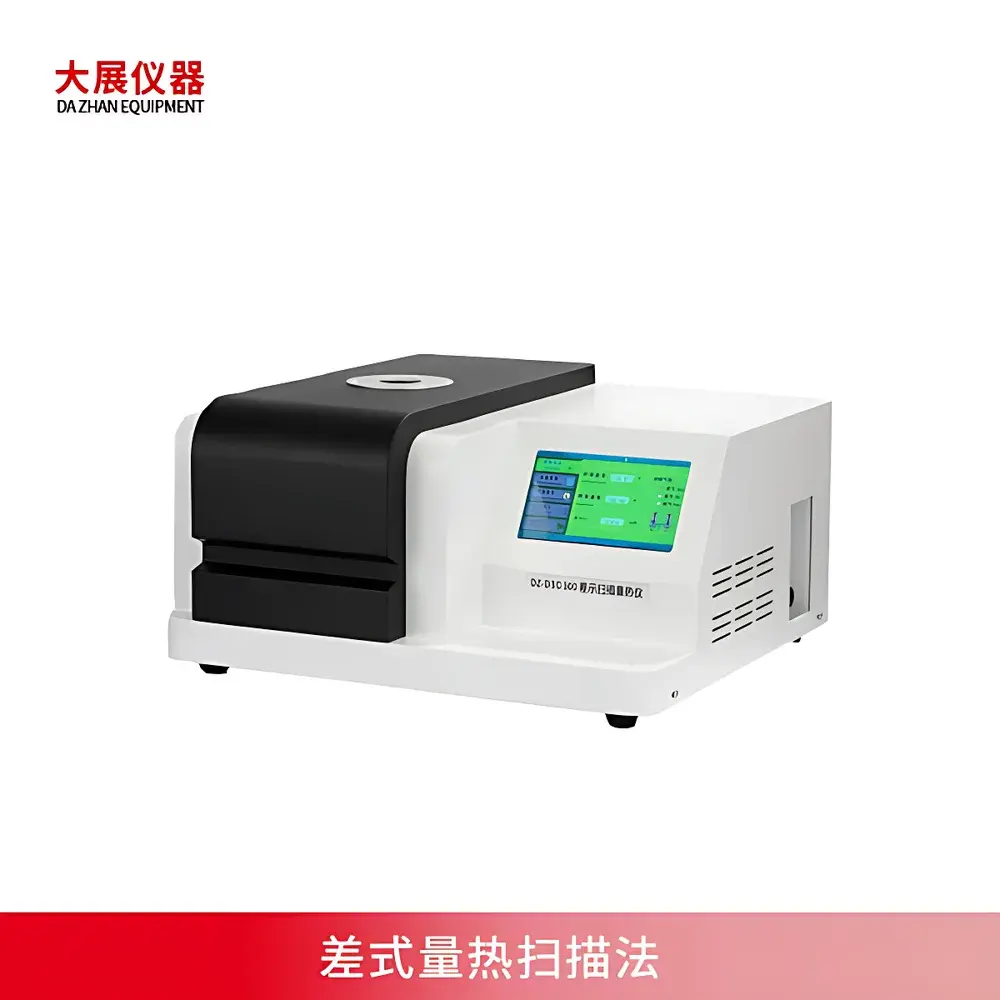
DZHAN DZ-DSC300 Differential Scanning Calorimeter
| Brand | DZHAN |
|---|---|
| Origin | Jiangsu, China |
| Manufacturer Type | Authorized Distributor |
| Country of Origin | China |
| Model | DZ-DSC300 |
| Sample Capacity | Single-sample |
| Instrument Type | Heat-Flux DSC |
| Temperature Range | Ambient to 600 °C |
| Programmable Temperature Control | Fully Automated Multi-Stage Ramp/Hold/Cool |
| Heating/Cooling Rate | 0.1–100 K/min |
| DSC Signal Range | 0–±800 mW (field-expandable) |
| Temperature Stability | ±0.01 °C |
| Temperature Resolution | 0.001 °C |
| DSC Sensitivity | 0.001 mW |
| Isothermal Hold Duration | Up to 24 h |
| Atmosphere Control | Dual-gas auto-switching (N₂, Ar, O₂, or custom), 0–200 mL/min flow, ≤0.5 MPa pressure |
| Display | 7-inch 24-bit color capacitive touchscreen |
| Data Interface | Standard USB 2.0 |
| Calibration Standards Included | Indium, Tin, Lead |
| Software Features | Multi-point temperature calibration, GLP-compliant audit trail, real-time baseline correction |
Overview
The DZHAN DZ-DSC300 is a high-stability, heat-flux-type differential scanning calorimeter engineered for precise quantification of thermal transitions and enthalpic events in solid and semi-crystalline materials. Operating on the principle of symmetric twin-furnace differential heat flow measurement, the instrument compares the power required to maintain identical temperatures between a sample and an inert reference pan as both are subjected to a controlled linear or stepwise thermal program. This architecture enables accurate determination of endothermic and exothermic phenomena—including glass transitions (Tg), melting points (Tm), crystallization onset (Tc), solid-solid phase changes, curing kinetics, oxidative induction time (OIT), and decomposition enthalpies—across a broad operational range from ambient to 600 °C. Its thermally optimized furnace design, coupled with active temperature stabilization (±0.01 °C) and sub-milliwatt signal resolution (0.001 mW), ensures high reproducibility essential for comparative material qualification, regulatory submissions, and method validation under ISO 11357, ASTM E794, and USP <1163> guidelines.
Key Features
- Robust dual-zone heat-flux sensor architecture with integrated reference compensation for minimized baseline drift and enhanced long-term signal stability.
- Triple-lid insulated furnace enclosure minimizing radial thermal leakage and improving temperature homogeneity across the sample stage.
- Programmable six-segment thermal protocols supporting complex multi-step sequences: e.g., preconditioning → isothermal hold → dynamic ramp → secondary isotherm → rapid quench — all fully automated without manual intervention.
- Intuitive 7-inch capacitive touchscreen interface with real-time graphical display of heat flow, temperature, and furnace power; supports direct parameter entry, protocol recall, and immediate start/stop/pause functions.
- Dual-control architecture enabling simultaneous local operation and remote PC-based control via USB-connected software—ideal for lab environments requiring both walk-up usability and centralized data governance.
- Automated dual-gas manifold with pressure-regulated switching between inert (N₂, Ar) and reactive (O₂, air) atmospheres, configurable up to 200 mL/min with pressure monitoring (≤0.5 MPa).
Sample Compatibility & Compliance
The DZ-DSC300 accommodates standard aluminum, gold-plated aluminum, and high-pressure stainless-steel crucibles (6.7–20 µL volume), supporting samples ranging from 0.5 mg to 50 mg in mass. It is routinely deployed in GMP-aligned QC laboratories for polymer batch release testing (e.g., Tg consistency per ISO 11357-2), pharmaceutical solid-state characterization (polymorph screening, excipient compatibility per ICH Q5A), and battery electrode material thermal safety profiling (exotherm onset detection per UL 9540A). The system complies with key metrological requirements for thermal analysis instrumentation: traceable calibration using certified reference materials (Indium, Tin, Lead) included with each unit; NIST-traceable temperature accuracy verified at multiple points; and full support for 21 CFR Part 11–compliant electronic records when used with validated software modules (audit trail, electronic signatures, user access levels).
Software & Data Management
Bundled DSC Analysis Suite v3.x provides comprehensive post-run processing including baseline subtraction (tangent, sigmoidal, or polynomial), peak integration (onset, peak, endset), kinetic modeling (Ozawa-Flynn-Wall, Kissinger), and multi-curve overlay with statistical comparison. All raw data files (.dsc) are stored in ASCII-compatible format for third-party import (Origin, MATLAB, Python pandas). Software enforces GLP-compliant metadata capture: operator ID, instrument serial number, calibration date, environmental conditions (lab temp/humidity), and full parameter logging for every run. Audit trails record all user actions—including data modification, calibration updates, and report generation—with immutable timestamps and digital signatures.
Applications
- Thermal characterization of thermoplastics, thermosets, and elastomers: Tg, Tm, ΔHf, cold crystallization, crosslink density estimation.
- Pharmaceutical development: polymorphic form identification, hydrate/anhydrate transition analysis, drug-excipient compatibility screening, lyophilized product stability assessment.
- Food science: starch gelatinization, fat crystallization kinetics, moisture-induced phase behavior.
- Energy materials: cathode/anode thermal runaway onset, electrolyte decomposition pathways, SEI layer formation enthalpy.
- Quality control: batch-to-batch consistency verification, shelf-life prediction via accelerated aging studies, specification compliance against internal or pharmacopoeial standards.
FAQ
What calibration standards are supplied with the DZ-DSC300?
Indium (Tm = 156.6 °C), Tin (Tm = 231.9 °C), and Lead (Tm = 327.5 °C) are included for routine temperature and enthalpy calibration. Certified reference materials for OIT and specific heat capacity (sapphire) are available as optional accessories.
Is the instrument compatible with nitrogen purging during low-temperature measurements?
Yes—the dual-gas manifold supports continuous N₂ purge down to −20 °C ambient-equivalent conditions when paired with optional cryogenic cooling accessories (not included with base configuration).
Can the DZ-DSC300 perform modulated DSC (MDSC®)?
No—this is a conventional heat-flux DSC platform. MDSC functionality requires proprietary hardware modulation and is not supported by the DZ-DSC300’s sensor and furnace architecture.
Does the software support automated reporting per ISO 17025 requirements?
Yes—templates for certificate-of-analysis (CoA) generation include instrument calibration status, uncertainty budget estimates, raw data export links, and operator-signoff fields—all compliant with ISO/IEC 17025:2017 clause 7.8.2.
What maintenance intervals are recommended for optimal performance?
Furnace cleaning and sensor inspection every 6 months; crucible replacement after 200 runs or visible degradation; annual full-system calibration and thermocouple verification by authorized service personnel.



