
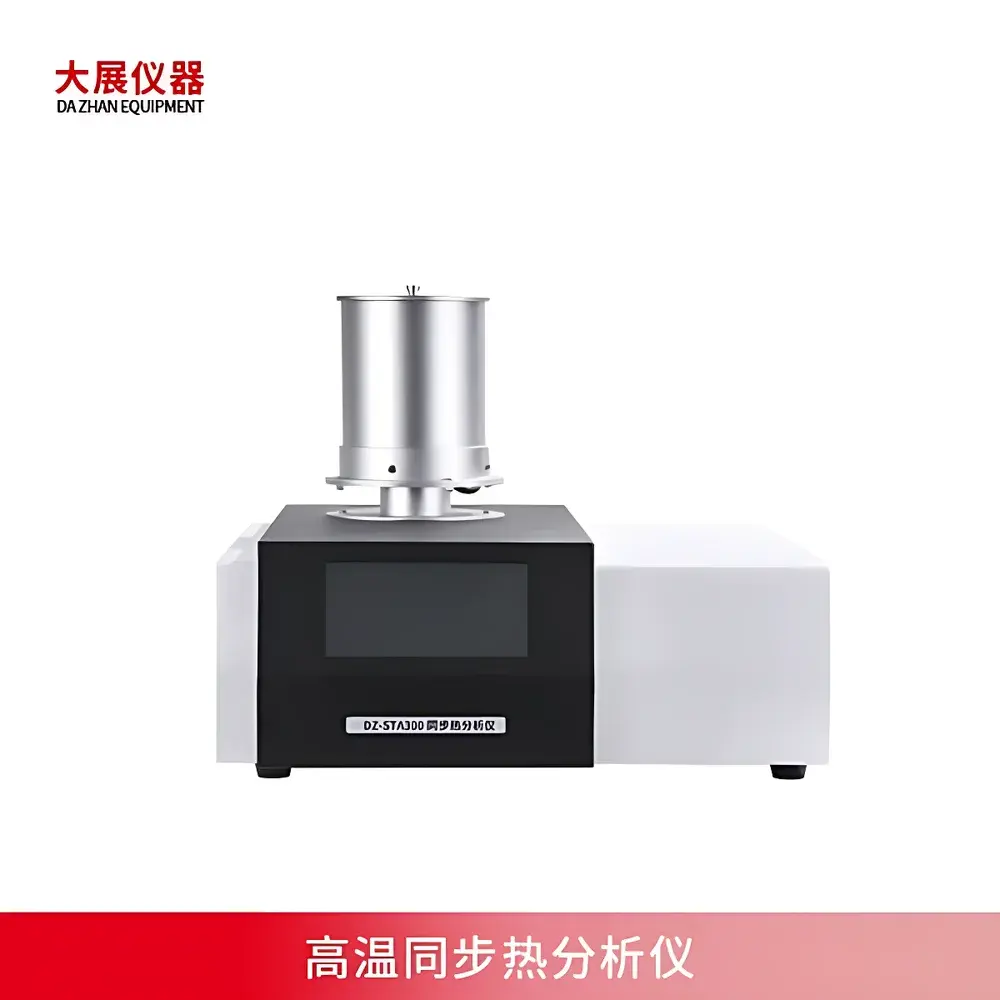
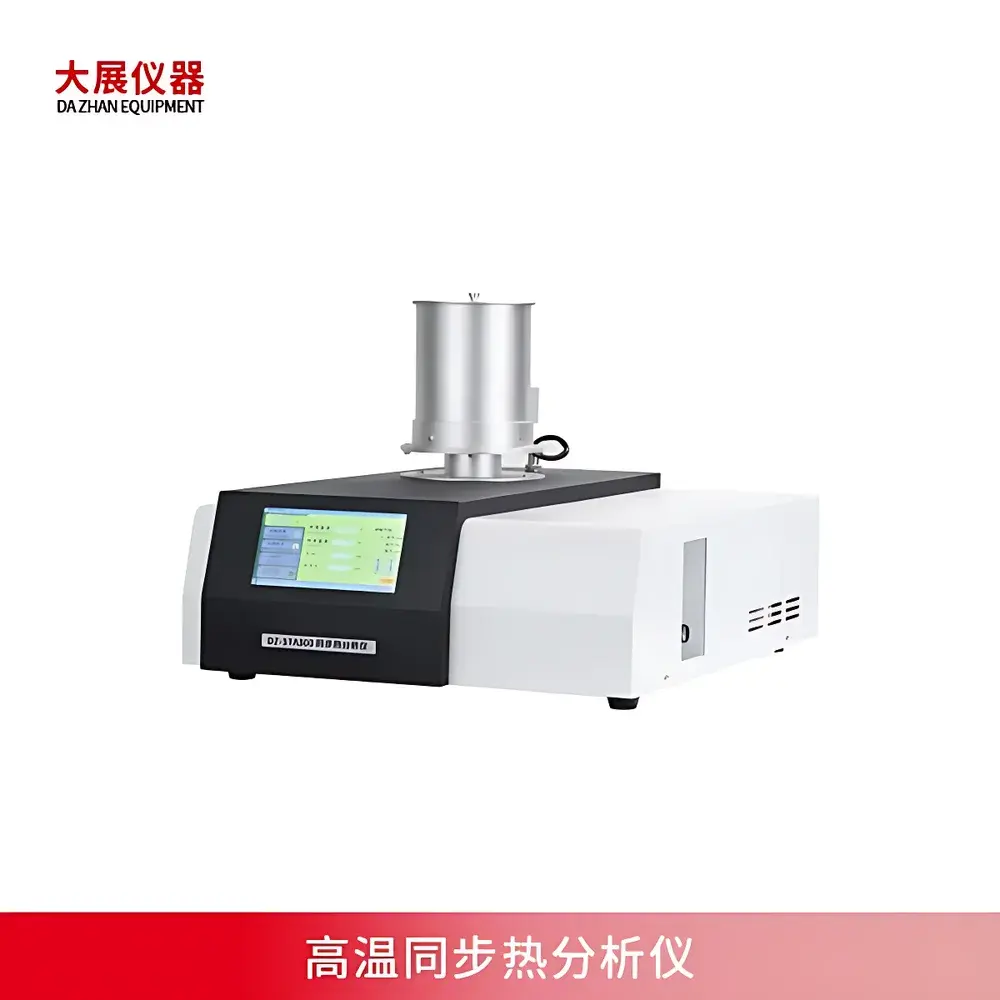
Nanjing Dazhan DZ-STA300 High-Temperature Simultaneous Thermal Analyzer
| Brand | Nanjing Dazhan |
|---|---|
| Origin | Jiangsu, China |
| Manufacturer Type | Direct Manufacturer |
| Product Origin | Domestic (China) |
| Model | DZ-STA300 |
| Price Range | USD 16,800–21,000 (FOB) |
| Temperature Range | Ambient to 1550 °C |
| Heating Rate | 0.1–100 °C/min |
| Max Sample Mass | 5 g |
| Atmosphere Compatibility | Inert, Oxidizing, Reducing |
Overview
The Nanjing Dazhan DZ-STA300 High-Temperature Simultaneous Thermal Analyzer is an engineered platform for concurrent thermogravimetric analysis (TGA) and differential scanning calorimetry (DSC) under controlled atmospheric conditions. It operates on the principle of coupling high-precision microbalance measurement with heat flow detection in a single furnace chamber—enabling real-time, mass-normalized correlation between weight change (TG), derivative weight loss (DTG), and thermal transitions (DSC). Designed for demanding high-temperature applications up to 1550 °C, the instrument supports rigorous materials characterization across metallurgy, advanced ceramics, aerospace alloys, polymer composites, pharmaceutical excipients, and inorganic functional materials. Its dual-sensor architecture—comprising a high-stability thermobalance and symmetrical heat-flux DSC sensor—ensures reproducible baseline stability and minimal thermal lag, critical for kinetic modeling and phase transformation studies.
Key Features
- High-temperature furnace with dual-row wound noble-metal Ni–Cr heating elements, delivering uniform temperature distribution and extended service life beyond 1500 °C
- Integrated platinum–rhodium alloy sample holder and sensor assembly, resistant to oxidation, corrosion, and thermal creep at elevated temperatures
- Top-opening furnace design with vertical lift mechanism—minimizing mechanical stress on the sample rod and eliminating risk of sensor misalignment during loading
- Thermally decoupled architecture: power supply, cooling fan module, and main electronics are physically separated from the balance and furnace zones to suppress electromagnetic interference and vibrational noise
- Multi-zone thermal shielding system isolates the microbalance chamber from radiant and conductive heat transfer, maintaining <±0.1 °C temperature stability during isothermal holds up to 300 minutes (extendable to 72 h)
- Onboard dual-channel gas control with digital mass flow meters (MFCs), supporting independent regulation of two gases (e.g., N₂/Ar for inert, O₂/air for oxidative, H₂/N₂ for reducing) in static or dynamic (up to 200 mL/min) modes
Sample Compatibility & Compliance
The DZ-STA300 accommodates standard crucibles—including high-purity alumina, silicon carbide, and platinum—enabling analysis of aggressive samples such as molten salts, refractory oxides, and reactive metal powders. It complies with core methodology standards including ASTM E1131 (TGA), ASTM E1269 (DSC heat capacity), ISO 11357-1 (polymer DSC), and ISO 11358-1 (TGA). Data acquisition and processing meet GLP requirements through audit-trail-enabled software with user access control, electronic signature support, and full metadata logging (time stamp, operator ID, calibration history, atmosphere parameters). The system supports 21 CFR Part 11 readiness via optional configuration for regulated pharmaceutical and medical device development labs.
Software & Data Management
The proprietary STAControl™ software provides synchronized acquisition and multi-parametric analysis of TG, DTG, DSC, and residual mass curves. Functions include automatic peak identification, baseline correction, kinetic modeling (Ozawa–Flynn–Wall, Kissinger, Friedman), specific heat calculation, enthalpy integration, and reaction onset/dissociation temperature determination. Export formats include CSV, Excel (.xlsx), PDF reports with embedded metadata, and image-ready PNG/SVG. All calibrations—temperature (In, Zn, Sn, Al, Ag, Au, graphite), enthalpy (KCl, sapphire), and mass—are performed using NIST-traceable reference materials with multi-point correction across the full operating range (ambient to 1550 °C). Raw data files are stored in vendor-neutral binary format with checksum validation.
Applications
- Metallurgy: Oxidation kinetics of superalloys, decomposition behavior of intermetallics, solid-state phase transformations in Ti–Al and Ni–Fe systems
- Advanced Ceramics: Sintering profiles of SiC, ZrO₂, and Al₂O₃; thermal stability of MAX phases; binder burnout in green bodies
- Polymers & Composites: Glass transition (Tg) and cold crystallization (Tcc) in semi-crystalline thermoplastics; filler–matrix interaction analysis; flame-retardant decomposition mechanisms
- Pharmaceuticals: Polymorph screening, hydrate/dehydrate transitions, excipient compatibility, and thermal degradation pathways per ICH Q1A(R2)
- Energy Materials: Decomposition thermodynamics of cathode precursors (e.g., LiCoO₂, NMC), thermal runaway onset in battery electrolytes, and catalyst support stability
FAQ
What is the maximum recommended heating rate for quantitative kinetic analysis?
For reliable activation energy determination using model-free methods, a heating rate ≤20 °C/min is recommended to maintain thermal equilibrium between sample and furnace.
Can the instrument perform isothermal TGA at 1400 °C for extended durations?
Yes—the system supports isothermal holds up to 300 minutes at 1400 °C with ±0.1 °C stability; optional extended hold firmware enables 72-hour protocols with automated drift compensation.
Is calibration traceable to international standards?
All temperature, enthalpy, and mass calibrations use NIST SRMs (e.g., SRM 720e, 3451, 782b) and follow ISO/IEC 17025-aligned procedures documented in the Certificate of Calibration.
Does the software support ASTM-compliant reporting templates?
Yes—preconfigured report modules align with ASTM E1131 Annex A1 (TGA), E1269 Table 1 (DSC), and E1641 (kinetics), including mandatory fields for instrument ID, analyst, atmosphere, and purge gas flow rate.
What crucible types are validated for use above 1000 °C?
Alumina (Al₂O₃) and silicon carbide (SiC) crucibles are certified for continuous operation to 1550 °C; Pt–Rh crucibles are rated to 1700 °C but require inert or reducing atmospheres to prevent oxidation.



