
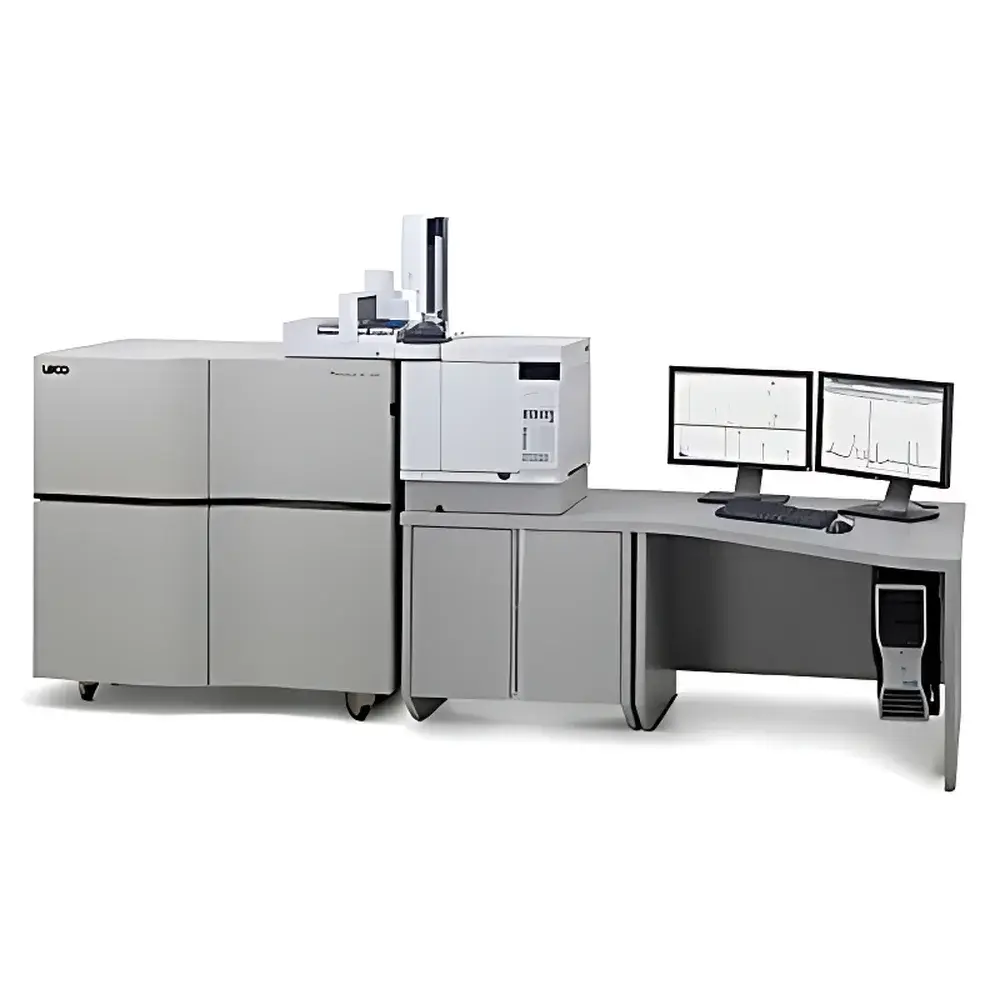
LECO Pegasus HRT High-Resolution Gas Chromatography Time-of-Flight Mass Spectrometer
| Brand | LECO |
|---|---|
| Origin | USA |
| Manufacturer Type | Original Equipment Manufacturer (OEM) |
| Origin Category | Imported |
| Model | Pegasus HRT |
| Instrument Type | Time-of-Flight Mass Spectrometer (TOF-MS) |
| Data Acquisition Rate | 200 full-spectrum scans/sec |
| Mass Resolution (Full Width at Half Maximum, FWHM) | 50,000 across full mass range |
| Mass Accuracy | <100 ppb (external calibration, 3-day interval) |
| Dynamic Linear Range | 10⁵–10⁶ |
| Ion Transmission Efficiency (Multi-Reflection Path) | >80% |
| Effective Flight Path Length | 64 m |
| Calibration Options | External standard, Continuous internal standard, Pseudo-external standard |
| Software | ChromaTOF v5.2+ with TrueSignal™ Deconvolution, PeakFind™, Library Search (NIST, Wiley, LECO Custom) |
Overview
The LECO Pegasus HRT is a high-resolution gas chromatography time-of-flight mass spectrometer (GC-HRT) engineered for untargeted screening, comprehensive metabolomics, environmental contaminant profiling, and forensic toxicology applications requiring simultaneous high mass resolution, sub-ppm mass accuracy, and ultrafast spectral acquisition. Unlike conventional linear TOF or orthogonal-acceleration TOF instruments, the Pegasus HRT employs LECO’s proprietary Folded Flight Path™ (FFP™) architecture — a multi-reflection “flight box” design that extends the effective ion flight path to 64 meters without thermal drift-induced instability. This eliminates the mechanical and thermal constraints inherent in traditional tubular flight tubes (typically 1–2 m), enabling true time-of-flight-based mass separation at sustained 50,000 resolution (FWHM) across the full mass range (m/z 40–1,000). The absence of grids, lenses, or RF-guiding elements in the flight region preserves native spectral fidelity, ensuring optimal compatibility with commercial electron ionization (EI) spectral libraries (NIST, Wiley, and LECO-curated libraries) and eliminating spectral distortion caused by transmission filters or mass-selective pre-filters.
Key Features
- Folded Flight Path™ (FFP™) technology delivering 64-meter effective ion flight distance within a compact, thermally stable chamber — no active temperature control required, minimal sensitivity to ambient fluctuations
- Real-time acquisition of 200 full-spectrum scans per second at full 50,000 mass resolution — enabling robust peak detection in fast GC and comprehensive two-dimensional GC (GC×GC) separations
- Mass accuracy better than 100 ppb using external calibration performed only once every 72 hours; optional continuous internal standard correction available for long-duration unattended runs
- Ion transmission efficiency >80% through the multi-reflection path, achieved via gridless mirror optics and multi-stage ion focusing — overcoming historical throughput limitations of reflective TOF designs
- Three user-selectable resolution modes (Standard, High, Ultra-High) and three calibration strategies (external, continuous internal, pseudo-external) for method flexibility across regulatory and discovery workflows
- No quadrupole, no ion trap, no energy filter — pure EI-TOF configuration optimized for library-match reliability and quantitative reproducibility under GLP/GMP-compliant conditions
Sample Compatibility & Compliance
The Pegasus HRT interfaces seamlessly with all major GC platforms (Agilent, Thermo, Shimadzu, PerkinElmer) via standard transfer line configurations and supports both split/splitless and cold-on-column injection. It is fully compatible with standard 30-m capillary columns (0.25 mm ID, 0.25 µm film thickness) and GC×GC modulators (e.g., LECO QuadJet, Zoex Cryo-Modulator). The system meets ASTM E2912-21 (Standard Guide for High-Resolution GC-TOFMS Data Acquisition and Processing), ISO/IEC 17025:2017 requirements for analytical instrument validation, and supports FDA 21 CFR Part 11-compliant audit trails when operated with ChromaTOF’s secure user authentication and electronic signature modules. All spectral data are stored in open-format .tdf files compliant with mzML 1.1 standards for third-party software interoperability.
Software & Data Management
ChromaTOF software (v5.2 or later) provides integrated acquisition, processing, and reporting capabilities. Its TrueSignal™ deconvolution engine resolves co-eluting peaks with high fidelity using retention time and spectral covariance, while PeakFind™ automatically detects, integrates, and annotates features with retention index alignment. Library search leverages probability-based matching (dot-product + reverse dot-product + identity threshold) against NIST/EPA/NIH, Wiley, and custom LECO EI libraries. Quantitative workflows support internal standard normalization, matrix-matched calibration curves, and QC sample tracking with statistical outlier detection. Raw data archives, processing parameters, and report outputs are version-controlled and exportable in CSV, PDF, and XML formats for LIMS integration.
Applications
- Untargeted metabolomics and lipidomics in biological fluids (plasma, urine, tissue extracts)
- Residue analysis of pesticides, pharmaceuticals, and emerging contaminants in food and environmental matrices (soil, water, air particulates)
- Forensic toxicology screening for novel psychoactive substances (NPS) and designer drugs
- Essential oil fingerprinting and adulteration detection using GC×GC-HRT
- Reaction monitoring in catalysis and synthetic chemistry via real-time volatile profiling
- Regulatory compliance testing under EU REACH, US EPA Method 8270/8272, and WHO guidelines for trace organic analysis
FAQ
How does the Folded Flight Path™ improve resolution without compromising acquisition speed?
The FFP™ architecture increases the effective flight path length to 64 m while maintaining picosecond-level time measurement precision and sub-nanosecond ion packet width — enabling resolution scaling proportional to √(flight path) without sacrificing duty cycle or scan rate.
Is continuous mass calibration required for routine operation?
No. External calibration every 72 hours maintains <100 ppb mass accuracy; continuous internal standard correction is optional for extended unattended analyses (e.g., overnight GC×GC runs).
Can the Pegasus HRT be used for quantitative analysis under regulated environments?
Yes. When configured with ChromaTOF’s 21 CFR Part 11 module, it supports electronic signatures, audit trails, user role management, and raw data integrity verification — validated for use in GLP and GMP laboratories.
Does the system support GC×GC coupling?
Yes. It is fully compatible with commercial thermal and cryogenic modulators and delivers high-fidelity spectral acquisition at modulation periods as short as 2–4 seconds.
What spectral libraries are natively supported?
NIST MS Search, Wiley Registry, and LECO’s proprietary EI spectral library (over 1.2 million reference spectra), all searchable with retention index filtering and confidence scoring.





