LCT-700 HPLC/GPC-FTIR/MALDI Coupling Interface System

| Origin | USA |
|---|---|
| Manufacturer Type | Authorized Distributor |
| Origin Category | Imported |
| Model | LCT-700 |
| Instrument Class | IR Auxiliary Coupling Interface |
| Instrument Type | Benchtop Laboratory System |
| Wavenumber Range | 8000–500 cm⁻¹ |
| Spectral Resolution | 0.5 cm⁻¹ |
| Scan Speed | 20 scans/sec |
| Signal-to-Noise Ratio | 15,000:1 |
Ask about pricing, availability and specifications.
Overview
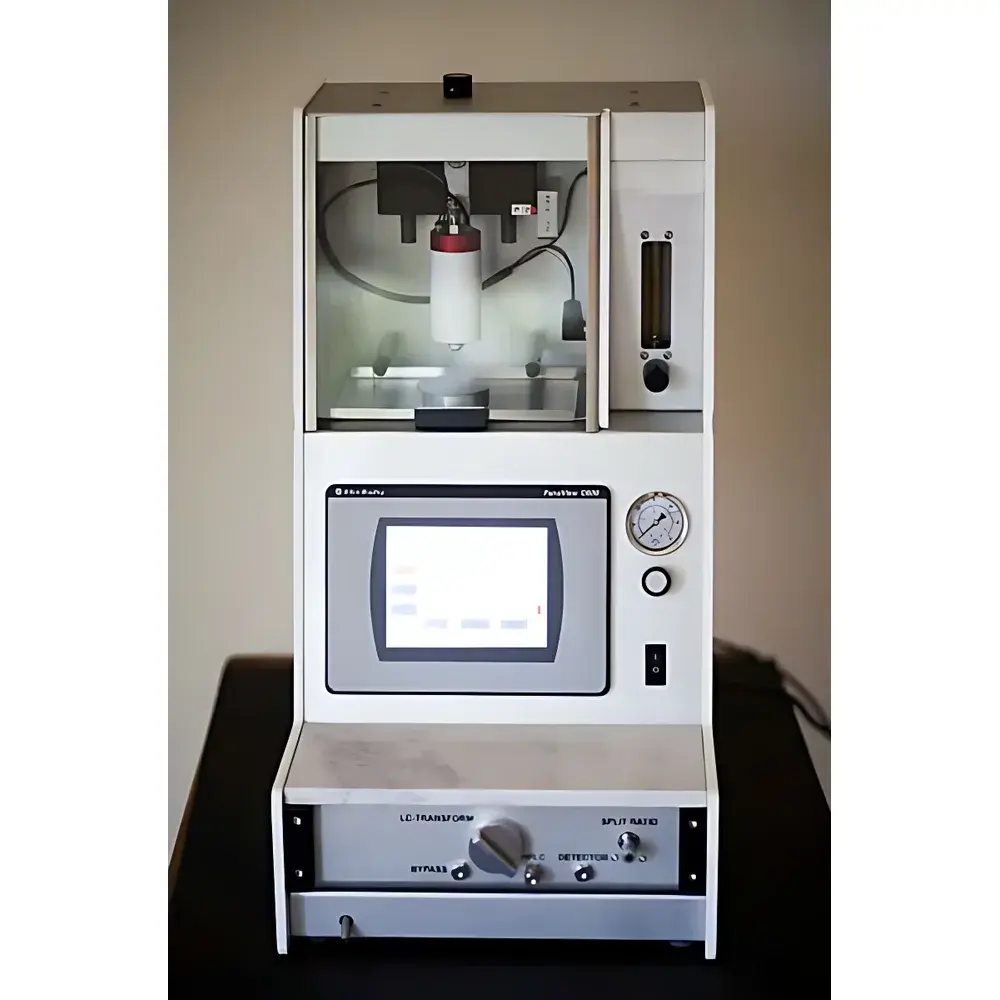
The LCT-700 HPLC/GPC-FTIR/MALDI Coupling Interface System is an engineered solution for real-time hyphenated analysis, enabling seamless integration of high-performance liquid chromatography (HPLC), gel permeation chromatography (GPC), field-flow fractionation (FFF), and matrix-assisted laser desorption/ionization (MALDI) with Fourier-transform infrared (FTIR) spectroscopy. Unlike conventional post-run offline analysis, the LCT-700 operates on a continuous, flow-through principle: effluent from the chromatographic column is subjected to rapid solvent removal via thermally controlled ultrasonic nebulization, followed by deposition of analyte micro-residues onto a reflective or transmission IR substrate—fully synchronized with chromatographic elution. This coupling architecture preserves molecular integrity and functional group specificity while eliminating time-lag artifacts associated with fraction collection and manual transfer. The system is designed for rigorous analytical environments where structural elucidation of unknown peaks, polymer microstructure characterization, or trace-level impurity identification must be performed without compromising chromatographic resolution or spectral fidelity.
Key Features
- Universal HPLC/GPC compatibility: Interfaces with all major commercial LC platforms—including Agilent, Waters, Shimadzu, and Thermo Fisher—regardless of detector configuration (UV-Vis, RI, ELSD, or MS).
- Modular FTIR integration: Supports both single-beam and interferometer-based FTIR spectrometers from Bruker, PerkinElmer, Nicolet, and JASCO via standardized optical alignment fixtures and beam-path adapters.
- Ultrasonic nebulization interface: Equipped with temperature-regulated piezoelectric spray nozzles (operable up to 170 °C), enabling efficient solvent evaporation across reversed-phase, normal-phase, and aqueous GPC mobile phases—including acetonitrile, THF, DMF, and water/methanol gradients.
- Nanogram-scale detection sensitivity: Achieves sub-10 ng absolute detection limits for carbonyl-, amide-, and aromatic-containing compounds through optimized droplet size distribution and controlled deposition geometry.
- Real-time synchronization: Hardware-triggered acquisition ensures one-to-one correspondence between chromatographic retention time and FTIR spectral acquisition, supporting dynamic spectral library matching and peak-specific functional group mapping.
Sample Compatibility & Compliance
The LCT-700 accommodates a broad range of sample classes including synthetic polymers (e.g., polyolefins, polyacrylates, PEGs), pharmaceutical actives and excipients, natural product isolates, and degradation products. It supports both volatile and semi-volatile analytes, provided mobile phase volatility permits complete solvent removal under defined thermal conditions. The system complies with ASTM E1421–22 (Standard Guide for Describing and Measuring Performance of FTIR Spectrometers) and aligns with ISO 17025 requirements for method validation in accredited laboratories. When deployed in regulated environments, the integrated software supports audit trails, electronic signatures, and data integrity protocols consistent with FDA 21 CFR Part 11 and EU Annex 11 expectations.
Software & Data Management
The LCT-700 is operated via proprietary coupling control software compatible with Windows 10/11 (64-bit). It provides synchronized instrument control across LC pump, autosampler, column oven, and FTIR spectrometer. Spectral acquisition supports rapid-scanning mode (20 spectra/sec), co-addition averaging, and real-time baseline correction. Data output includes time-resolved spectral stacks, 3D contour plots (retention time × wavenumber × absorbance), and peak-integrated spectral libraries. All raw and processed data are stored in open-format HDF5 containers, ensuring long-term readability and interoperability with third-party chemometric tools (e.g., MATLAB, Python scikit-learn, Unscrambler X). Export options include CSV, JCAMP-DX, and CDF for LIMS integration.
Applications
- Structural verification of HPLC peak identities in pharmaceutical stability studies, particularly for degradants and isomeric impurities not resolved by UV alone.
- Microstructural analysis of copolymers via GPC-FTIR: quantifying comonomer ratios, end-group composition, and branching frequency directly from elution fractions.
- Characterization of MALDI matrix-analyte co-crystals prior to ionization, enabling rational selection of optimal matrix systems based on hydrogen-bonding patterns observed in situ.
- Quality control of polymer additives (e.g., antioxidants, plasticizers) in complex formulations where overlapping UV chromophores hinder selective detection.
- Forensic analysis of seized materials requiring orthogonal confirmation—e.g., distinguishing structurally similar opioids or synthetic cannabinoids using fingerprint-region IR signatures.
FAQ
Can the LCT-700 be retrofitted to an existing FTIR spectrometer?
Yes—the system includes mechanical mounting kits and optical path adapters for Bruker Tensor series, PerkinElmer Frontier, Nicolet iS50, and JASCO FT/IR-6000 platforms.
Is gradient elution supported?
Yes—temperature-controlled nebulization maintains stable deposition efficiency across binary and ternary gradients, including water/acetonitrile and THF/methanol systems.
What substrates are compatible with the deposition stage?
Standard configurations support KBr pellets, diamond ATR crystals, ZnSe windows, and gold-coated reflective slides; custom substrates can be accommodated upon request.
Does the system meet GLP or GMP documentation requirements?
The software provides full electronic record retention, user access controls, change history logging, and 21 CFR Part 11-compliant signature workflows when configured with validated installation and operational qualification protocols.
What maintenance is required for the ultrasonic nozzle assembly?
Nozzle cleaning is recommended after every 50 hours of operation using isopropanol sonication; consumable replacement intervals are tracked automatically within the software dashboard.