
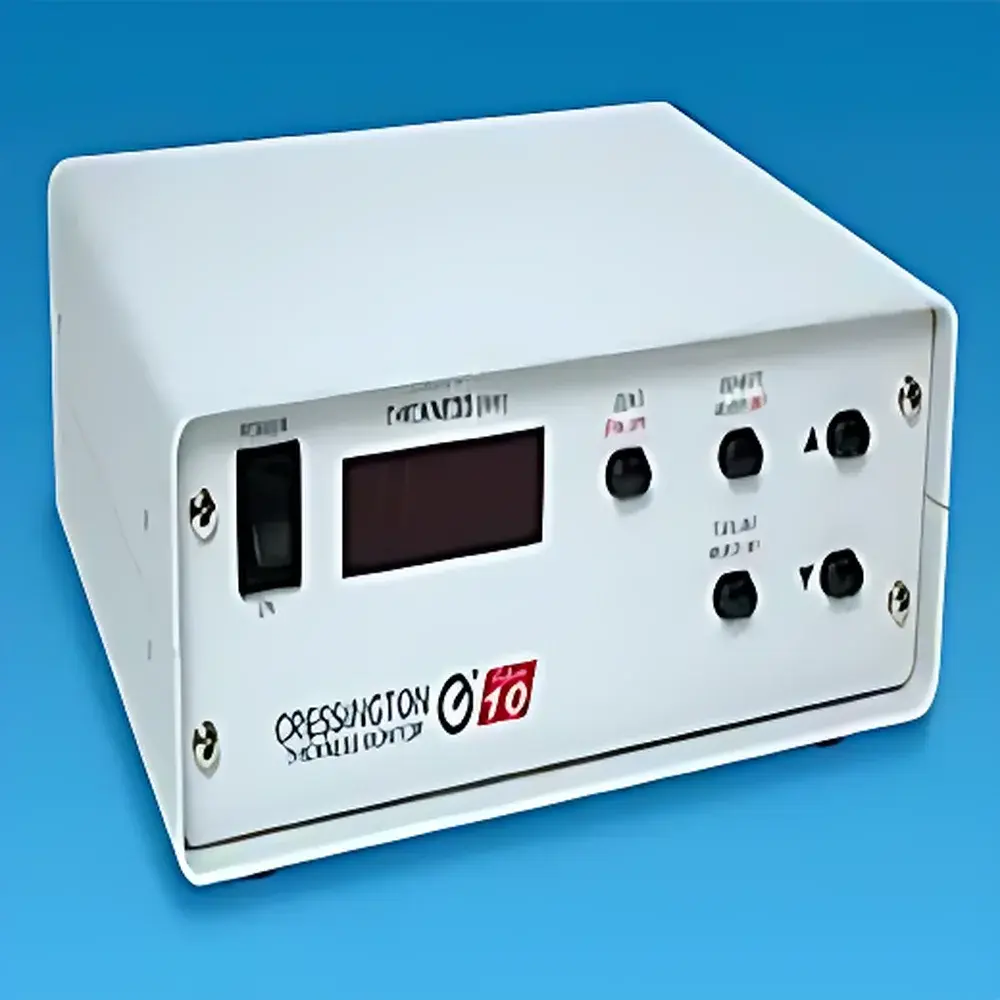
Ted Pella M10 High-Resolution Quartz Crystal Microbalance (QCM) Thickness Monitor and Controller
| Brand | Ted Pella |
|---|---|
| Model | M10 |
| Measurement Resolution | 0.5 nm |
| Display Range | 0–999.9 Å |
| Output Interface | BNC |
| Vacuum Compatibility | Yes (via CS-108 feedthrough) |
| Crystal Mounting | M4 bracket, crystal area 6 mm² |
| Power Supply | Integrated oscillator box with MTM-10 controller |
| Compliance | Designed for UHV and high-vacuum thin-film deposition systems |
Overview
The Ted Pella M10 High-Resolution Quartz Crystal Microbalance (QCM) Thickness Monitor and Controller is a precision in-situ metrology instrument engineered for real-time, quantitative monitoring of thin-film deposition processes—including thermal evaporation, electron-beam evaporation, sputtering, and magnetron sputtering. It operates on the fundamental piezoelectric principle of the quartz crystal microbalance: as mass accumulates on the electrode surface of an AT-cut quartz crystal resonator, its resonant frequency decreases linearly according to the Sauerbrey equation. This frequency shift—measured electronically with high-stability oscillation circuitry—is directly proportional to the areal mass loading, enabling nanometer-scale thickness determination when material density is known. The M10 delivers a measurement resolution of 0.5 nm (0.05 Å), displayed on a four-digit LED readout spanning 0–999.9 Å—sufficient for sub-monolayer control in advanced optical coating, semiconductor passivation, and functional nanomaterial synthesis.
Key Features
- High-resolution thickness monitoring at 0.5 nm (0.05 Å) sensitivity, traceable to fundamental quartz resonance physics
- Integrated MTM-10 controller box with stable temperature-compensated oscillator circuitry for low-drift operation
- CS-108 vacuum feedthrough with integrated O-ring seal and dual BNC/SMB connectors for reliable signal transmission under high-vacuum (≤10⁻⁷ Torr) and UHV conditions
- Compact crystal monitor head with M4 mounting bracket (18 mm × 21 mm footprint) and standardized 6 mm active crystal area for interchangeability with industry-standard QCM sensors
- 7-inch (108 mm) shielded crystal head cable with low-noise BNC termination and optional BNC elbow for constrained chamber geometries
- No external PC required—standalone operation with immediate LED feedback supports rapid process iteration and operator-guided deposition control
Sample Compatibility & Compliance
The M10 is compatible with all standard 6 MHz fundamental-mode quartz crystals (e.g., Inficon, Sycon, or custom-coated variants) and supports both conductive and dielectric thin films—including metals (Al, Au, Cr, Ti), oxides (SiO₂, Al₂O₃, ITO), nitrides (Si₃N₄, TiN), and organic molecular layers. Its mechanical design conforms to common vacuum flange standards (CF, KF, ISO-K), and the CS-108 feedthrough meets ISO 3669 dimensional specifications. While the system itself does not carry formal certification, its architecture aligns with GLP-compliant thin-film process documentation requirements: frequency data logging (when interfaced via analog output), operator-accessible calibration constants, and non-volatile storage of material density parameters support audit-ready process records per ISO/IEC 17025 and ASTM F1529 guidelines for thin-film metrology.
Software & Data Management
The M10 operates as a standalone hardware controller with no embedded firmware or proprietary software dependency. Analog voltage output (0–10 V DC, scalable to thickness or rate) enables integration into third-party data acquisition systems (e.g., LabVIEW, MATLAB, or PLC-based controllers) for time-stamped logging, closed-loop rate control, or multi-sensor correlation. Optional analog-to-digital conversion modules allow synchronization with shutter timing, substrate rotation, or source power modulation. Though the unit lacks native USB/Ethernet connectivity or FDA 21 CFR Part 11-compliant electronic signatures, its deterministic analog interface supports validated system integration in GMP environments where external DAQ systems provide audit trails, user authentication, and electronic record retention.
Applications
- In-situ monitoring of multilayer optical coatings requiring Å-level repeatability across batches (e.g., anti-reflective stacks, distributed Bragg reflectors)
- Process development for ALD and reactive sputtering where nucleation kinetics and interfacial growth modes demand sub-nanometer temporal resolution
- Research-scale fabrication of perovskite photovoltaic absorbers, 2D TMD heterostructures, and MOF thin films where stoichiometric control dictates optoelectronic performance
- Calibration reference for secondary thickness gauges (e.g., ellipsometers, XRR) during chamber qualification and cross-instrument validation
- Teaching laboratories demonstrating mass-frequency transduction, thin-film nucleation theory, and vacuum process metrology fundamentals
FAQ
What crystal frequencies does the M10 support?
The M10 is optimized for standard 6 MHz fundamental-mode quartz crystals; operation with overtone crystals (e.g., 3rd or 5th harmonic) is not supported.
Can the M10 measure deposition rate in real time?
Yes—the LED display updates at ≥10 Hz, and the analog output provides continuous rate derivation (Å/s) when connected to a differentiating DAQ channel.
Is the crystal head compatible with heated or cooled substrates?
The standard crystal head is rated for ambient to 80 °C operation; high-temperature variants (up to 200 °C) require custom oscillator tuning and are available upon request.
How is material density entered and stored?
Density is manually entered via front-panel push buttons and retained in non-volatile memory until reset; no password protection or version history is implemented.
Does the system include NIST-traceable calibration documentation?
No—calibration is user-performed using certified reference crystals; Ted Pella provides technical guidance but does not supply certified calibration certificates with standard units.



