
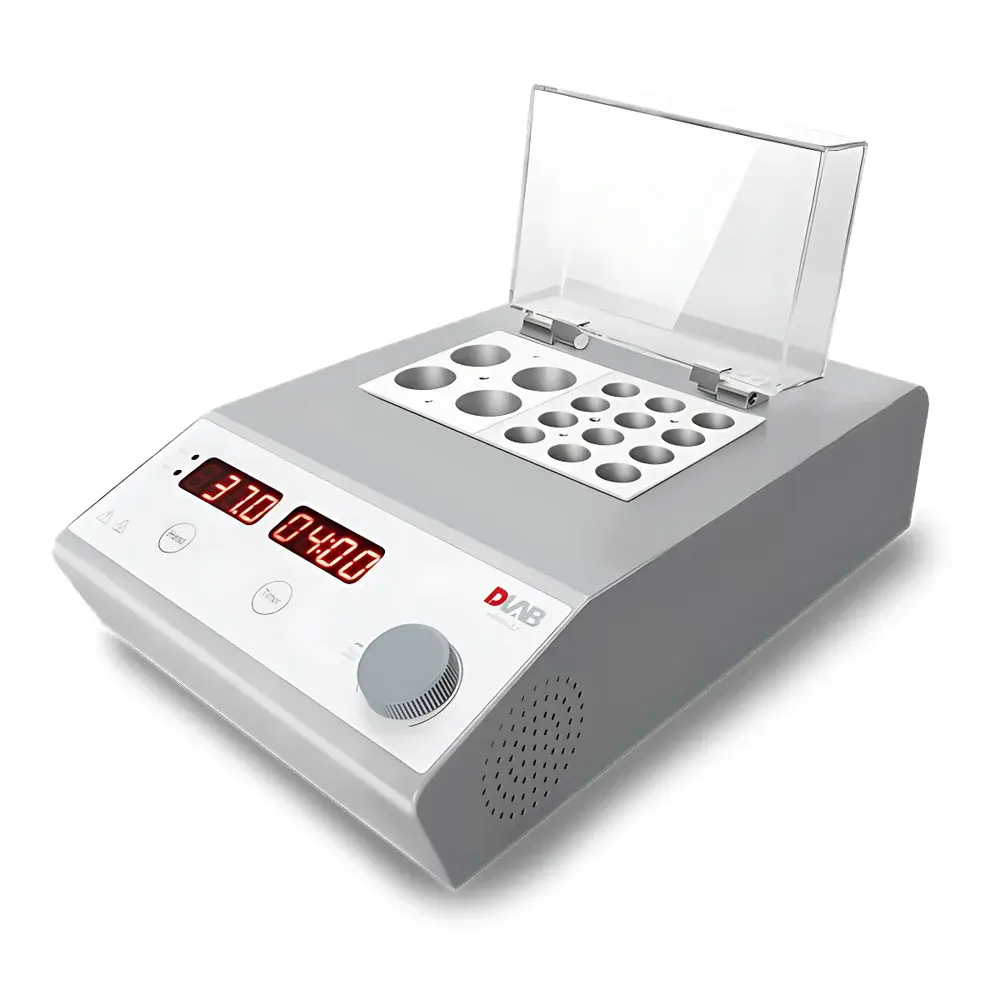
DLAB HB105-S2 Digital Dual-Channel Metal Block Heater
| Brand | DLAB |
|---|---|
| Origin | Beijing, China |
| Manufacturer Type | Direct Manufacturer |
| Model | HB105-S2 |
| Temperature Range | Ambient +5°C to 105°C |
| Temperature Accuracy | ±0.3°C (25–90°C), ±0.6°C (90–105°C) |
| Block Uniformity at 37°C | ±0.2°C |
| Timer Range | 0 min to 99 h 59 min |
| Power Consumption | 200 W |
| Dimensions (L×W×H) | 290 × 210 × 120 mm |
| Net Weight | 3.2 kg |
| Operating Ambient | 10–40°C, <80% RH |
| Input Voltage | 110/220 V, 50/60 Hz |
| External Probe Support | Yes |
| Display | LED |
| Safety Features | Overheat Protection, Insulated Lid |
Overview
The DLAB HB105-S2 Digital Dual-Channel Metal Block Heater is an engineered solution for precise, stable, and reproducible thermal incubation of multiple sample sets in parallel. Unlike water baths or dry block heaters with single-zone control, the HB105-S2 integrates two independent aluminum heating blocks—each with dedicated PID temperature regulation and real-time digital feedback—enabling simultaneous yet distinct thermal protocols across two experimental conditions. Its core architecture relies on high-thermal-conductivity aluminum alloy blocks (6061-T6 grade), precision-machined to accommodate standardized tube formats (e.g., 0.2 mL, 0.5 mL, 1.5 mL, 2.0 mL, and 15/50 mL conical tubes), ensuring rapid heat transfer and minimal thermal lag. The device operates on resistive heating elements embedded beneath each block surface, coupled with NTC thermistors for closed-loop monitoring. This design delivers robust performance across life science, clinical diagnostics, and quality control workflows where consistency between replicates—and between channels—is critical for assay integrity.
Key Features
- Dual independent heating zones with separate digital temperature and timer controls—eliminates cross-channel thermal interference
- PID-controlled temperature regulation with accuracy of ±0.3°C (25–90°C) and ±0.6°C (90–105°C); block uniformity maintained at ±0.2°C at 37°C
- LED display showing real-time temperature and elapsed time for each channel; intuitive rotary parameter adjustment interface
- Integrated overtemperature protection circuitry that automatically deactivates heating if block temperature exceeds set limit by >5°C
- Removable insulated lid with precision-cut apertures minimizes convective heat loss and prevents airborne contamination during extended incubations
- Support for external PT100 or NTC probe input—enables validation-grade monitoring aligned with ISO/IEC 17025 traceability requirements
- Universal power supply (110/220 V, 50/60 Hz) and compact footprint (290 × 210 × 120 mm) suitable for benchtop integration in GLP-compliant laboratories
Sample Compatibility & Compliance
The HB105-S2 accommodates a broad range of standard laboratory consumables without adapters, including PCR strips, microcentrifuge tubes, screw-cap vials, and small-volume reaction vessels. Its dual-block layout allows concurrent processing of different sample types—for example, enzymatic digestion in one channel while performing DNA denaturation in the other. From a regulatory standpoint, the heater complies with IEC 61010-1:2010 for electrical safety in laboratory equipment. Its programmable timer and non-volatile parameter memory support audit-ready operation under GLP and GMP frameworks. While not intrinsically 21 CFR Part 11 compliant, its external probe interface and deterministic timer behavior facilitate integration into validated systems when paired with compliant data acquisition software.
Software & Data Management
The HB105-S2 operates as a standalone instrument with no proprietary software dependency. All operational parameters—including target temperature, hold time, and channel activation—are configured locally via front-panel controls and retained in EEPROM memory after power cycling. For laboratories requiring electronic recordkeeping, the optional external temperature probe output (0–5 V analog or RS-232) enables connection to third-party data loggers or LIMS platforms. Timestamped temperature logs can be exported for review during internal audits or regulatory inspections. No firmware updates are required during routine use; however, DLAB provides calibration documentation templates aligned with ISO/IEC 17025 Clause 6.4 for user-performed periodic verification.
Applications
- Enzyme kinetics assays requiring strict thermal consistency across replicate reactions
- Cell lysis and protein extraction protocols where controlled, non-boiling heat application preserves biomolecule integrity
- Standard curve preparation in ELISA and qPCR workflows—especially when calibrating multiple standards simultaneously
- Sample thawing and pre-warming of reagents prior to chromatographic injection or spectrophotometric analysis
- Quality control testing of thermal stability for pharmaceutical excipients and diagnostic reagent kits
- Teaching laboratories conducting comparative thermal experiments (e.g., enzyme activity vs. temperature gradients)
FAQ
Can the HB105-S2 maintain temperature stability during prolonged incubations (>24 h)?
Yes—the unit’s thermal mass, PID tuning, and low-drift sensor architecture ensure drift of <±0.1°C over 48-hour continuous operation at 37°C, verified per ASTM E2209-17 Annex A2.
Is calibration certificate included with purchase?
No; however, DLAB provides a factory calibration report (traceable to NIM, China) upon request. Users may perform field verification using a NIST-traceable reference thermometer.
Does the device support ramp-and-hold temperature profiles?
No—the HB105-S2 implements stepwise temperature control only. For multi-stage thermal protocols, external programmable controllers or sequential manual adjustment is required.
What tube formats are natively supported without inserts?
0.2 mL PCR tubes (8-strip or individual), 0.5 mL, 1.5 mL, and 2.0 mL microcentrifuge tubes; 15 mL and 50 mL conical tubes require optional aluminum inserts (sold separately).
How is overheating protection triggered?
A redundant thermal cutoff switch activates at 115°C ±3°C, cutting power to both blocks independently of the main controller—meeting IEC 61010-1 Clause 11.3 fail-safe requirements.



