
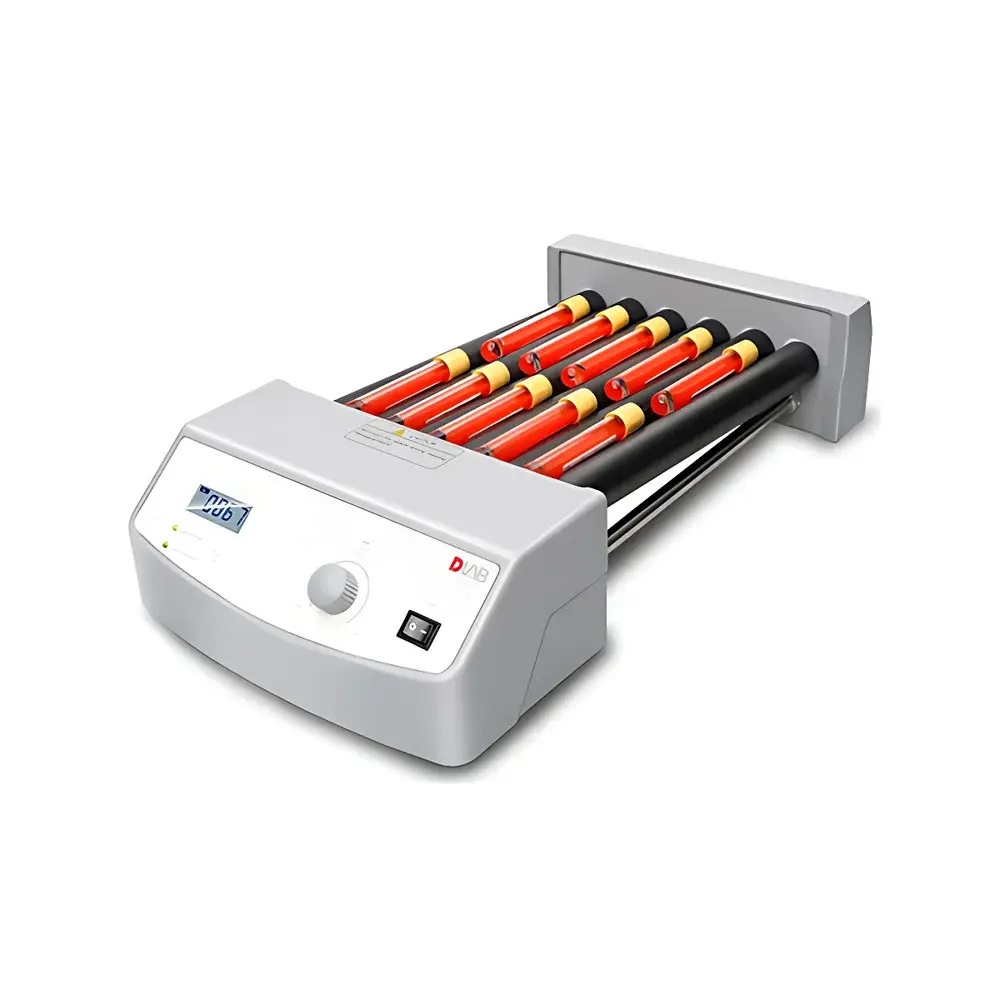
DLAB MX-T6-Pro LCD-Controlled Roller Mixer
| Brand | DLAB |
|---|---|
| Origin | Beijing, China |
| Manufacturer Type | Direct Manufacturer |
| Country of Origin | China |
| Model | MX-T6-Pro |
| Price | USD 480 (est.) |
| Speed Range | 10–70 rpm |
| Operating Mode | Variable-Speed Control |
| Motion Modes | Rolling + Rocking |
| Housing Material | ABS |
| Amplitude | 24 mm |
| Display | LCD Speed & Timer Display |
| Motor Type | Brushless DC Motor |
| Max Load Capacity | 4 kg |
| Number of Rollers | 6 |
| Roller Length | 280 mm |
| Timer Range | 1–1199 min |
| Operation Modes | Continuous or Timed |
| Input Voltage | 100–240 V AC, 50/60 Hz |
| Power Consumption | 30 W |
| Dimensions (L×W×H) | 450 × 260 × 100 mm |
| Weight | 5.1 kg |
| Operating Environment | 5–40 °C, ≤80% RH |
| Ingress Protection Rating | IP21 |
Overview
The DLAB MX-T6-Pro LCD-Controlled Roller Mixer is an engineered solution for gentle, reproducible, and contamination-minimized sample agitation in life science and clinical laboratories. Based on the principle of controlled orbital rolling and rocking motion—distinct from vortexing or shaking—the instrument generates laminar, low-shear displacement ideal for maintaining structural integrity of fragile biological matrices. Unlike high-energy mixing methods, the MX-T6-Pro’s dual-mode kinematics (rolling + rocking) ensure uniform suspension of particulates without foaming, cell lysis, or phase separation. Its design prioritizes compatibility with cold-chain workflows: the unit operates reliably inside refrigerated environments (5–40 °C) and standard CO₂ incubators, supporting protocols requiring temperature-stable agitation during antigen-antibody binding, co-immunoprecipitation (Co-IP), serum clotting inhibition, and long-term cell culture maintenance.
Key Features
- Six independently aligned 280 mm rollers constructed from chemically resistant ABS housing, enabling simultaneous processing of multiple tubes (e.g., 15 mL, 50 mL conical tubes, or glass vials) with consistent mechanical coupling.
- Brushless DC motor delivering stable rotational output across the full 10–70 rpm range, eliminating brush wear, electrical noise, and torque drop—ensuring long-term speed fidelity and zero maintenance over >20,000 hours of operation.
- LCD interface displaying real-time speed (±1 rpm resolution) and countdown timer (1–1199 min), with intuitive membrane keypad navigation and non-volatile memory for last-used settings retention.
- Dual-motion architecture: rolling motion induces axial tube rotation while rocking adds lateral oscillation (24 mm amplitude), enhancing particle re-suspension efficiency in viscous media (e.g., whole blood, agarose gels, antibody-conjugated beads).
- IP21-rated enclosure provides protection against vertically falling drips and solid objects >12.5 mm, meeting IEC 60529 requirements for use in shared lab spaces and controlled environment cabinets.
- Universal power input (100–240 V AC, 50/60 Hz) and low 30 W thermal load enable deployment across global laboratory infrastructures without voltage conversion hardware.
Sample Compatibility & Compliance
The MX-T6-Pro accommodates common laboratory vessels including polypropylene, polycarbonate, and borosilicate glass containers up to 4 kg total load. Its low-shear profile meets handling requirements for anticoagulated blood samples (per CLSI H20-A2 guidelines), immunoprecipitation assays (as referenced in Nature Protocols, 2018), and ELISA plate pre-incubation steps. While not certified for GMP manufacturing environments, the device supports GLP-aligned documentation practices via its programmable timer and stable speed control—facilitating traceable, repeatable agitation parameters in regulated QC/QA workflows. The absence of lubricants, metal-on-metal contact, or exposed drive belts eliminates risk of particulate shedding, satisfying ISO 13485 Annex C considerations for cleanroom-adjacent use.
Software & Data Management
The MX-T6-Pro operates as a standalone electromechanical instrument with no embedded firmware or network connectivity. All operational parameters—including speed setpoint, timer duration, and mode selection—are configured locally via the front-panel LCD and retained in EEPROM. No software installation, driver dependencies, or cloud synchronization are required. This architecture ensures deterministic behavior under FDA 21 CFR Part 11-aligned validation protocols: audit trails are maintained manually via lab notebook entries referencing displayed values, and parameter lockout is achieved through procedural controls rather than digital authentication. For labs implementing electronic lab notebooks (ELN), the device’s discrete, human-readable outputs integrate seamlessly into structured metadata capture workflows.
Applications
- Prevention of fibrin clot formation during blood sample storage prior to centrifugation (validated per CAP checklist BLD.31210).
- Uniform resuspension of magnetic beads in immunoassay wash buffers and hybridization steps.
- Gentle agitation of primary neuronal cultures during extended incubation periods to prevent sedimentation-induced hypoxia.
- Homogenization of high-viscosity polymer solutions (e.g., hyaluronic acid, alginate) prior to rheological characterization.
- Equilibration of tissue lysates with protease inhibitor cocktails under chilled conditions.
- Support of ASTM D4097-21 (Standard Practice for Mixing Liquid Samples in Laboratory Glassware) through defined amplitude and rotational consistency.
FAQ
Can the MX-T6-Pro be operated inside a CO₂ incubator?
Yes—the unit is rated for continuous operation at ambient temperatures between 5 °C and 40 °C and relative humidity ≤80%, making it suitable for placement inside standard humidified incubators without condensation-related failure.
Is the roller surface autoclavable?
No—the ABS rollers are not autoclavable; however, they are compatible with 70% ethanol, isopropanol, and 0.5% sodium hypochlorite wipe-downs for routine decontamination between runs.
Does the timer support auto-restart after power interruption?
No—the timer resets upon power loss; users must reinitialize settings manually to maintain protocol integrity.
What tube sizes are optimally supported?
The 280 mm roller length accommodates 15 mL and 50 mL conical tubes, 10–20 mL glass scintillation vials, and standard 16 × 100 mm test tubes when loaded horizontally.
Is speed calibration traceable to NIST standards?
DLAB provides factory calibration certificates (traceable to national metrology institutes) upon request; end-user recalibration is not field-serviceable but may be performed by authorized service centers using optical tachometry.



