
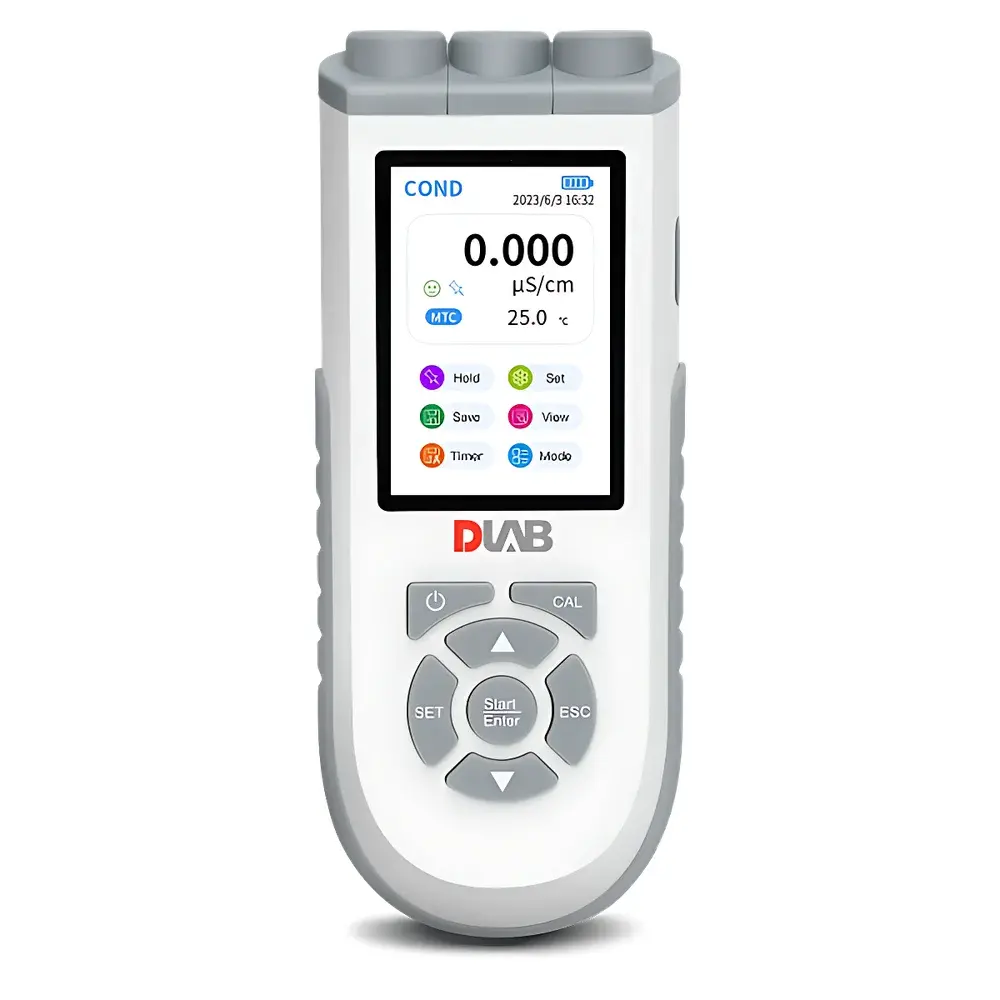
DLAB DEC10 Portable Conductivity Meter (Single-Parameter)
| Brand | DLAB |
|---|---|
| Origin | Beijing, China |
| Manufacturer Type | Manufacturer |
| Product Origin | Domestic (China) |
| Model | DEC10 |
| Measurement Parameter | Conductivity (single-parameter) |
| Portability | Portable |
| Conductivity Range | 0–2000.0 mS/cm with auto-ranging: 0–19.999 µS/cm |
| Extended conductivity range (with included electrode) | 0–200 mS/cm |
| TDS Range | 0–1000.0 g/L (adjustable TDS factor) |
| Resistivity Range | 5.000 Ω·cm – 100.0 MΩ·cm |
| Salinity Range | 0–100 ppt |
| Temperature Range | (−10.0 to 135.0) °C / (14.0 to 275.0) °F |
| Temperature Accuracy | ±0.2 °C |
| Conductivity Accuracy | ±0.5% FS ±1 digit |
| Conductivity Calibration | Single-point |
| Conductivity Resolution | 0.001 / 0.01 / 0.1 / 1 (auto-selected per range) |
| ATC Range | 0.0–50.0 °C / 32.0–122.0 °F |
| Display | 3.5-inch TFT color LCD |
| Data Storage | 3000 measurement records |
| Power | Rechargeable Li-ion battery (DH10-LI01, pre-installed) |
| Charging Interface | USB Type-C |
| IP Rating | IP57 |
| Included Accessories | DCON201T conductivity cell (K=1), three calibration standards (50 mL each: 146.6 µS/cm, 1408 µS/cm, 12.85 mS/cm), charging cable, carrying case (33 × 27.2 × 8.2 cm), user manual |
Overview
The DLAB DEC10 Portable Conductivity Meter is a field-deployable, single-parameter electrochemical instrument engineered for precise, reliable, and repeatable measurement of electrical conductivity in aqueous solutions. Based on the fundamental principle of conductometric analysis—where conductivity is derived from the solution’s ability to carry electric current under an applied AC voltage—the DEC10 employs a two-electrode, frequency-compensated measurement circuit optimized for minimal polarization error and stable signal acquisition across wide dynamic ranges. Its design targets routine quality control, environmental monitoring, wastewater assessment, and educational laboratory applications where portability, ruggedness, and regulatory-compliant data integrity are essential. The instrument complies with core performance expectations outlined in ASTM D1125 (Standard Test Methods for Electrical Conductivity and Resistivity of Water) and supports traceable calibration practices aligned with ISO/IEC 17025 requirements for testing laboratories.
Key Features
- 3.5-inch high-resolution TFT color display with intuitive graphical UI, enabling rapid parameter navigation and real-time trend visualization
- Auto-ranging conductivity measurement across six decades (0.001 µS/cm to 2000 mS/cm), with intelligent range switching and automatic unit scaling
- Integrated temperature compensation (ATC) using a built-in NTC thermistor; user-selectable reference temperatures (20 °C or 25 °C) and linear compensation coefficients
- Rechargeable lithium-ion battery (DH10-LI01) with USB Type-C charging interface—designed to meet EU CE and RoHS directives, including low-power sleep mode and power-loss memory retention
- Robust mechanical architecture rated IP57: dust-protected and capable of withstanding immersion in 1 m of water for up to 30 minutes—suitable for outdoor, industrial, and marine sampling environments
- Onboard data management system supporting storage of up to 3000 timestamped measurements, including conductivity, TDS, resistivity, salinity, and temperature values
- Single-point calibration protocol compatible with standard KCl solutions (146.6 µS/cm, 1408 µS/cm, 12.85 mS/cm); calibration status and date logged automatically
Sample Compatibility & Compliance
The DEC10 is validated for use with low- to high-conductivity aqueous samples—including drinking water, surface water, seawater, brines, process streams, and nutrient solutions. It accommodates variable sample geometries via its submersible DCON201T conductivity cell (cell constant K = 1.0 cm⁻¹), which features platinum black electrodes and PEEK housing for chemical resistance and mechanical durability. While not intrinsically safe for explosive atmospheres, the meter meets IEC 61010-1 safety standards for portable electrical equipment used in laboratory and field settings. Its measurement uncertainty budget—±0.5% full scale ±1 digit for conductivity and ±0.2 °C for temperature—is consistent with GLP-aligned documentation workflows and supports audit-ready recordkeeping when paired with external data export protocols.
Software & Data Management
Data retrieval is performed via manual review on-device or through optional PC-based software (not bundled) that accepts CSV exports via USB connection. All stored records include embedded metadata: measurement ID, date/time stamp, measured parameters, temperature reading, calibration status, and electrode identification. The firmware implements non-volatile memory with power-fail protection—ensuring no loss of calibration settings or historical data during unexpected shutdowns. Although the DEC10 does not support FDA 21 CFR Part 11 electronic signature functionality out-of-the-box, its deterministic measurement logic, immutable calibration logs, and timestamped audit trail satisfy foundational data integrity criteria for ISO 9001 and ISO 14001-certified operations.
Applications
- Environmental field surveys: river, lake, and groundwater conductivity profiling for salinity and contamination screening
- Wastewater treatment plant monitoring: influent/effluent conductivity tracking as a surrogate for total dissolved solids (TDS) and ionic load
- Aquaculture and hydroponics: real-time nutrient solution strength verification and dosing feedback control
- Pharmaceutical water systems: purified water (PW) and water-for-injection (WFI) conductivity spot checks per USP
- Educational laboratories: undergraduate electrochemistry experiments involving electrolyte concentration–conductivity relationships
- Food & beverage QC: brine concentration validation in pickling, canning, and dairy processing lines
FAQ
What type of conductivity cell is included with the DEC10?
The instrument ships with the DCON201T two-electrode, K=1.0 cm⁻¹ platinum black cell, optimized for general-purpose aqueous measurements from ultrapure water to concentrated brines.
Does the DEC10 support multi-point conductivity calibration?
No—it implements a single-point calibration workflow, sufficient for most routine applications where relative consistency and traceability to certified standards are prioritized over absolute metrological rigor.
Can the DEC10 measure resistivity directly, or is it calculated?
Resistivity is calculated in real time from the measured conductivity and temperature-corrected cell constant; no separate sensor is required.
Is the battery replaceable by the end user?
The DH10-LI01 rechargeable battery is factory-installed and service-replaceable only by authorized DLAB technical centers to maintain IP57 integrity and electrical safety certification.
How is temperature compensation applied during conductivity measurement?
The DEC10 applies linear temperature compensation using the default NaCl-based coefficient (2.0%/°C), with option to input custom β-values for non-standard electrolytes via the configuration menu.




