
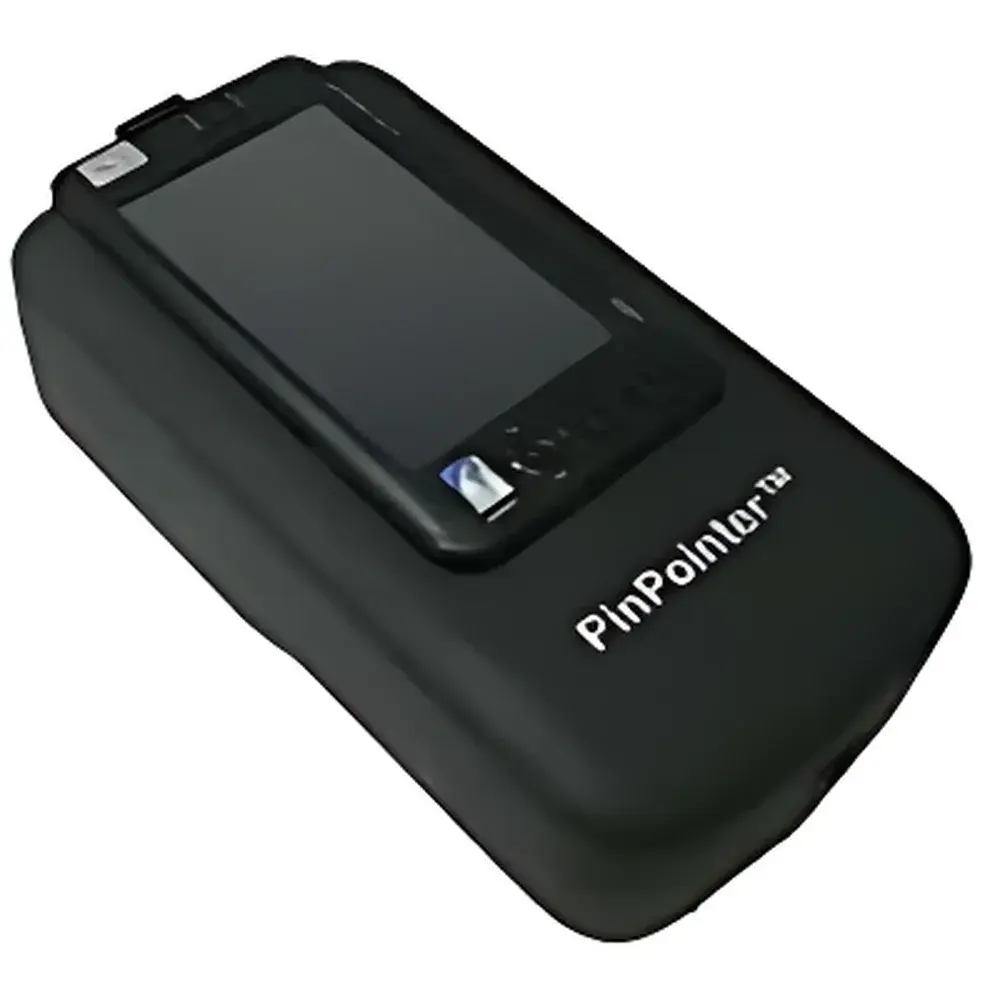
PINPOINTER Handheld Raman Spectrometer
| Origin | USA |
|---|---|
| Manufacturer Type | Authorized Distributor |
| Import Status | Imported |
| Model | PINPOINTER |
| Instrument Type | Portable/Handheld Raman Spectrometer |
| Spectral Range | 200–3300 cm⁻¹ |
| Spectral Resolution | 13 cm⁻¹ @ 1000 cm⁻¹ |
| Spatial Resolution | Lateral 105 µm, Axial 200 µm |
| Minimum Wavenumber Shift | <0.1 nm |
| Spectral Repeatability | 13 cm⁻¹ @ 1000 cm⁻¹ |
| Excitation Wavelength | 785 nm |
| Laser Power | 5–300 mW |
| Wavelength Stability | <1 cm⁻¹ over 12 h |
| Photometric Stability | <4% over 12 h |
| Optical NA | 0.22 |
| Sample Spot Size | 0.1–0.3 mm |
| Power Supply | Rechargeable battery, >4 h runtime per charge |
| Dimensions | 216 × 109 × 64 mm (8.5" × 4.3" × 2.5") |
| Weight | 1.36 kg (3 lbs.) |
| Operating Temperature | −25 °C to +45 °C |
Overview
The PINPOINTER Handheld Raman Spectrometer is an engineered solution for field-deployable, non-destructive molecular identification based on inelastic light scattering—Raman spectroscopy. Utilizing a stabilized 785 nm diode laser excitation source and a high-throughput transmission grating spectrometer, the system delivers reproducible spectral data across the fingerprint region (200–3300 cm⁻¹), where vibrational modes provide chemically specific signatures. Designed for operational robustness in variable environmental conditions—from forensic crime scenes to pharmaceutical manufacturing floors—the instrument integrates a ruggedized optical path, thermally compensated detector, and sealed optical bench to maintain alignment and calibration integrity during transport and repeated use. Its core architecture complies with fundamental principles of quantitative Raman measurement: consistent laser-sample interaction geometry, dark-current-compensated CCD acquisition, and real-time photometric normalization.
Key Features
- True point-and-shoot operation enabled by integrated Windows-based microcomputer and RSIQ™ control software—no external PC or driver installation required.
- Optimized 785 nm excitation minimizes fluorescence interference while maintaining sufficient photon flux for rapid signal acquisition from low-Raman-cross-section materials.
- Rechargeable lithium-ion battery supports >4 hours of continuous operation; hot-swappable design permits uninterrupted workflow in extended field deployments.
- Stainless-steel armored fiber-optic probe with adjustable-focus cap accommodates solid, powder, gel, and liquid samples without physical contact or sample preparation.
- Onboard spectral calibration using internal reference standards ensures wavenumber accuracy within ±1 cm⁻¹ over 12-hour periods—meeting ASTM E1840 and ISO 8573 traceability expectations for portable analytical instrumentation.
- RSIQ-QUAL™ optional software module enables library matching against industry-standard SPC-formatted spectral databases (e.g., SDBS, NIST, commercial pharmaceutical libraries) with configurable match thresholds and hit-quality scoring.
Sample Compatibility & Compliance
The PINPOINTER accepts a broad range of sample states—including crystalline solids, amorphous powders, tablets, polymers, biological tissues, and aqueous solutions—via its interchangeable probe accessories. The 0.1–0.3 mm spot size and 105 µm lateral resolution allow discrimination between adjacent domains in heterogeneous mixtures or layered structures. All hardware and firmware components are designed to support GLP-compliant workflows: audit trails for spectral acquisition parameters, user authentication logs, and timestamped metadata export (including laser power, integration time, and ambient temperature) are natively supported. Software modules comply with FDA 21 CFR Part 11 requirements when deployed with electronic signature and role-based access controls activated. No hazardous optics or Class IV laser exposure risk—the system operates as a Class 1M device under IEC 60825-1:2014.
Software & Data Management
RSIQ™ software provides full instrument control, real-time spectral preview, automatic dark-current subtraction, and one-click spectral capture with embedded baseline correction. Acquired spectra are stored in vendor-neutral .spc and .csv formats, preserving raw intensity, wavenumber axis, acquisition settings, and GPS-tagged geolocation metadata (when enabled). ID-FIND™ extension adds automated peak detection, multivariate preprocessing (SNV, derivative, smoothing), and probabilistic library search with confidence scoring. All spectral libraries are importable/exportable in SPC format, ensuring interoperability with third-party chemometric platforms (e.g., MATLAB, Unscrambler X, Pirouette). Data export supports CSV, PDF reports with embedded spectra, and XML-based LIMS integration via RESTful API endpoints.
Applications
- Pharmaceutical QA/QC: Raw material identification (RMID), counterfeit drug screening, and blend uniformity assessment per USP <1120> and Ph. Eur. 2.2.48 guidelines.
- Forensic Science: In situ identification of illicit substances, explosives residues, and trace evidence at crime scenes—validated in multiple peer-reviewed studies cited by NIJ and ENFSI.
- Hazardous Materials Response: Rapid identification of unknown chemicals in industrial spills or transportation incidents without opening containers.
- Academic & Field Research: Mineralogical mapping in geology, pigment analysis in art conservation, and polymer degradation monitoring in environmental science.
- Food Safety: Detection of adulterants (e.g., melamine in milk powder), pesticide residues on produce surfaces, and authenticity verification of botanical extracts.
FAQ
Is the PINPOINTER suitable for quantitative analysis?
While optimized for qualitative identification and semi-quantitative trend monitoring, absolute quantification requires external calibration standards and matrix-matched reference spectra due to inherent variations in sample morphology and laser coupling efficiency.
Does the system require annual recalibration?
No scheduled recalibration is mandatory; however, users are advised to perform daily wavelength and intensity verification using the included NIST-traceable polystyrene standard before critical measurements.
Can the instrument operate in direct sunlight?
Yes—the optical design incorporates narrow-band notch filtering and temporal gating to suppress ambient light interference, enabling reliable operation even under unshaded outdoor conditions.
What spectral libraries are included by default?
The base configuration includes a curated 500-entry library covering common pharmaceuticals, explosives, polymers, and inorganic salts; additional libraries are available as licensed add-ons.
Is remote diagnostics supported?
Yes—RSIQ™ includes secure remote desktop capability (with user consent) for technical support teams to diagnose firmware, driver, or software-level issues without physical access.





