
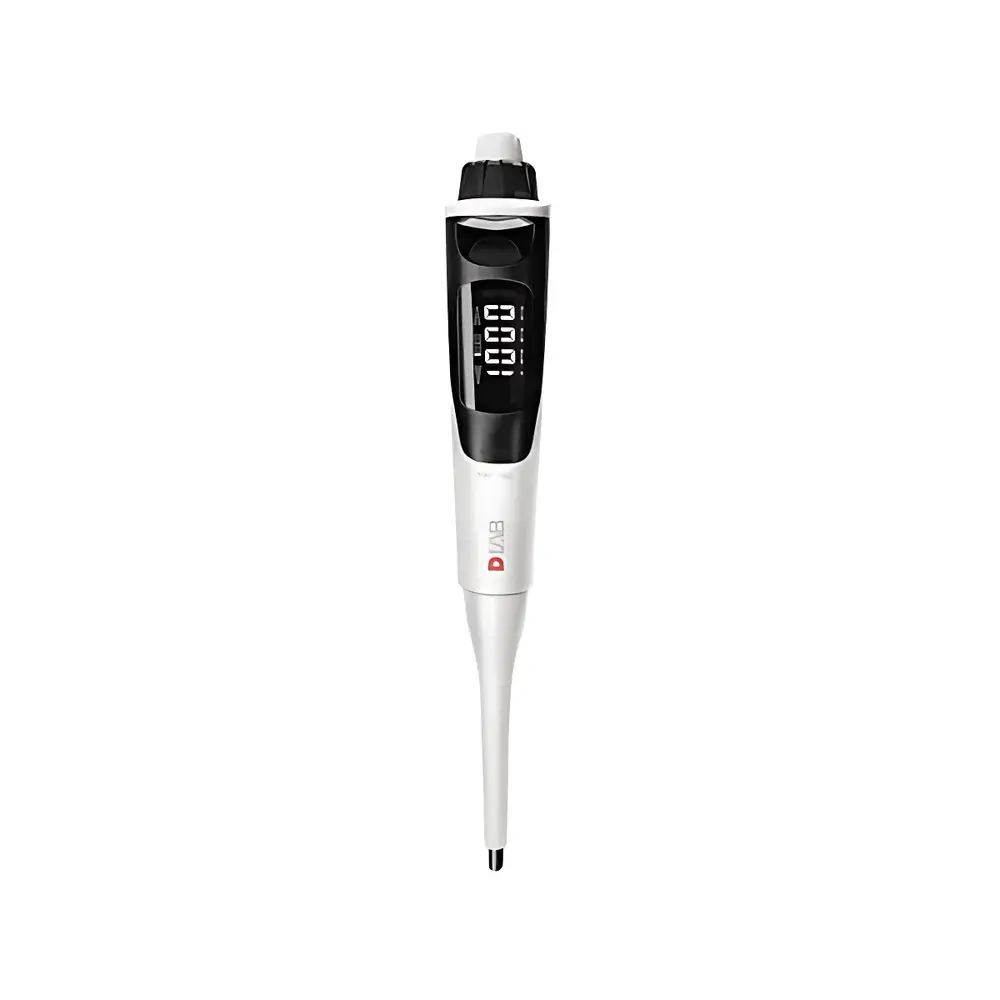
DLAB dPette Single-Channel Electronic Pipette
| Brand | DLAB |
|---|---|
| Origin | Beijing, China |
| Manufacturer Type | Original Equipment Manufacturer (OEM) |
| Product Category | Domestic |
| Model | dPette |
| Instrument Type | Single-Channel Electronic Pipette |
| Automation Level | Motorized |
| Channels | 1 |
| Volume Range | 0.5–1000 µL |
| Maximum Capacity | 1 mL |
| Accuracy (at 1000 µL) | ±3.00 µL |
| Precision (CV% at 1000 µL) | ≤0.60% |
| Accuracy (at 10 µL) | ±0.035 µL |
| Precision (CV% at 10 µL) | ≤3.50% |
| Step Increment | 0.1 µL (0.5–10 µL), 0.1 µL (5–50 µL), 1 µL (30–300 µL), 5 µL (100–1000 µL) |
| Power Source | Rechargeable Li-ion Battery |
| Sterilization | Autoclavable Piston Components (121°C, 20 min) |
| Calibration | User-performed via USB-connected analytical balance and PC software |
Overview
The DLAB dPette Single-Channel Electronic Pipette is an engineered solution for precision liquid handling in regulated and high-throughput laboratory environments. Designed on the principle of motor-driven positive displacement, it integrates brushless stepper motor actuation with a thermally stable air-cushion piston system to deliver repeatable volumetric delivery across its full 0.5–1000 µL range. Unlike conventional manual pipettes, the dPette eliminates operator-induced variability—such as inconsistent plunger pressure or thumb fatigue—while retaining the ergonomic familiarity of a handheld tool. Its architecture complies with ISO 8655-2 (2022) requirements for electronic pipettes, ensuring traceable performance against internationally recognized metrological standards. The device is particularly suited for applications demanding strict adherence to GLP, GMP, and CLIA protocols where documentation of calibration history and operational parameters is essential.
Key Features
- High-resolution brushless stepper motor enabling precise control over aspiration and dispensing speed—adjustable across three programmable profiles (slow/medium/fast) per volume range;
- Integrated rechargeable lithium-ion battery supporting dual charging modes: cradle-based induction charging and direct micro-USB cable connection—providing >12 hours of continuous operation per full charge;
- Four preconfigured volume ranges (0.5–10 µL, 5–50 µL, 30–300 µL, 100–1000 µL) with automatic range detection and optimized step resolution for each span;
- Large backlit LCD display mounted directly on the pipette body—mirroring manual pipette layout for intuitive visual feedback and real-time parameter confirmation without requiring external interfaces;
- Dual rotary encoder interface allowing all settings—including volume selection, mode switching (pipette/mix/dispense), speed adjustment, and calibration initiation—to be executed using tactile, glove-compatible controls;
- Autoclavable piston assembly (121 °C, 20 min, 100 kPa) compliant with ISO 17664-1 for reprocessing of critical contact parts, minimizing cross-contamination risk in molecular biology and cell culture workflows;
- Onboard self-calibration routine executable via USB connection to a certified analytical balance and Windows-based calibration utility—generating timestamped, user-identifiable calibration reports compliant with FDA 21 CFR Part 11 audit trail requirements.
Sample Compatibility & Compliance
The dPette accommodates standard conical polypropylene tips (DNASafe™, low-retention, filtered, or sterile options) conforming to ISO 8655-3 tip geometry specifications. It maintains accuracy and precision when handling aqueous buffers, diluted acids/bases, ethanol solutions (up to 70%), and glycerol-containing media (<15% v/v). Performance validation data are provided per ISO 8655-6 Annex A for viscosity-dependent error correction. The instrument meets CE marking requirements under Directive 2014/30/EU (EMC) and 2011/65/EU (RoHS), and its firmware architecture supports secure firmware updates and configuration locking for regulated environments.
Software & Data Management
Calibration and configuration management are performed through DLAB’s proprietary dPette Control Suite—a lightweight Windows application that logs every calibration event with digital signatures, system timestamps, balance serial number, and deviation metrics. Export formats include CSV and PDF (with embedded digital signature). Audit trail functionality satisfies ALCOA+ principles (Attributable, Legible, Contemporaneous, Original, Accurate, Complete, Consistent, Enduring, Available) for quality assurance documentation. No cloud connectivity is implemented; all data remain local unless explicitly exported by the user—ensuring compliance with institutional data sovereignty policies.
Applications
- Quantitative PCR (qPCR) master mix preparation requiring sub-microliter accuracy at 1–10 µL volumes;
- Cell line passaging and viability assays where consistent seeding density depends on reproducible 50–200 µL transfers;
- ELISA plate coating and wash steps demanding precise 100–1000 µL dispensing with minimal inter-operator variation;
- Standard curve generation in HPLC sample prep where volumetric linearity must be verified across four decades of volume;
- ISO/IEC 17025-accredited testing laboratories performing internal method validation per ISO/IEC 17025:2017 Clause 7.7 (Sampling and Handling of Test Items).
FAQ
Is the dPette compatible with third-party pipette tips?
Yes—it accepts any tip meeting ISO 8655-3 dimensional tolerances and has been validated with major OEM and generic tip brands.
Can calibration data be exported for regulatory submission?
Yes—calibration reports are exportable in signed PDF format with embedded metadata required for FDA or EMA submissions.
What is the recommended recalibration interval?
DLAB recommends quarterly calibration for routine use; however, frequency should be determined by risk assessment per ISO/IEC 17025 or internal SOPs.
Does the dPette support multi-step protocols such as serial dilution or reverse pipetting?
It supports single-step pipetting, mixing (up to 99 cycles), and repeat dispensing—but does not embed protocol scripting or sequence memory.
How is sterilization validated for the autoclavable components?
The piston and seal assembly undergoes ISO 17664-1-compliant validation for 20 cycles at 121 °C, with post-sterilization functional testing confirming no drift in accuracy or seal integrity.



