
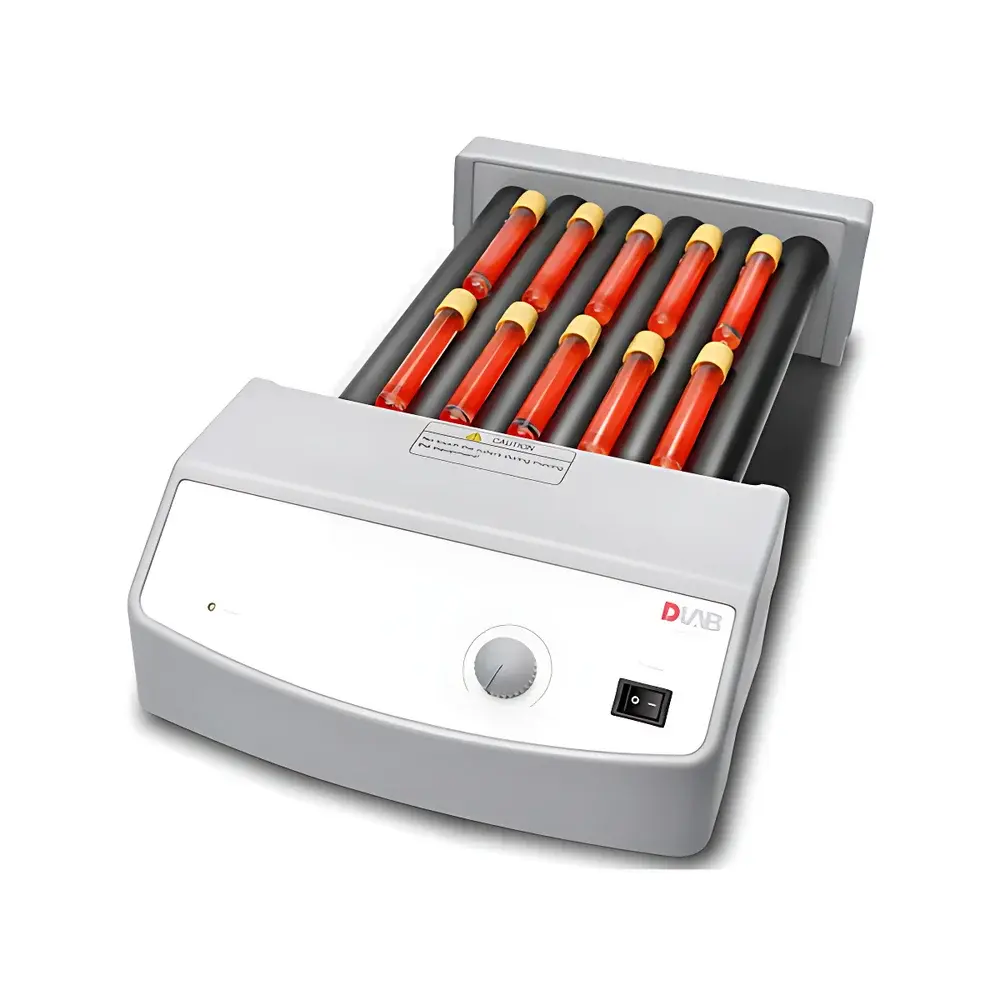
DLAB MX-T6-S Standard Rolling Mixer
| Brand | DLAB |
|---|---|
| Origin | Beijing, China |
| Manufacturer Type | Direct Manufacturer |
| Country of Origin | China |
| Model | MX-T6-S |
| Price | USD 395 (est.) |
| Speed Range | 0–70 rpm |
| Operation Mode | Continuously Adjustable Speed |
| Motion Type | Rolling + Rocking |
| Housing Material | ABS Plastic |
| Amplitude | 24 mm |
| Speed Indication | Analog Scale |
| Motor Type | DC Motor |
| Max Load Capacity | 4 kg |
| Number of Rollers | 6 |
| Roller Length | 280 mm |
| Power Supply | 100–240 V, 50/60 Hz |
| Power Consumption | 25 W |
| Dimensions (L×W×H) | 450 × 260 × 120 mm |
| Net Weight | 4.5 kg |
| Operating Environment | 5–40 °C, ≤80% RH |
| Ingress Protection Rating | IP21 |
Overview
The DLAB MX-T6-S Standard Rolling Mixer is an engineered laboratory mixing device designed for gentle, uniform, and reproducible agitation of low- to medium-viscosity samples requiring extended incubation-compatible motion. Unlike vortex or orbital shakers, the MX-T6-S employs a dual-axis mechanical motion—simultaneous rolling and rocking—based on eccentric cam-driven roller rotation. This kinematic configuration generates controlled orbital displacement with a fixed 24 mm amplitude, minimizing shear stress while ensuring thorough homogenization of sediment-prone or density-stratified suspensions. Its application scope aligns with protocols demanding non-turbulent mixing, including anticoagulant-treated blood sample maintenance, antibody-antigen binding in immunoprecipitation workflows, reagent resuspension prior to ELISA or Western blotting, and cell culture media equilibration. The device operates continuously under ambient lab conditions (5–40 °C, ≤80% RH) and complies with basic electrical safety standards per IEC 61010-1, supported by its IP21-rated enclosure—providing protection against vertically falling solid objects and limited ingress of moisture.
Key Features
- Six independently mounted 280 mm-long rollers, spaced to accommodate standard 12–15 mm diameter test tubes, microcentrifuge tubes, and conical centrifuge tubes up to 50 mL volume
- Continuously adjustable speed control (0–70 rpm) via precision potentiometer, calibrated with analog scale for stable, drift-free operation without digital feedback loop dependency
- Dual-motion architecture combining longitudinal rolling (axial tube rotation) and lateral rocking (±12 mm horizontal oscillation), enhancing particle suspension efficiency without foaming or denaturation
- DC motor drive with thermal overload protection and low-noise brushless commutation—optimized for 24/7 unattended operation at constant speed settings
- Chemically resistant ABS housing with smooth, non-porous surfaces facilitating rapid wipe-down decontamination between runs; no crevices or threaded fasteners exposed to reagent splashes
- Universal input power supply (100–240 V, 50/60 Hz) enabling seamless deployment across global laboratory infrastructures without voltage converters
Sample Compatibility & Compliance
The MX-T6-S supports routine handling of biological, biochemical, and diagnostic specimens where mechanical integrity must be preserved: whole blood (EDTA/K₂EDTA tubes), serum/plasma aliquots, agarose gel slices during hybridization, magnetic bead suspensions in nucleic acid purification, and viscous polymer solutions (e.g., methylcellulose-based cell culture matrices). It meets general-purpose lab equipment requirements under ISO/IEC 17025-accredited environments when used as a sample preparation tool within validated SOPs. While not certified to GLP or GMP Annex 11 standards out-of-the-box, its analog speed control, absence of embedded software, and deterministic mechanical behavior simplify audit documentation for regulated QC/QA labs performing manual process verification.
Software & Data Management
The MX-T6-S operates without firmware, embedded controllers, or connectivity interfaces—eliminating cybersecurity risks, calibration drift from software updates, and validation overhead associated with electronic data capture. All operational parameters are set manually and remain invariant over time, supporting ALCOA+ principles (Attributable, Legible, Contemporaneous, Original, Accurate) in paper-based or LIMS-integrated workflows. Speed setting verification is performed visually via the engraved analog scale; no electronic logging or audit trail is generated—a design choice aligned with laboratories prioritizing simplicity, long-term reliability, and minimal regulatory burden for non-critical mixing steps.
Applications
- Maintenance of anticoagulated blood samples during transport or pre-analytical holding (preventing fibrin clot formation without hemolysis)
- Uniform dispersion of magnetic beads in immunoassay kits and automated extraction platforms
- Rehydration and homogenization of lyophilized reagents and enzyme conjugates
- Gentle agitation of tissue homogenates and organelle fractions to prevent aggregation
- Equilibration of pH-sensitive buffers and isotonic saline solutions prior to cell seeding
- Supporting CLIA-waived and CAP-accredited testing workflows where mixer qualification follows manufacturer-defined performance checks
FAQ
Is the MX-T6-S suitable for mixing high-viscosity samples such as glycerol-based stock solutions?
Yes—its dual-motion profile and 4 kg load capacity enable effective handling of viscosities up to ~500 mPa·s when using appropriately sized containers; however, optimal performance is observed below 200 mPa·s.
Can the unit be operated inside a cold room or incubator?
It is rated for operation between 5–40 °C and ≤80% RH; continuous use below 10 °C may affect motor torque response and ABS housing ductility—consult environmental validation data before installation in refrigerated enclosures.
Does the device support timer-based cycling (e.g., on/off intervals)?
No—the MX-T6-S provides only continuous rotation; external programmable timers or relay switches are required for intermittent operation.
What cleaning agents are compatible with the ABS housing?
70% ethanol, isopropanol, diluted sodium hypochlorite (≤0.5%), and neutral pH detergents; avoid chlorinated solvents, acetone, or strong alkalis which may craze the polymer surface.
Is roller alignment adjustable for custom tube diameters?
Roller spacing is fixed at factory specification; users should verify tube outer diameter compatibility (10–16 mm recommended) prior to loading.



