
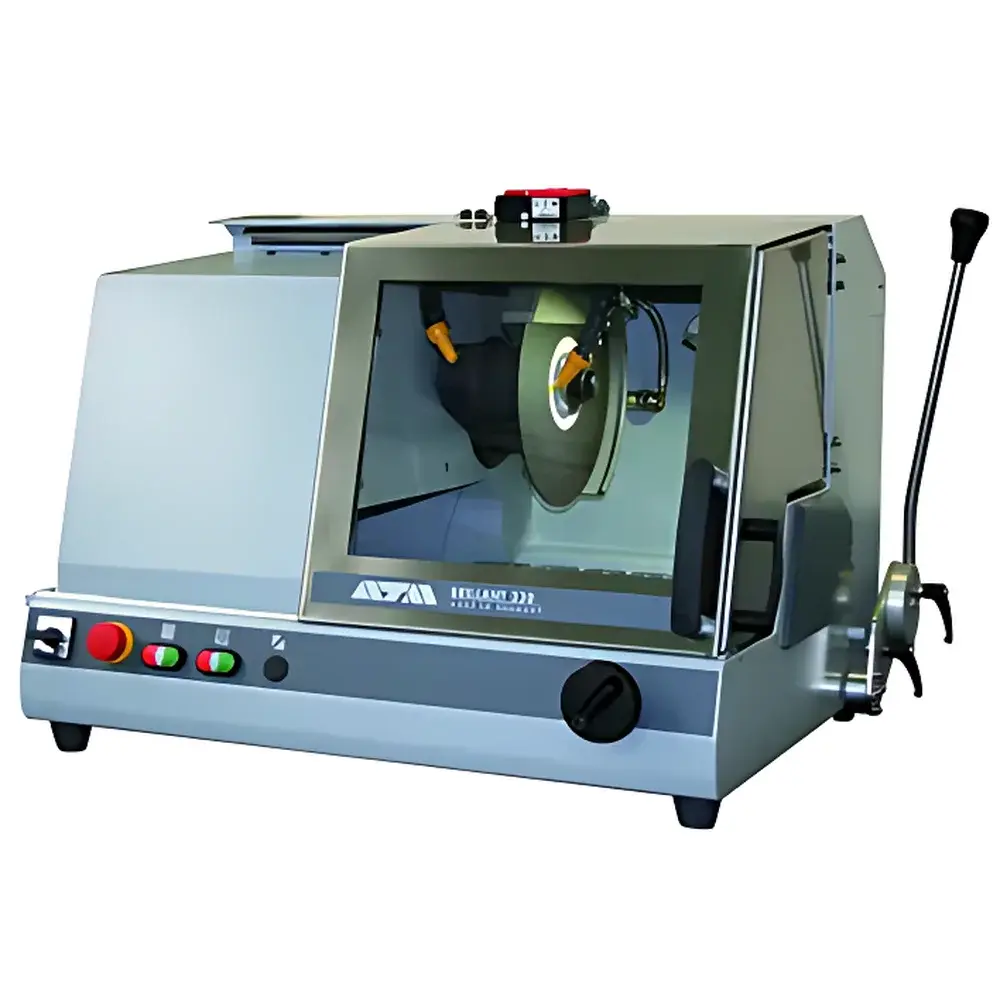
QATM Brillant 230 Manual Wet Abrasive Cutting Machine
| Brand | QATM |
|---|---|
| Origin | Germany |
| Model | Brillant 230 |
| Cutting Method | Wet abrasive wheel cutting |
| Max Sample Diameter | Ø110 mm |
| Z-axis Adjustment Resolution | 0.01 mm |
| Frame Material | Cast aluminum |
| Safety Features | Interlocked sliding front door and side doors |
| Illumination | Energy-efficient LED lighting in cutting chamber |
| Wheel Drive | Gear-controlled manual feed mechanism |
| Wear Protection | Replaceable wear ring on main spindle |
| Chamber Access | Dual-side openings (left & right) for extended workpieces |
| Clamping Options | Compatible with multiple standard sample holders |
Overview
The QATM Brillant 230 is a precision-engineered manual wet abrasive cutting machine designed for reliable, repeatable sectioning of metallic, ceramic, and composite specimens in metallurgical, materials science, and quality control laboratories. Operating on the principle of controlled mechanical abrasion using a rotating diamond- or silicon carbide-impregnated wheel under continuous coolant flow, the Brillant 230 ensures minimal thermal distortion and edge integrity—critical for subsequent microstructural analysis (e.g., optical microscopy, SEM, EBSD). Its rigid cast-aluminum frame provides high dimensional stability during operation, while the gear-driven manual feed system delivers consistent cutting force without vibration-induced deviations. Unlike motorized feed systems, this manually actuated architecture offers full operator tactile feedback and granular control over feed rate—particularly advantageous when sectioning brittle, heterogeneous, or heat-sensitive materials where abrupt force changes may induce cracking or delamination.
Key Features
- Manual gear-controlled Z-axis feed with fine-pitch adjustment enabling 0.01 mm incremental positioning—optimized for producing parallel thin sections for quantitative metallography.
- Spacious cutting chamber (W × D × H ≈ 320 × 300 × 250 mm) accommodates Ø110 mm maximum sample diameter and supports multi-angle clamping fixtures including V-blocks, adjustable angle chucks, and custom mandrels.
- Dual lateral access ports (left and right) permit longitudinal sectioning of elongated components such as rods, tubes, or extrusions without repositioning.
- Interlocked sliding front door and hinged side doors comply with EN ISO 13857 and EN 60204-1 safety standards; all doors disable wheel rotation when opened.
- Integrated energy-efficient LED lighting within the cutting chamber enhances visibility of specimen geometry and cut-line alignment without generating radiant heat.
- Main spindle incorporates a replaceable hardened steel wear ring to extend service life and maintain concentricity after prolonged abrasive loading.
- Coolant reservoir (capacity ~8 L) features level indicator, filter basket, and recirculation pump compatible with standard water-soluble coolants or ethanol-based fluids for non-ferrous applications.
Sample Compatibility & Compliance
The Brillant 230 is validated for sectioning a broad spectrum of engineering materials—including ferrous alloys (steels, cast irons), non-ferrous metals (Al, Cu, Ti, Mg), sintered carbides, technical ceramics (Al₂O₃, SiC), and polymer-matrix composites. Its wet-cutting configuration meets ASTM E3-22 requirements for metallographic specimen preparation and aligns with ISO 14971 risk management principles for laboratory equipment. The machine’s mechanical design adheres to CE marking directives (2006/42/EC Machinery Directive), and its electrical architecture conforms to IEC 61000-6-2/6-4 immunity and emission standards. No software-based data logging or electronic audit trail is embedded—making it suitable for GLP environments where manual procedural documentation suffices.
Software & Data Management
The Brillant 230 operates without embedded firmware or digital interface. All operational parameters—including feed rate, depth of cut, and coolant flow—are set and recorded manually via calibrated dials and physical log sheets. This analog architecture eliminates cybersecurity vulnerabilities and simplifies qualification under FDA 21 CFR Part 11 Annex 11 frameworks where electronic records are not required. Users maintain traceability through standardized lab notebooks referencing specimen ID, wheel type (e.g., “SiC 220#”, “Diamond 150#”), coolant composition, and final section thickness measurements taken with certified micrometers (e.g., Mitutoyo 293-831-30).
Applications
- Preparation of transverse/longitudinal sections from rolled, forged, or additive-manufactured components for grain size analysis per ASTM E112.
- Sectioning of coated systems (e.g., thermal barrier coatings, PVD layers) prior to cross-sectional SEM-EDS evaluation.
- Routine QC sampling in foundries and heat-treatment facilities requiring rapid, reproducible cuts for hardness testing (ASTM E10/E18).
- Failure analysis labs performing root-cause investigation on fractured turbine blades, bearing races, or weld joints.
- Academic research involving serial sectioning for 3D reconstruction of microstructures (e.g., dual-beam FIB-SEM correlation studies).
FAQ
What types of abrasive wheels are compatible with the Brillant 230?
Standard ISO 40/41 mounting flanges accept 230 mm diameter wheels with 32 mm arbor hole—commonly used configurations include resin-bonded SiC (for aluminum/copper), vitrified Al₂O₃ (for steels), and metal-bonded diamond (for carbides/ceramics). Wheel thickness must not exceed 3.2 mm.
Is coolant filtration integrated into the system?
Yes—the built-in reservoir includes a removable stainless-steel mesh filter basket (mesh size: 150 µm) positioned upstream of the recirculation pump to trap abrasive debris and prevent nozzle clogging.
Can the machine be adapted for automated feed via retrofit?
No. The Brillant 230 is exclusively a manual-feed platform. QATM offers the Brillant 300 series for motorized, programmable feed applications.
What maintenance intervals are recommended for daily use?
Daily: Clean chamber interior and inspect coolant level; weekly: Check gear train lubrication and tighten spindle locknuts; annually: Replace wear ring and verify spindle runout (< 0.02 mm TIR) using dial indicator.
Does the device support vacuum chucking or electrostatic sample holding?
No. Fixturing relies solely on mechanical clamping—standard accessories include three-jaw chucks, vise-type holders, and custom-machined adapters for irregular geometries.
Related Products



