
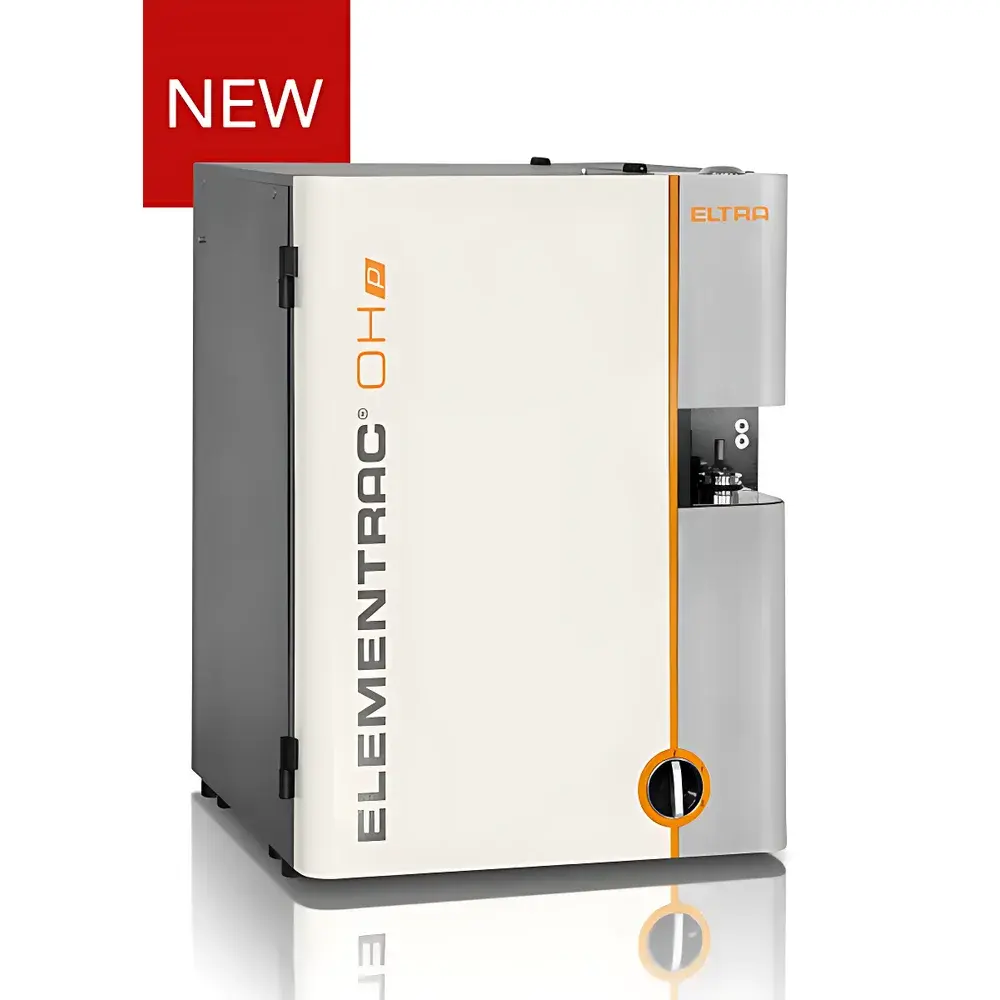
ELTRA ELEMENTRAC OH-p Oxygen and Hydrogen Analyzer
| Brand | ELTRA |
|---|---|
| Origin | Germany |
| Model | OH-p |
| Instrument Type | Oxygen/Hydrogen Analyzer |
| Analysis Range | Oxygen 0.1 ppm – 2.0 wt%, Hydrogen 0.01 ppm – 1000 ppm |
| Analysis Time | Oxygen 85 s, Hydrogen 100 s |
| Furnace Max Temperature | 3000 °C |
| Furnace Power | 8.5 kW |
| Detection Principle | Inert Gas Fusion Coupled with IR Absorption (O) and Thermal Conductivity Detection (H) |
| Sample Form | Solid, granular, or chip-shaped inorganic materials (e.g., metals, ceramics, refractories) |
| Calibration | Single-point and multi-point linear regression |
| Cooling Options | Tap water, recirculating chiller, or heat exchanger |
| Compliance Support | ASTM E1019, ISO 14284, ISO 22371, USP <232>/<233>, GLP/GMP-ready data audit trail |
Overview
The ELTRA ELEMENTRAC OH-p is a high-precision inert gas fusion analyzer engineered for the simultaneous quantitative determination of oxygen and hydrogen in solid inorganic materials. Operating on the principle of high-temperature pulse furnace fusion under ultra-pure inert carrier gas (typically helium or nitrogen), the OH-p thermally decomposes samples at up to 3000 °C—enabling complete liberation of interstitial and bound oxygen and hydrogen. Liberated oxygen reacts quantitatively with graphite crucible carbon to form CO, which is subsequently oxidized to CO₂ via Schütze reagent (copper oxide-based catalyst). The resulting CO₂ is measured by dual-path infrared absorption spectroscopy. Hydrogen, released as elemental H₂, is detected independently using two high-stability thermal conductivity detectors (TCDs) with optimized sensitivity and baseline stability. This dual-detection architecture ensures trace-level accuracy without cross-interference, supporting rigorous quality control and R&D applications across metallurgy, advanced ceramics, and refractory manufacturing.
Key Features
- Inert gas fusion system with programmable 8.5 kW pulse furnace, delivering stable temperatures up to 3000 °C for complete sample decomposition.
- Dual infrared detection cells (short- and long-path) automatically selected based on oxygen concentration—ensuring optimal signal-to-noise ratio across the full dynamic range (0.1 ppm to 2.0 wt%).
- Two dedicated high-sensitivity TCDs for hydrogen measurement, calibrated for sub-ppm detection (LOD ≤ 0.01 ppm) and robust against matrix-induced drift.
- Sealed, valve-controlled gas circuit with segmented leak-check functionality—minimizing atmospheric contamination and enhancing measurement reproducibility.
- Water-cooled sample introduction port isolates ambient gases during loading, preventing background O₂/H₂ ingress and improving blank stability.
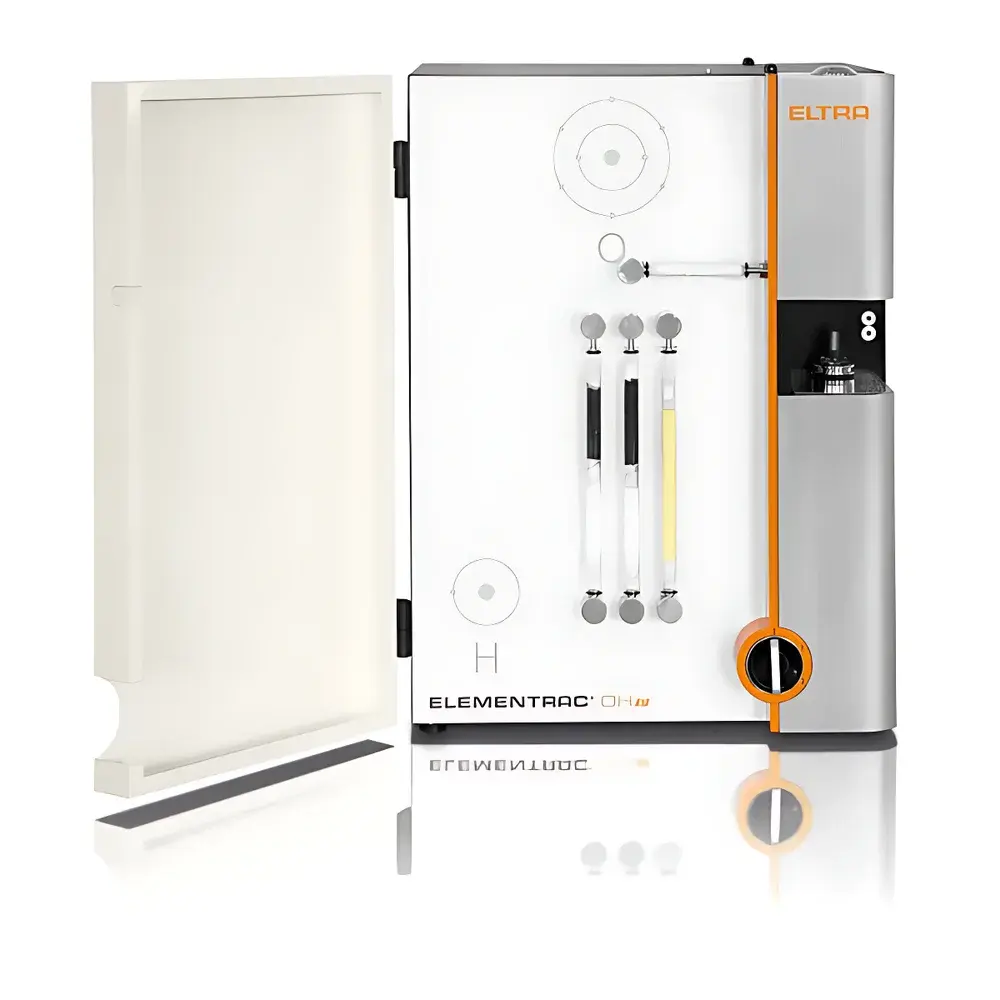
- Modular reagent and filter compartment concealed behind front-access door—facilitating rapid visual inspection, cleaning, and replacement without tooling or system shutdown.
- Flexible cooling interface compatible with tap water, recirculating chillers, or external heat exchangers—adapting to lab infrastructure constraints.
Sample Compatibility & Compliance
The OH-p accepts a broad spectrum of solid inorganic specimens—including ferrous and non-ferrous alloys (steels, cast iron, copper, titanium), refractory metals (molybdenum, tungsten, niobium), technical ceramics (Al₂O₃, SiC, ZrO₂), and sintered powders. Granular or chip-shaped samples require no encapsulation; only fine powders or reactive materials are placed in nickel baskets or capsules. The system supports ASTM E1019 (standard test methods for determination of oxygen, nitrogen, and hydrogen in steel and other alloys), ISO 14284 (steel—determination of oxygen content), and ISO 22371 (refractory products—determination of hydrogen). Data integrity aligns with FDA 21 CFR Part 11 requirements through secure user authentication, electronic signatures, and immutable audit trails—making it suitable for GLP and GMP-regulated environments.
Software & Data Management
ELEMENTRAC software provides full instrument control, real-time signal visualization (IR absorbance, TCD voltage, furnace temperature, gas flow), and automated result calculation. Each analysis stores raw detector outputs, calibration parameters, furnace profiles, and operator metadata in a relational database. Export options include CSV, PDF analytical reports, and XML-formatted data compliant with LIMS integration standards. The software supports customizable comment fields per analysis, batch reporting, statistical process control (SPC) charting, and multi-level calibration management—including single-point verification and multi-point linear regression with residual error assessment. All method files are password-protected and version-controlled.
Applications
- Quality assurance of low-oxygen specialty steels used in aerospace and nuclear components.
- Hydrogen embrittlement screening in high-strength fasteners and weld deposits.
- Oxygen content validation in titanium sponge and additive manufacturing feedstock powders.
- Process optimization of vacuum arc remelting (VAR) and electron beam melting (EBM) furnaces.
- Research into hydrogen storage materials and oxide ion conductors for solid oxide fuel cells.
- Trace oxygen monitoring in silicon carbide and alumina ceramics for semiconductor equipment components.
FAQ
What sample forms are compatible with the OH-p?
Solid metallic chips, granules, or powders—up to 1 g mass—can be directly loaded. Powders may require nickel containment; no capsule sealing is needed for most metal samples.
How does the OH-p eliminate background interference from furnace components?
Pre-fusion graphite crucible conditioning (inert gas purge + thermal soak) removes adsorbed moisture and residual carbon oxides prior to sample drop, minimizing system blank contributions.
Is method validation support available for regulated industries?
Yes—full IQ/OQ documentation templates, performance qualification protocols, and 21 CFR Part 11 compliance packages are provided with optional validation services.
Can the OH-p be integrated into an existing laboratory network?
It supports standard Ethernet TCP/IP communication, OPC UA compatibility, and direct SQL database access for seamless LIMS or MES connectivity.
What maintenance intervals are recommended for routine operation?
Dust filters and Schütze reagent tubes should be inspected every 50–100 analyses; full system leak checks and IR cell purging are advised quarterly or after major maintenance events.
Related Products




