
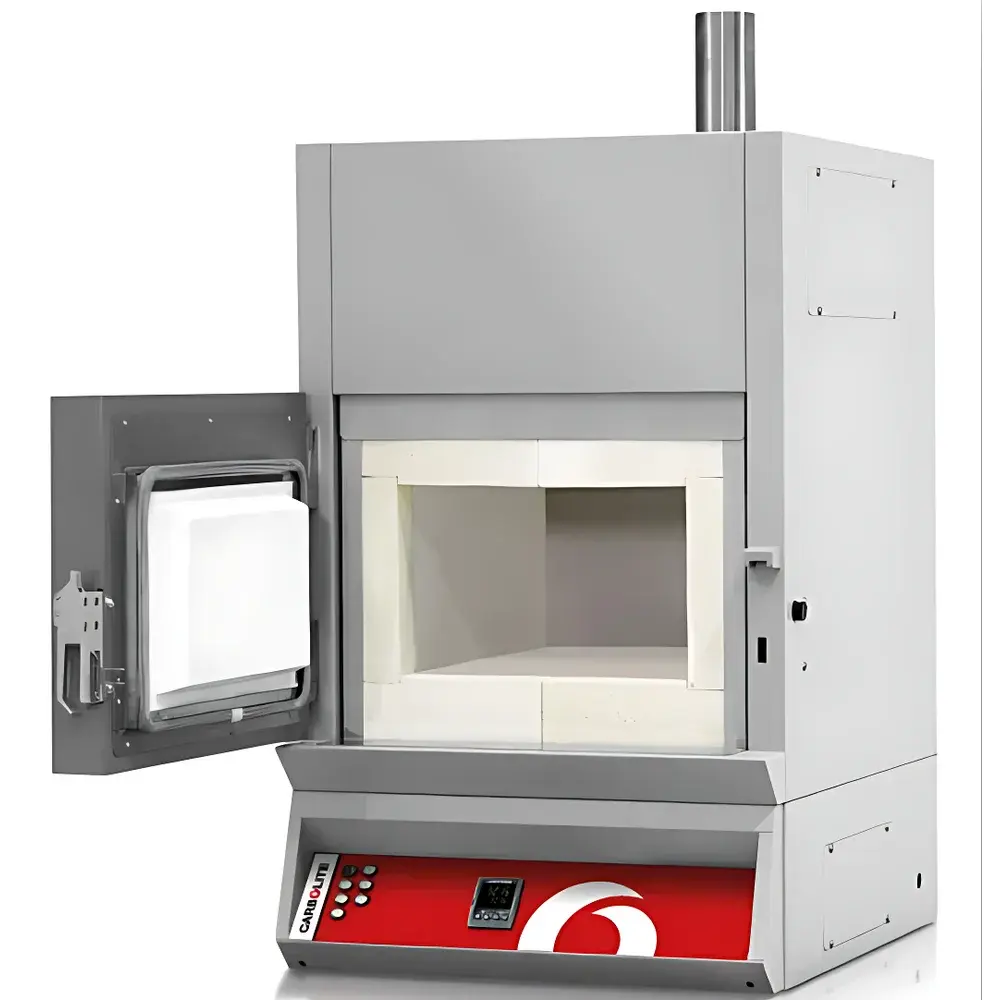
Carbolite Gero ABF 8/28 Dual-Combustion Ashing Furnace
| Brand | Carbolite Gero |
|---|---|
| Origin | United Kingdom |
| Model | ABF 8/28 |
| Type | Box-Type Muffle Furnace |
| Maximum Temperature | 800 °C |
| Auxiliary Combustion Zone Temperature | up to 950 °C |
| Chamber Volume | 28 L |
| Internal Dimensions | 210 × 290 × 445 mm |
| Temperature Control Accuracy | ±5 °C |
| Rated Power | 8000 W |
| Heating Element | Resistance Wire |
| Furnace Lining | Silicon Carbide (SiC) |
| Base Plate | Silicon Carbide |
| Standard Sample Support | Dual-tier wire mesh tray with clamps |
| Insulation Power Consumption at 500 °C | Measured |
| Max Carbon Load per Batch | 40 g |
| Compliance | CE, UKCA, IEC 61000-6-3, IEC 61000-6-4 |
Overview
The Carbolite Gero ABF 8/28 is a purpose-engineered dual-combustion ashing furnace designed for complete oxidative decomposition of organic-rich, high-smoke-generating samples—particularly biomass, foodstuffs, animal tissues, sewage sludge, and plant-derived feedstocks. Unlike conventional muffle furnaces, the ABF series integrates a primary ashing chamber and a secondary high-temperature combustion zone (up to 950 °C), ensuring thorough oxidation of volatile organic compounds and residual carbonaceous smoke before exhaust. This architecture eliminates soot deposition, minimizes chimney fouling, and delivers reproducible, low-residue ash yields compliant with standardized gravimetric methods (e.g., ISO 11885, ASTM D2974, EN 15403). The furnace operates under controlled airflow via an integrated fan-assisted exhaust system, maintaining laminar flow dynamics across the dual-zone thermal path and enabling reliable ash mass determination for elemental analysis (ICP-OES, AAS) and regulatory reporting.
Key Features
- Dual-zone thermal architecture: Primary ashing chamber (max 800 °C) + independent auxiliary combustion zone (up to 950 °C) for complete post-combustion of pyrolytic vapors
- Robust silicon carbide (SiC) furnace lining and base plate—resistant to thermal shock, acid condensates, and alkali corrosion common in biological ashing
- PID 3216P1 programmable controller with ramp-soak profiles, real-time temperature logging, and user-defined safety limits
- Large 28 L working volume (210 × 290 × 445 mm internal dimensions) supporting high-throughput batch processing
- Dual-tier stainless steel sample trays with adjustable clamps—optimized for uniform heat distribution and cross-sectional airflow
- Fan-assisted exhaust system with calibrated draft control ensures consistent residence time in the secondary combustion zone
- Maximum batch carbon load limited to 40 g—engineered to maintain stoichiometric air-to-fuel ratio and prevent incomplete oxidation
- CE and UKCA marked; conforms to electromagnetic compatibility standards IEC 61000-6-3 (emission) and IEC 61000-6-4 (immunity)
Sample Compatibility & Compliance
The ABF 8/28 is validated for use with heterogeneous, high-volatiles matrices requiring clean ash residue—especially where regulatory compliance mandates trace-level accuracy. It meets procedural requirements for ash content determination per ISO 2171 (cereals), AOAC 942.05 (animal feed), and USP (pharmaceutical residual ash). Its SiC construction resists degradation from chloride-, phosphate-, or sulfate-laden samples, extending service life under GLP/GMP environments. Optional over-temperature protection (hardware-based cut-off at 850 °C) supports unattended overnight operation while preserving sample integrity and instrument longevity. All electrical interfaces comply with IEC 61010-1 for laboratory equipment safety.
Software & Data Management
While the ABF 8/28 operates via its embedded PID 3216P1 controller, it supports analog output (0–10 V or 4–20 mA) for integration into centralized lab monitoring systems (e.g., LabWare LIMS, Siemens Desigo CC). Temperature profiles, hold times, and alarm events are timestamped and stored onboard for audit-ready traceability. When paired with optional data loggers or PLC gateways, the furnace satisfies FDA 21 CFR Part 11 requirements for electronic records—including user authentication, audit trails, and non-erasable event logs. Firmware updates are performed via USB interface with version-controlled release notes.
Applications
- Preparation of ash for elemental analysis (ICP-MS, XRF, AAS) in environmental soil testing and wastewater sludge characterization
- AOAC-compliant ash determination in agricultural commodities, dairy products, and pet food formulations
- Residual ash quantification in pharmaceutical excipients and active pharmaceutical ingredients (APIs)
- Thermal pre-treatment of biomass prior to calorific value assessment (ASTM D5865)
- Carbon black and polymer filler residue analysis in rubber and plastics R&D
- Validation of incineration efficiency in waste-to-energy pilot studies
FAQ
What is the maximum recommended organic carbon load per cycle?
The ABF 8/28 is rated for a maximum of 40 g total carbon per batch to ensure complete oxidation and avoid smoke carryover.
Can the auxiliary combustion zone operate independently of the main chamber?
No—the auxiliary zone activates only when the main chamber exceeds 400 °C and is thermally coupled to maintain stoichiometric afterburning.
Is the furnace compatible with three-phase power supply?
Yes; optional 400 V / 50 Hz three-phase configuration is available upon request to accommodate higher grid stability requirements.
Does the SiC lining require periodic replacement?
Under normal operation with non-corrosive samples, the SiC lining exhibits service life exceeding 5 years; replacement intervals depend on frequency of high-chloride ashing cycles.
How is temperature uniformity verified across the chamber?
Carbolite Gero provides factory calibration certificates (traceable to NPL standards) documenting ±3 °C uniformity at 500 °C across nine-point mapping per IEC 60068-3-5.



