
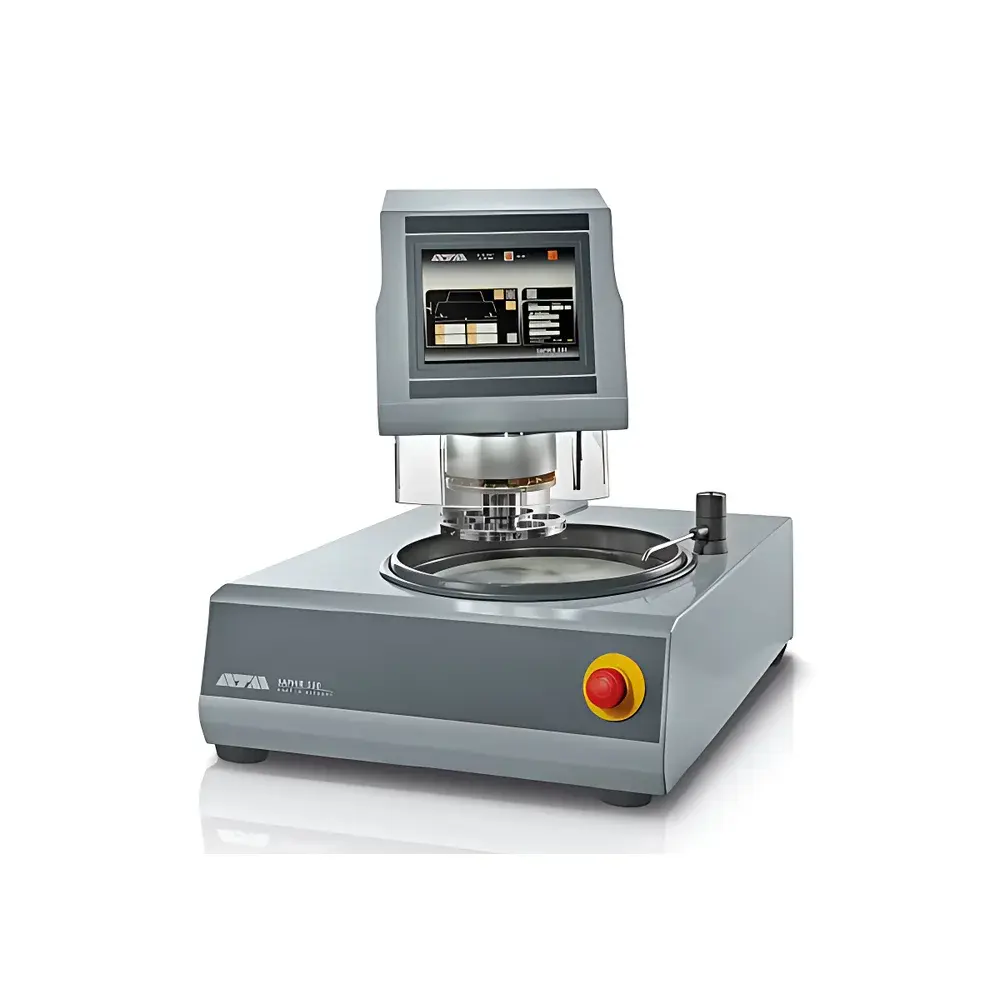
QATM Saphir 550 Automated Single-Station Metallographic Grinding and Polishing System
| Brand | QATM (formerly ATM) |
|---|---|
| Origin | Germany |
| Model | Saphir 550 (compatible with Rubin 520 grinding/polishing head) |
| Dimensions (L×W×D) | 560 × 550–650 × 660 mm |
| Number of Grinding/Polishing Plates | 1 |
| Plate Diameter | Ø 200–300 mm |
| Main Plate Speed | 50–600 rpm |
| Rubin 520 Head Speed | 30–150 rpm |
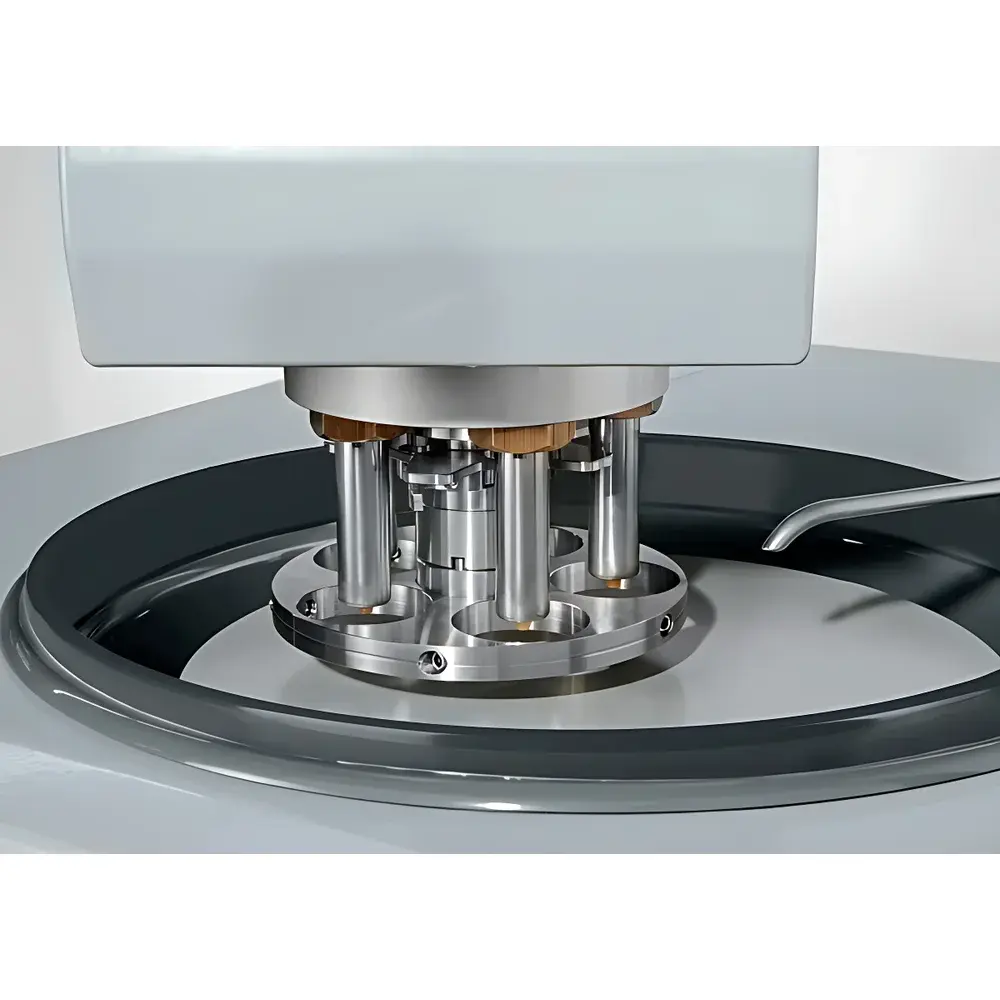
| Sample Capacity (per cycle, single-point loading) | 1–6 specimens (up to Ø 50 mm) |
| Single-Point Load Range | 5–100 N |
| Central Load Range | 20–400 N |
| Power Supply | 3.2 kVA |
| Base Unit Power Consumption (S6/40% duty cycle) | 0.75 kW |
| Rubin Head Power Consumption (S1 continuous) | 0.17 kW |
| Operating Water Pressure | ≤ 6 bar (R½" inlet) |
| Weight | ~85 kg |
| Precision Material Removal Control | ±0.1 mm depth resolution |
Overview
The QATM Saphir 550 is a precision-engineered, fully automated single-station metallographic grinding and polishing system designed for laboratories requiring high reproducibility, operator safety, and strict compliance with metallurgical sample preparation standards. Built upon QATM’s legacy of German engineering excellence—and successor to the widely adopted Rubin series—the Saphir 550 integrates the Rubin 520 intelligent grinding/polishing head to deliver controlled, repeatable material removal across diverse metallic, ceramic, and composite specimens. Its operational principle relies on synchronized rotational kinematics between the motor-driven grinding/polishing plate and the independently driven, programmable specimen holder head, enabling precise control over normal force distribution, shear stress application, and thermal management during sequential abrasive stages. This architecture ensures uniform planarization and minimizes relief artifacts—critical for subsequent microstructural analysis via optical microscopy, SEM, or EBSD.
Key Features
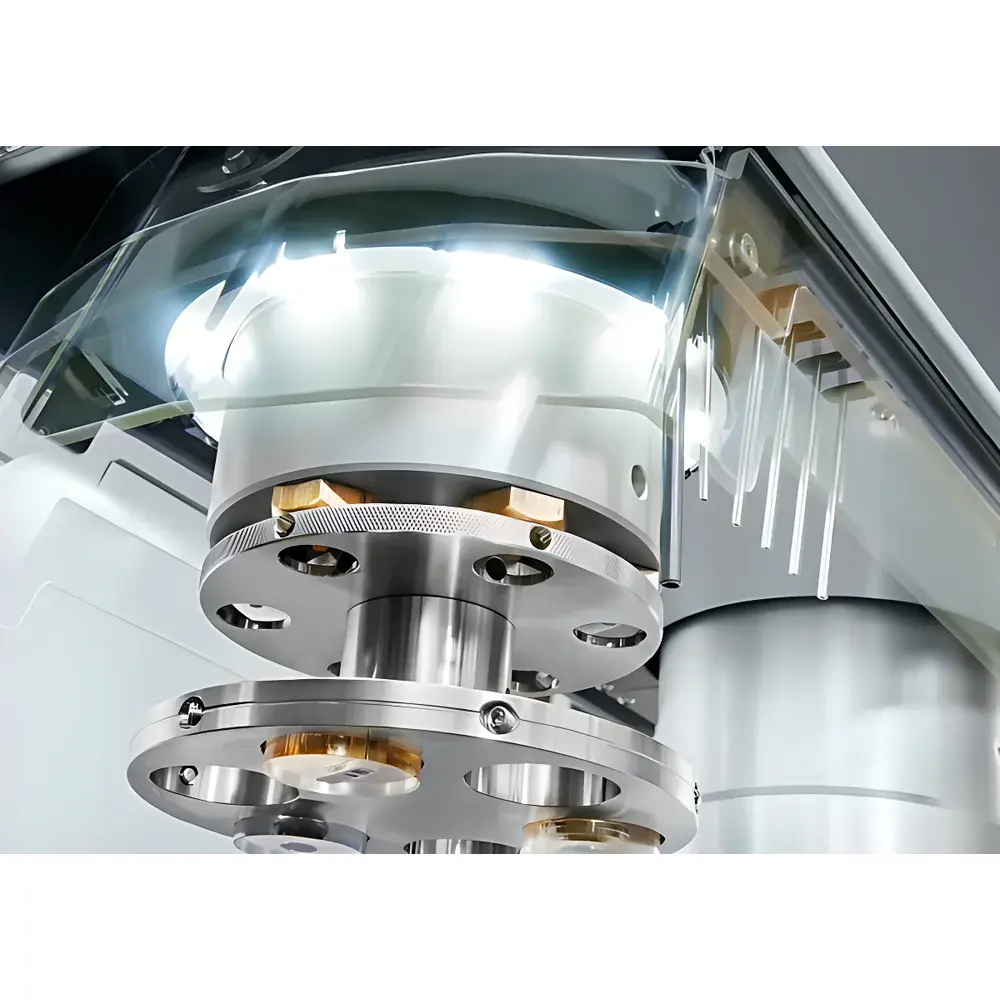
- Automated Rubin 520 grinding/polishing head with dual-direction (clockwise & counterclockwise) rotation capability and real-time speed adjustment (30–150 rpm)
- Single-plate configuration with interchangeable Ø 200–300 mm grinding/polishing discs, optimized for standard ISO/ASTM metallographic protocols
- Independent digital control of main plate speed (50–600 rpm) and head speed, enabling fine-tuned shear rate modulation per abrasive step
- Programmable load application: selectable single-point (5–100 N) or central loading (20–400 N), supporting simultaneous processing of up to six Ø 50 mm specimens with consistent pressure distribution
- Integrated automatic liquid dosing system with programmable flow timing and volume, compatible with water, lubricants, and colloidal silica suspensions
- Precision depth-controlled grinding: pre-set material removal depth (±0.1 mm resolution) with automatic termination upon reaching target thickness—essential for cross-sectional analysis and coating thickness measurement
- Motorized height and lateral position memory for rapid repositioning between programs; touchscreen HMI supports intuitive program creation, editing, and secure storage of >100 user-defined methods
- Full-spectrum LED illumination with glare-free coverage of the entire working area; motorized safety guard with interlocked stop function compliant with EN ISO 13857 and EN 60204-1
Sample Compatibility & Compliance
The Saphir 550 accommodates a broad spectrum of conductive and non-conductive materials—including ferrous and non-ferrous alloys, sintered metals, hardmetals, ceramics, and polymer composites—without mechanical modification. Its modular specimen holders support standard metallographic mounts (thermosetting resins, cold-mount epoxies) and custom fixtures. All operational parameters—including speed, load, dwell time, coolant delivery, and depth targets—are fully traceable and auditable, supporting GLP/GMP workflows and regulatory readiness for ISO/IEC 17025-accredited labs. The system complies with CE marking requirements, electromagnetic compatibility (EN 61326-1), and functional safety standards (EN ISO 13849-1, PL e). Optional audit trail logging and electronic signature modules align with FDA 21 CFR Part 11 requirements for regulated environments.
Software & Data Management
The embedded QATM TouchControl™ interface provides a dedicated, password-protected environment for method development, execution, and documentation. Each stored program includes metadata (operator ID, date/time stamp, version history), parameter logs (actual vs. setpoint values for speed, load, depth, fluid volume), and event timestamps (start/stop, emergency stops, guard actuation). Export functionality supports CSV and PDF report generation for integration into LIMS or ELN platforms. Firmware updates are delivered via encrypted USB key or network connection, maintaining full backward compatibility and version control. No cloud dependency or external subscription is required—ensuring data sovereignty and uninterrupted operation in air-gapped facilities.
Applications
- Routine quality control of heat-treated steels, aluminum castings, and titanium aerospace components
- Preparation of failure analysis samples from fractured surfaces, weld zones, and fatigue crack tips
- Standardized cross-sectioning of PCBs, solder joints, and thin-film coatings for layer thickness quantification
- High-precision sectioning of geological core samples and archaeological metal artifacts
- Development and validation of new abrasive media and lubricant formulations under controlled shear conditions
- Teaching laboratories requiring robust, repeatable demonstrations of ASTM E3, ISO 16071, and EN 10365 metallographic protocols
FAQ
What standards does the Saphir 550 support for metallographic sample preparation?
It is engineered to comply with ASTM E3, ISO 16071, EN 10365, and DIN 50018, with programmable parameters aligned to stage-specific requirements for grinding, rough polishing, and final polishing.
Can the Rubin 520 head be retrofitted onto older QATM systems?
The Rubin 520 head is mechanically and electronically compatible only with Saphir-series platforms (Saphir 550, Saphir 650); retrofitting to pre-Saphir models is not supported due to revised bus architecture and firmware dependencies.
Is remote monitoring or diagnostics available?
Yes—via optional Ethernet interface and QATM RemoteService module, enabling secure remote firmware updates, diagnostic log retrieval, and live parameter monitoring (subject to local IT policy approval).
How is water consumption managed during extended polishing cycles?
The integrated water control valve operates in pulsed mode synchronized with rotation phase, reducing average flow by up to 40% versus continuous delivery while maintaining effective cooling and debris removal.
Does the system support automated multi-step sequences without manual intervention?
Yes—full unattended operation across up to six sequential steps (e.g., SiC grinding → diamond suspension polishing → colloidal silica final polish), including automatic head retraction, plate cleaning, and fluid switching.



