
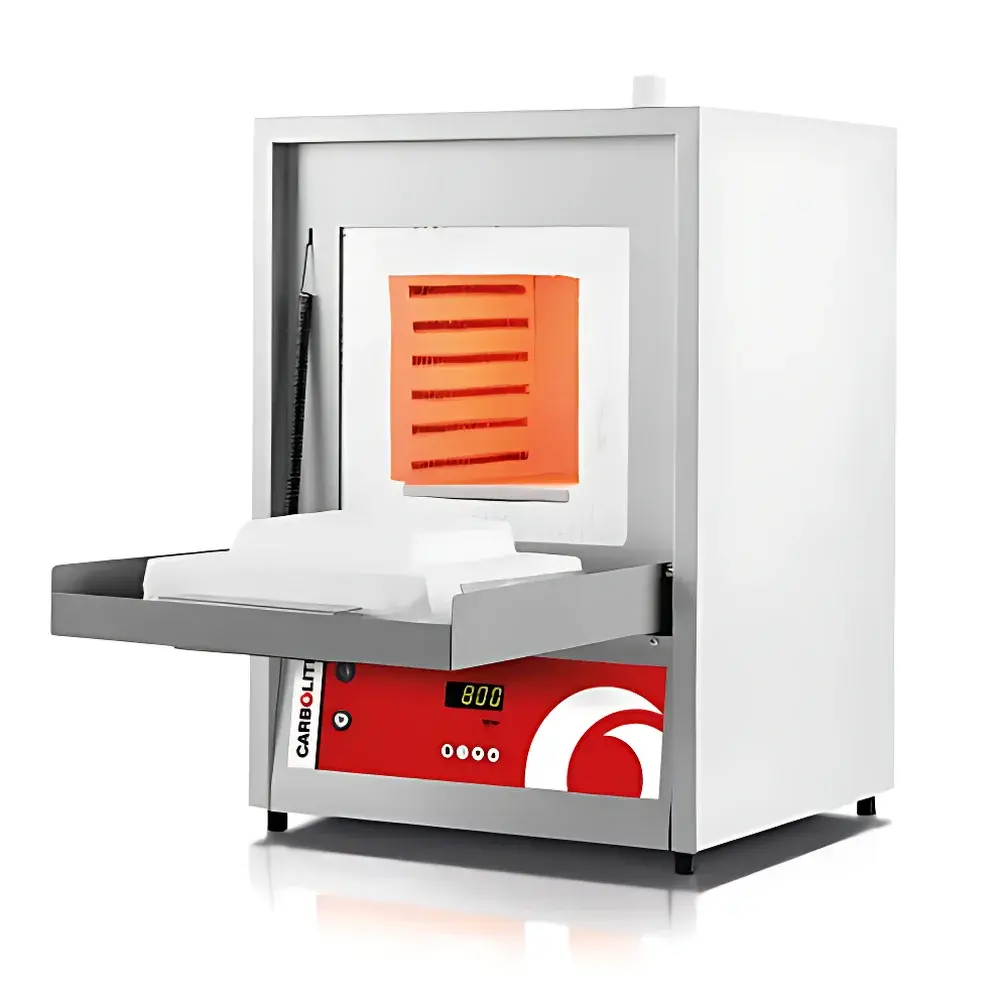
Carbolite Gero ELF 11/6B/301 Standard Muffle Furnace
| Brand | Carbolite Gero |
|---|---|
| Origin | United Kingdom |
| Model | ELF 11/6B/301 |
| Type | Box-Type Muffle Furnace |
| Max Temperature | 1100 °C |
| Temperature Uniformity | ±5 °C |
| Max Power | 2600 W |
| Ramp Time to Max Temp | 40 min |
| Heating Method | Resistance Wire (Radiant Spiral) |
| Internal Dimensions | 210 × 220 × 310 mm (L×W×H) |
| Chamber Volume | 14 L |
| Controller | PID 301 Single-Stage Programmable |
| Door Type | Top-Hinged Downward-Opening |
| Insulation | Vacuum-Formed Low-Mass Ceramic Fiber |
| Hearth Material | Rigid Alumina Ceramic |
| Exhaust | Top-Mounted Ceramic Chimney |
Overview
The Carbolite Gero ELF 11/6B/301 is a precision-engineered, benchtop box-type muffle furnace designed for routine thermal processing in academic, industrial, and quality control laboratories. Operating on the principle of radiant heat transfer via high-emissivity spiral resistance wire elements embedded in low-thermal-mass insulation, the ELF series delivers rapid thermal response, stable setpoint maintenance, and repeatable heating profiles across its full operating range up to 1100 °C. Its muffle architecture isolates samples from direct contact with heating elements and combustion byproducts—ensuring contamination-free thermal treatment essential for ashing, calcination, sintering, heat treatment of ceramics, and pre-conditioning of analytical substrates. Engineered for daily reliability rather than intermittent use, the ELF 11/6B/301 integrates structural robustness with ergonomic access and passive thermal management—making it suitable for ISO/IEC 17025-compliant testing environments where procedural consistency and instrument traceability are mandatory.
Key Features
- High-efficiency radiant heating system using semi-recessed, full-surface spiral resistance wires mounted on both side walls—optimized for uniform temperature distribution and minimal thermal lag.
- Vacuum-formed ceramic fiber insulation (low heat capacity, low thermal conductivity) enabling rapid ramp rates (≤40 min to 1100 °C) and reduced standby energy consumption.
- Rigid alumina ceramic hearth rated for continuous service at 1100 °C—resistant to thermal shock, abrasion, and chemical attack from common inorganic residues.
- Downward-opening hinged door with air-circulation cooling channels—maintains external cabinet surface temperature below 50 °C during operation, improving operator safety and lab spatial efficiency.
- PID 301 single-stage programmable controller with digital setpoint input, real-time temperature display, over-temperature cut-off protection, and configurable delay start/timer functions (up to 99 h 59 min).
- Top-mounted ceramic chimney with standardized flange interface—compatible with optional fume extraction ducting or secondary scrubber systems when processing halogenated, sulfurous, or heavy-metal-containing samples.
Sample Compatibility & Compliance
The ELF 11/6B/301 accommodates standard crucibles (alumina, silica, platinum), ceramic boats, and small metal fixtures within its 14 L chamber (210 × 220 × 310 mm internal dimensions). It supports ASTM E1112 (ash content determination), ISO 1171 (determination of ash in coal and coke), and USP (residue on ignition). While not certified for Class I Div 1 hazardous locations, its fully insulated enclosure and fail-safe thermal cutoffs meet EN 61000-6-3 (EMC) and EN 61000-6-4 emission standards. For GLP/GMP-regulated workflows, optional data logging modules support 21 CFR Part 11–compliant audit trails when paired with validated PC-based acquisition software.
Software & Data Management
The built-in PID 301 controller operates independently without external software; however, optional RS485/Modbus RTU interface enables integration into centralized lab monitoring systems (e.g., LabVantage, Thermo Fisher SampleManager). Third-party SCADA-compatible drivers allow real-time temperature logging, alarm event capture, and automated report generation—including timestamped ramp/soak/hold sequences. All configuration parameters are non-volatile and retained during power interruption. Firmware updates are performed via secure USB dongle under controlled change management protocols per ISO/IEC 17025 Clause 5.9.
Applications
- Ashing of biological tissues, foodstuffs, polymers, and environmental filter media per AOAC 942.05 and EPA Method 1631.
- Calcination of catalyst precursors, battery cathode materials (e.g., LiCoO₂), and metal oxides prior to XRD or BET analysis.
- Heat treatment of metallurgical samples for grain structure stabilization before microhardness testing (ASTM E384).
- Pre-drying and conditioning of reference standards, filter papers, and weighing dishes in gravimetric analysis workflows.
- Thermal cycling validation of electronic component substrates and encapsulants under controlled inert or ambient atmospheres.
FAQ
What is the recommended maintenance interval for the ELF 11/6B/301?
Annual inspection of door gasket integrity, thermocouple calibration verification (using NIST-traceable reference), and visual assessment of heating element deformation is advised. Ceramic fiber insulation requires no scheduled replacement under normal usage.
Can the furnace operate under inert gas purge?
Yes—the unit features two 6 mm BSP threaded ports (one on rear wall, one on side) for controlled gas inlet/outlet; optional gas flow regulators and O₂ analyzers are available for nitrogen or argon atmosphere applications.
Is the PID 301 controller upgradeable to multi-segment programming?
No—this model is factory-configured for single-segment control only. Multi-step ramp/soak profiles require the higher-tier CWF or HTF series with integrated touchscreen controllers.
Does the furnace include a certificate of conformance?
Each unit ships with a UK-manufactured CoC listing serial number, test date, max temp verification (at 1100 °C), and compliance references to BS EN 60519-1 and IEC 61000-6-2.



