
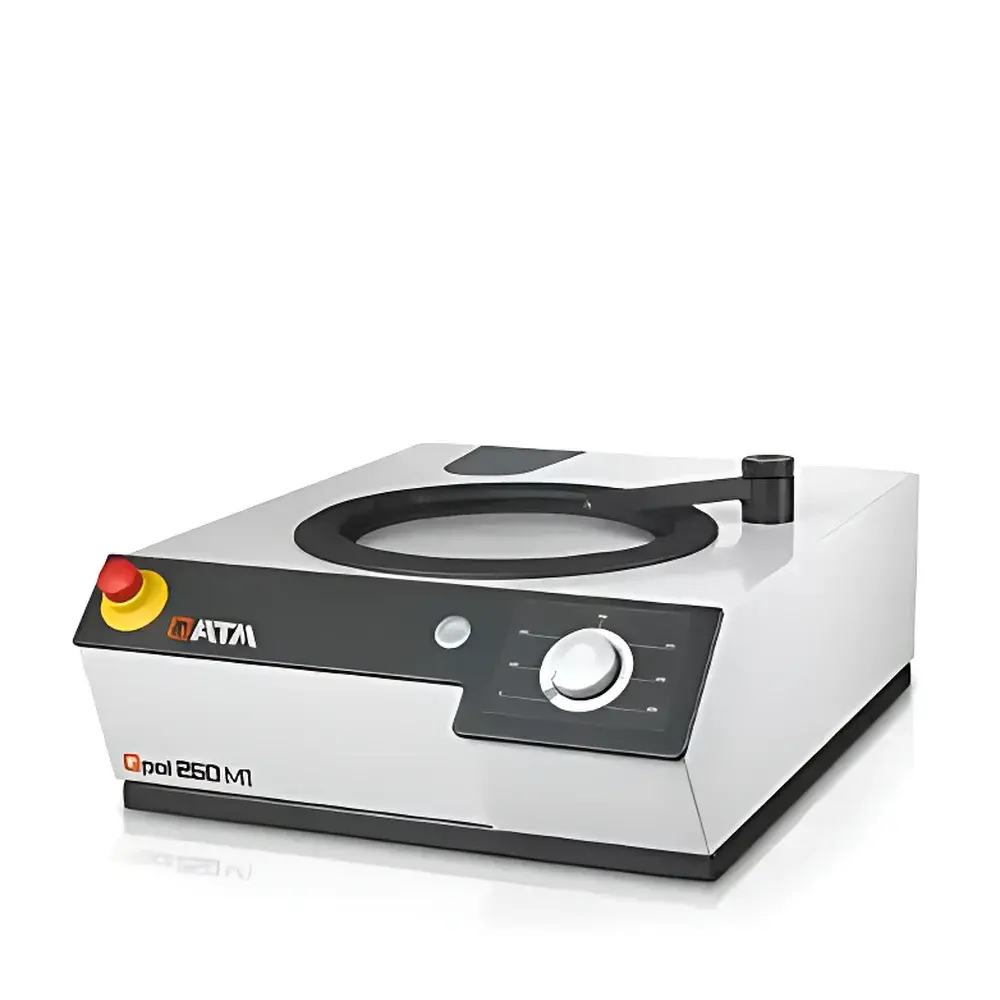
QATM Qpol 250 M1 Manual Single-Disc Grinding and Polishing Machine
| Brand | QATM |
|---|---|
| Origin | Germany |
| Model | Qpol 250 M1 |
| Speed Range | 30–600 rpm, continuously adjustable |
| Platen Diameter | Ø 200 / 250 mm |
| Number of Platens | 1 |
| Dimensions (L×W×D) | 511 × 265 × 710 mm |
| Power Supply | 1.0 kVA |
| Rated Output (S1 duty) | 0.55 kW |
| Weight | ~25–30 kg |
| Water Inlet | R½", max. 6 bar |
| Optional Dosing System | Qdoser GO or Qdoser ONE |
Overview
The QATM Qpol 250 M1 is a precision-engineered manual single-disc grinding and polishing machine designed for reproducible, high-fidelity metallographic sample preparation in research laboratories, quality control departments, and failure analysis facilities. Built upon the legacy of the Saphir 250 M1 platform, this instrument employs a robust direct-drive motor architecture to deliver stable rotational torque across its full speed range — from low-speed coarse grinding (30 rpm) to high-speed final polishing (600 rpm). Its core operational principle relies on controlled mechanical abrasion under consistent pressure and rotational dynamics, enabling precise material removal rates and surface finish uniformity. The machine supports both clockwise and counterclockwise platen rotation — a critical capability for optimizing abrasive action with different consumables (e.g., diamond-impregnated discs, alumina suspensions, or colloidal silica) and mitigating edge rounding or directional artifact formation. Designed and manufactured in Germany, the Qpol 250 M1 adheres to DIN EN ISO 9001-certified production protocols and integrates mechanical safety features compliant with EN 61000-6-2 (EMC) and EN 61000-6-4 (emission standards).
Key Features
- Manually operated single-platen system with intuitive start/stop switch featuring LED status indication
- Bi-directional platen rotation (clockwise and counterclockwise), selectable via calibrated toggle switch with integrated acceleration button
- Dedicated spin-dry function: automatic 3-second high-speed rotation at 750 rpm post-process to remove residual coolant and abrasive slurry from the platen surface
- High-stiffness aluminum housing with durable powder-coated finish; vibration-dampening plastic inner liner ensures acoustic performance <65 dB(A) at 1 m distance
- Ergonomic lift mechanism enables rapid, tool-free access to the lower reservoir basin for cleaning and maintenance
- Modular compatibility with QATM’s manual dosing systems — Qdoser GO (basic volumetric dispensing) or Qdoser ONE (programmable multi-step liquid delivery with flow monitoring)
- Integrated water inlet (R½” thread) supporting up to 6 bar supply pressure, compatible with standard laboratory plumbing infrastructure
Sample Compatibility & Compliance
The Qpol 250 M1 accommodates a broad spectrum of metallic, ceramic, and composite specimens — including ferrous and non-ferrous alloys, sintered carbides, electronic packaging substrates, and geological thin sections. Its Ø 200/250 mm interchangeable platen configuration allows adaptation to standard consumable formats used in ASTM E3, ISO 14487, and EN 10365-compliant preparation workflows. The machine meets essential requirements for GLP (Good Laboratory Practice) environments through traceable operational parameters (speed setting, direction, runtime), mechanical stability, and repeatable force application when paired with standardized holders (e.g., QATM Qholder series). While not inherently automated, its design supports audit-ready documentation when integrated into SOP-driven labs operating under ISO/IEC 17025 or IATF 16949 frameworks.
Software & Data Management
As a manually operated system, the Qpol 250 M1 does not incorporate embedded firmware or digital control interfaces. However, its mechanical repeatability and calibrated speed dial (±2 rpm accuracy) enable strict procedural adherence across operators and shifts. When used with Qdoser ONE, users may log dispensing events (volume, timing, fluid type) via external PC-based configuration software — generating CSV-exportable logs suitable for 21 CFR Part 11-compliant record retention when deployed with appropriate electronic signature controls. All mechanical adjustments — including platen leveling, height calibration, and dosing nozzle alignment — are documented in the included multilingual technical manual (EN/DE/FR/ES), which conforms to Annex II of the EU Machinery Directive 2006/42/EC.
Applications
- Preparation of cross-sections for optical microscopy (OM) and scanning electron microscopy (SEM) analysis
- Grinding and polishing of weld joints, heat-affected zones (HAZ), and coating interfaces in aerospace and automotive components
- Routine QC of casting porosity, inclusion distribution, and grain structure in foundry and metallurgical laboratories
- Failure analysis of fracture surfaces and fatigue cracks requiring artifact-free edge preservation
- Standardized specimen preparation for hardness testing (Vickers, Rockwell, Knoop) per ASTM E384 and ISO 6507
- Research-scale development of novel abrasive media and lubricant formulations
FAQ
Is the Qpol 250 M1 compatible with automated sample holders or robotic loading systems?
No — it is strictly a manual operation platform. Automation integration requires third-party robotic end-effectors and custom mounting fixtures, outside QATM’s validated scope.
Can the platen be changed between Ø 200 mm and Ø 250 mm without tools?
Yes — the quick-release clamping system permits tool-free platen exchange in under 90 seconds, with built-in centering pins ensuring concentric runout <0.05 mm.
What maintenance intervals are recommended for the drive motor and bearings?
QATM specifies 12-month inspection intervals for grease replenishment (Lithium complex NLGI #2) and belt tension verification (if applicable); no scheduled replacement is required within the first 10,000 operational hours.
Does the spin-dry function activate automatically, or must it be triggered manually?
It is manually initiated via a dedicated momentary push-button after process completion — no timer or sensor-based auto-triggering is implemented.
Is CE marking valid for use in North America?
CE marking confirms compliance with EU directives only. For U.S./Canada deployment, users must verify local acceptance of EN standards or obtain supplementary UL/cUL listing through authorized regional certification bodies.



