
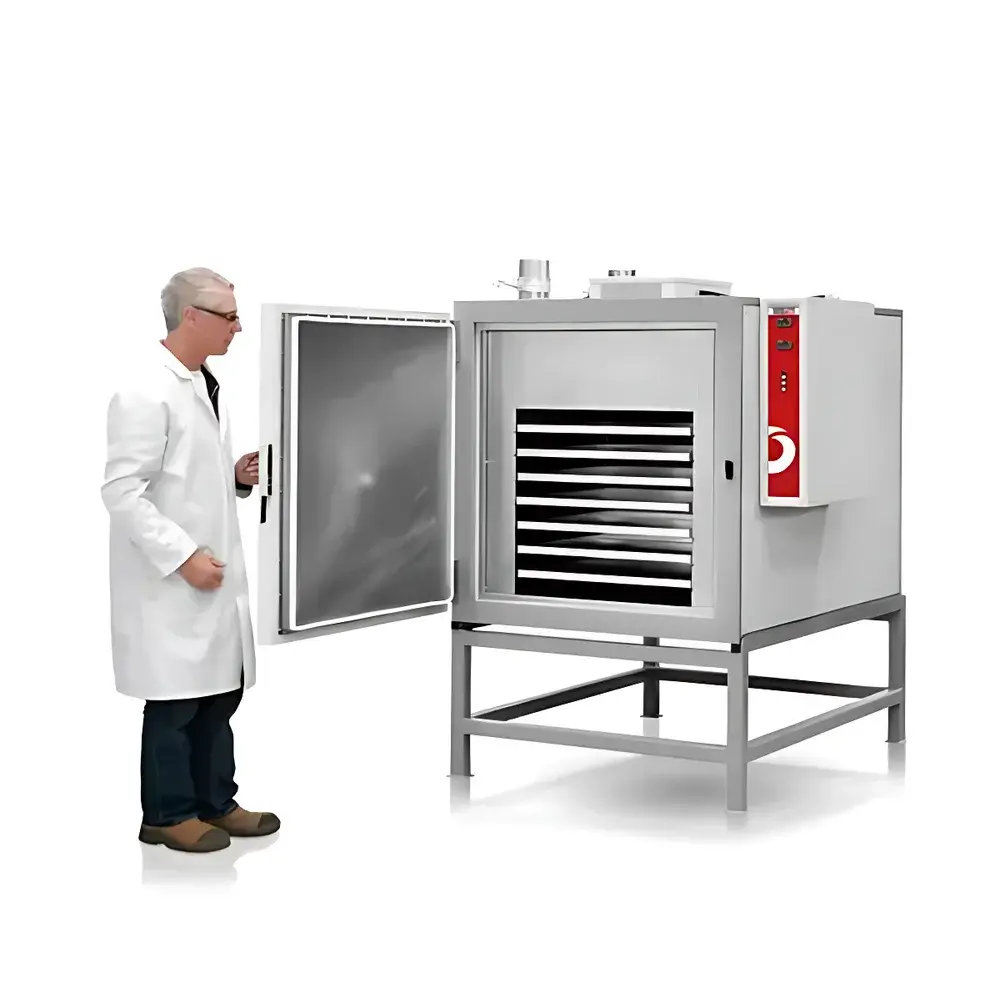
Carbolite Gero CD Series Coal Drying Ovens (CDLT & CDHT)
| Brand | Carbolite Gero |
|---|---|
| Origin | Germany |
| Model | CDLT / CDHT |
| Instrument Type | Precision Laboratory Drying Oven |
| Temperature Range | CDLT: Ambient to 50 °C |
| CDHT | Ambient +10 to 200 °C |
| Temperature Stability | ±1 °C |
| Temperature Uniformity | ±5 °C |
| Internal Dimensions (H×W×D) | 610 × 610 × 1220 mm |
| External Dimensions (H×W×D) | 1715 × 1345 × 1455 mm (incl. integral floor stand) |
| Chamber Volume | 454 L |
| Tray Configuration | 14 trays across 7 levels (2 per level) |
| Total Tray Surface Area | 5.0 m² |
| Heating Power | CDLT: 4500 W |
| CDHT | 9000 W |
| Supply Voltage | 380 V, 3-phase, 50/60 Hz |
| Controller | PID-based 132-series digital temperature controller with secondary overtemperature protection |
| Chamber & Air Duct Material | Corrosion-resistant AISI 304 stainless steel |
| Heating Element | Mineral-insulated metal-sheathed (MIMS) resistive elements |
| Airflow System | Horizontal high-velocity forced convection with pre-heated inlet air and dedicated exhaust for moisture removal |
| Compliance Standards | ASTM D2013/D2013M-12, ASTM D2691-01, ASTM D2961-11, ASTM D3302/D3302M-10, BS 1016-1:1973, BS 1016-102:2000, BS ISO 13909-1:2001, BS ISO 13909-2:2001 |
Overview
The Carbolite Gero CD Series comprises two purpose-engineered laboratory drying ovens—CDLT (Coal Drying Low Temperature) and CDHT (Coal Drying High Temperature)—designed exclusively for standardized coal moisture determination in accordance with internationally recognized test methods. These ovens operate on the principle of controlled forced-convection drying, where uniform airflow, precise thermal regulation, and material-specific temperature profiles ensure reproducible loss-on-drying (LOD) results. Unlike general-purpose ovens, the CD Series integrates metrological design features—including dual-stage temperature control, pre-heated air supply, and corrosion-resistant chamber architecture—to meet the stringent repeatability and traceability requirements of coal analysis laboratories operating under ASTM, BSI, and ISO regulatory frameworks.
Key Features
- Two dedicated configurations: CDLT for low-temperature drying (ambient to 50 °C) and CDHT for high-temperature applications (ambient +10 to 200 °C), each optimized for specific coal testing protocols.
- PID-based 132-series digital temperature controller with independent secondary overtemperature cut-off (setpoint adjustable), ensuring compliance with IEC 61000-4-2 and EN 60519-2 safety directives.
- Horizontal high-velocity airflow system engineered to deliver consistent air velocity across all 14 trays (arranged in 7 levels, two per shelf), minimizing stratification and maximizing moisture removal efficiency.
- Chamber and internal air ducts constructed from AISI 304 stainless steel—resistant to oxidation and acidic condensates formed during coal drying—ensuring long-term dimensional stability and contamination-free operation.
- Mineral-insulated metal-sheathed (MIMS) heating elements provide rapid thermal response, high mechanical durability, and resistance to thermal cycling fatigue over extended service life.
- Integrated floor-standing chassis eliminates need for external mounting or vibration isolation, while maintaining ergonomic access to tray loading zones and rear service panels.
Sample Compatibility & Compliance
The CD Series is validated for use with bituminous, anthracite, lignite, and washed coal samples as defined in ASTM D3302 (Standard Test Method for Moisture in the Analysis Sample of Coal and Coke), ASTM D2013/D2013M-12 (Standard Practice for Preparing Coal Samples for Analysis), and BS ISO 13909-1 & -2 (Hard Coal and Coke — Sampling). Each oven configuration satisfies the thermal performance criteria outlined in Clause 6.2 of ASTM D2961 (“Drying Oven Requirements”) and Clause 7.1 of BS 1016-102:2000 (“Specification for Drying Ovens for Coal”). The ±1 °C temperature stability and ±5 °C uniformity across the full working volume are verified per ISO/IEC 17025-accredited calibration procedures using NIST-traceable Class 1 platinum resistance thermometers.
Software & Data Management
While the CD Series operates via a standalone 132-series controller without embedded data logging, it supports full GLP/GMP-compliant recordkeeping through optional analog output (4–20 mA) and RS485 Modbus RTU interface. When integrated with validated laboratory information management systems (LIMS) or SCADA platforms, the oven enables time-stamped temperature trajectory capture, alarm event logging, and electronic audit trails compliant with FDA 21 CFR Part 11 requirements. All controller firmware updates and calibration certificates adhere to Carbolite Gero’s ISO 9001:2015 quality management system and are supplied with UKAS-accredited calibration documentation upon commissioning.
Applications
- Moisture content determination in coal preparation plants and third-party testing laboratories per ASTM, ISO, and BS methodologies.
- Pre-drying of coal samples prior to proximate analysis (ASTM D3172), ultimate analysis (ASTM D3176), or calorific value testing (ASTM D5865).
- Stabilization of reference coal samples for inter-laboratory proficiency testing programs administered by ISO/CEN/ASTM working groups.
- Controlled dehydration of mineralogically sensitive coal fractions where excessive thermal gradients could induce pyrolytic artifact formation.
- Validation of drying protocols in accredited environmental testing laboratories seeking ISO/IEC 17025 scope extension for solid fuel analysis.
FAQ
What distinguishes the CDLT from the CDHT model?
The CDLT is engineered for low-temperature drying (up to 50 °C) in accordance with ASTM D2013 and BS ISO 13909-1, while the CDHT supports higher drying temperatures (up to 200 °C) required by ASTM D2961 and BS 1016-102.
Is the oven suitable for non-coal materials?
Although designed specifically for coal, the CD Series may be used for other hygroscopic solids requiring controlled forced-convection drying—however, validation against relevant method-specific parameters (e.g., airflow rate, dwell time) is required prior to adoption.
Does the oven include factory calibration documentation?
Yes—each unit ships with a UKAS-accredited calibration certificate covering chamber uniformity, temperature stability, and controller accuracy at three points across the operational range.
Can the oven be connected to a central monitoring system?
Yes—via optional RS485 Modbus RTU or analog 4–20 mA outputs, enabling integration into existing plant-wide process control infrastructure.
What maintenance intervals are recommended?
Carbolite Gero recommends annual verification of airflow velocity profile, thermocouple calibration, and MIMS element resistance—procedures detailed in the OEM Maintenance Manual (Ref. CM-CD-REV4).



