
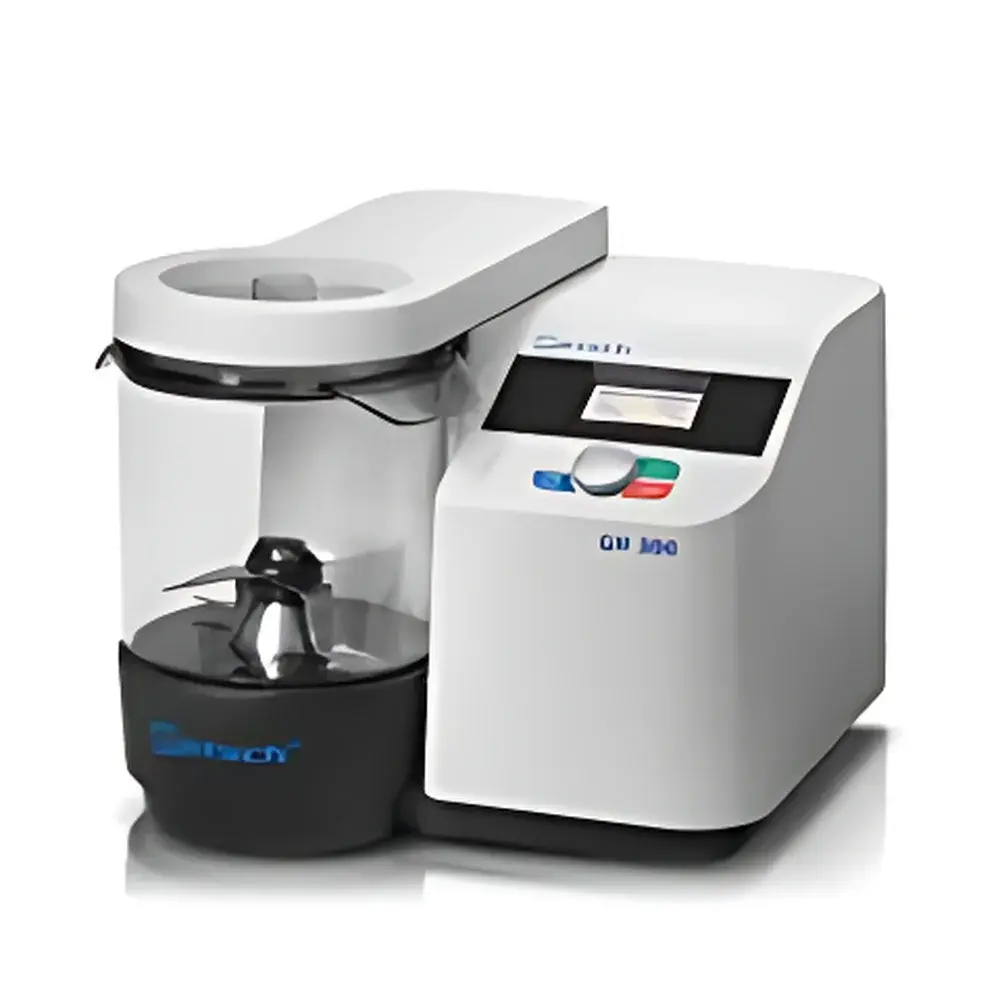
Retsch GM300 Expert Knife Mill
| Brand | Retsch |
|---|---|
| Origin | Germany |
| Model | GM300 |
| Motor Power | 1.1 kW continuous / >3 kW peak |
| Speed Range | 500–4000 rpm (100 rpm increments) |
| Grinding Chamber Volume | 5000 mL (reducible to 4000–4500 mL with gravity lid) |
| Max Feed Size | <130 mm |
| Final Particle Size | <300 µm |
| Batch Capacity | 4500 mL (with gravity lid) |
| Grinding Time | 5 s – 3 min (digital timer) |
| Compliance | CE, IP20 |
| Materials in Contact | Stainless steel 1.4034 blades, stainless steel 1.4435 container, PVDF knife holder, EPDM/FKM seals |
| Sterilization | Autoclavable components |
| Optional | Cryo-grinding kit with vented cryo-lid, dry ice compatibility |
| Programmable SOPs | 10 stored methods |
| Drive | Inverter-controlled three-phase AC motor |
| Dimensions (W×H×D) | 440 × 340 × 440 mm |
| Net Weight | ~30 kg |
Overview
The Retsch GM300 Expert Knife Mill is a high-performance, laboratory-scale cutting mill engineered for rapid, reproducible homogenization, comminution, and mixing of soft, elastic, fibrous, moist, fatty, or oily samples — particularly in food, agricultural, pharmaceutical, and biological laboratories. Operating on the principle of high-speed rotational shearing, the GM300 utilizes a precision-engineered stainless-steel knife rotor rotating within a large-volume grinding chamber to deliver controlled mechanical impact and cutting forces. Its robust 1.1 kW continuous-duty motor (with >3 kW short-term overload capacity) enables efficient size reduction of bulky specimens — including whole loaves of bread, intact pizzas, or large tissue sections — in a single run. Unlike domestic blenders or low-power mixers, the GM300 is designed for analytical rigor: its digitally adjustable speed (500–4000 rpm), programmable time control (5 s–3 min), and standardized grinding geometry ensure minimal inter-run variability and high repeatability — critical for QA/QC, method validation, and regulatory-compliant sample preparation.
Key Features
- Large 5000 mL grinding chamber with optional gravity lid to dynamically reduce effective volume (to 4000–4500 mL), enabling precise adaptation to batch size without compromising homogeneity.
- High-torque, inverter-controlled three-phase AC motor delivering consistent rotational energy across the full speed range (500–4000 rpm in 100 rpm steps).
- Autoclavable wetted parts: knife rotor (1.4034 stainless steel), grinding vessel (1.4435 stainless steel), knife holder (PVDF), and chemically resistant seals (EPDM and FKM).
- Digital interface with real-time display of speed, time, and active SOP; supports storage of up to 10 user-defined standard operating procedures.
- Cryo-grinding capability via dedicated vented cryo-lid and compatible stainless-steel vessel — enabling safe, efficient pulverization of tough, elastic, or thermolabile materials using dry ice.
- Intermittent drive mode for controlled pre-crushing of heterogeneous or layered samples prior to final homogenization.
- IP20-rated enclosure and CE-compliant electrical architecture suitable for standard laboratory environments.
Sample Compatibility & Compliance
The GM300 accommodates a broad spectrum of sample types: soft tissues, cheese, fruits, grains, herbs, polymers, rubber, and composite biomaterials — provided maximum feed dimensions remain under 130 mm. Its design meets essential requirements for Good Laboratory Practice (GLP) and supports traceable, auditable workflows when paired with documented SOPs. All contact surfaces comply with FDA-relevant material standards for food and pharmaceutical applications. The instrument’s mechanical consistency and programmability facilitate alignment with ISO 5725 (accuracy and precision of measurement methods) and ASTM D297 (rubber testing protocols). For regulated environments, data integrity is reinforced through non-volatile SOP storage and deterministic process parameters — foundational for 21 CFR Part 11 readiness when integrated into validated LIMS or ELN ecosystems.
Software & Data Management
While the GM300 operates via an embedded digital control panel (no external PC required), its parameter-driven architecture supports integration into centralized laboratory informatics systems. Each stored SOP includes speed, duration, and cycle configuration — enabling version-controlled method deployment across instruments. Timestamped operation logs (when externally recorded) support audit trails for GLP/GMP compliance. No proprietary software is required; however, lab managers may export SOP configurations manually for inclusion in electronic batch records or quality documentation systems. The absence of cloud connectivity or firmware-updatable logic ensures long-term operational stability and reduces cybersecurity exposure — a key consideration for regulated QC labs.
Applications
- Food safety testing: Homogenization of heterogeneous food matrices (e.g., meat products, dairy, baked goods) prior to microbiological, mycotoxin, or allergen analysis.
- Agricultural research: Preparation of plant tissues, seeds, and forage samples for NIR calibration, nutrient profiling, or DNA extraction.
- Pharmaceutical development: Blending of excipients and active ingredients at lab scale; comminution of soft dosage forms for dissolution testing.
- Biomonitoring: Rapid stabilization and particle-size control of environmental biosamples (e.g., algae, insect larvae, soil fauna) prior to molecular or elemental analysis.
- Cryo-milling of elastomers, gels, or lipid-rich tissues where thermal degradation must be avoided during size reduction.
FAQ
Can the GM300 process frozen or cryogenically cooled samples?
Yes — with the optional cryo-grinding kit (vented cryo-lid, stainless-steel vessel, and compatible blade assembly), the GM300 safely handles dry ice-cooled samples to prevent thermal degradation during milling.
Is the grinding chamber volume fixed or adjustable?
The nominal chamber volume is 5000 mL, but it is effectively reduced to 4000–4500 mL when using the gravity lid — optimizing energy transfer and homogeneity for smaller batches.
Are all wetted parts autoclavable?
Yes: the stainless-steel grinding vessel, rotor, PVDF knife holder, and EPDM/FKM seals are rated for standard autoclave cycles (121 °C, 2 bar, 20 min).
What is the smallest achievable particle size?
Under optimized conditions (e.g., extended runtime, high speed, cryo-assisted grinding), the GM300 consistently achieves final particle sizes below 300 µm — verified by sieve analysis or laser diffraction.
Does the GM300 support regulatory compliance for pharmaceutical QA?
Its deterministic operation, SOP storage, and autoclavable construction support alignment with USP <1118>, ICH Q5C, and internal GMP validation protocols — though formal qualification remains the user’s responsibility.



