
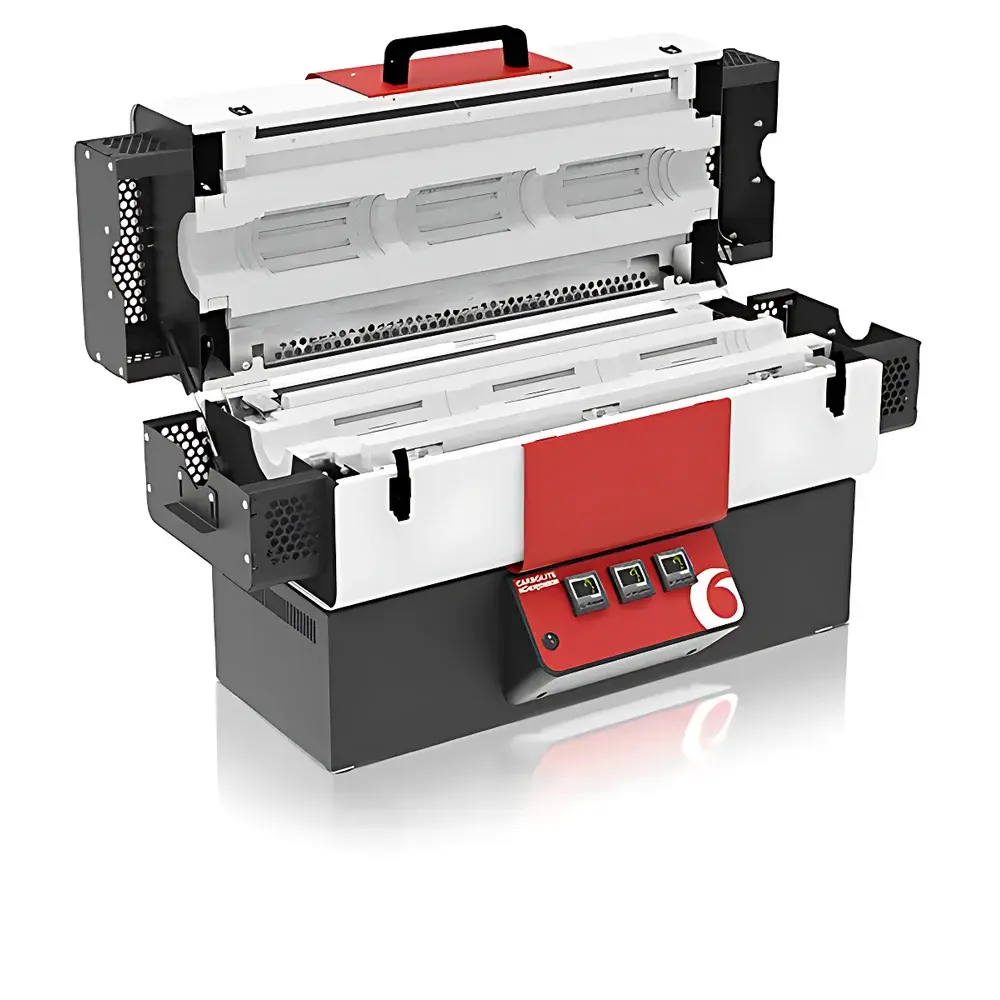
Carbolite Gero TG3 12/60/600 Gradient Tube Furnace
| Brand | Carbolite Gero |
|---|---|
| Origin | UK |
| Model | TG3 12/60/600 |
| Instrument Type | Gradient Tube Furnace |
| Max Temperature | 1200 °C |
| Temperature Control Accuracy | ±1 °C |
| Max Power | 2000 W |
| Heating Method | Resistive Wire Heating |
| Total Heated Length | 600 mm |
| Number of Independent Heating Zones | 3 |
| Zone Length per Section | 150 mm |
| Non-Heated Spacer Length (between zones) | 75 mm |
| Internal Tube Max OD | Not Specified |
| Controller | EPC3016P1 (24-segment programmable, per zone) |
| Over-Temperature Protection | Per Zone |
| Communication Interface | RS485 (optional) |
| Cooling | Forced-air assisted (standard), optional water-cooled flanges available |
Overview
The Carbolite Gero TG3 12/60/600 Gradient Tube Furnace is a precision-engineered thermal platform designed for applications requiring controlled axial temperature gradients across a single work tube. Unlike conventional uniform-temperature tube furnaces, the TG3 employs three independently controlled heating zones—each with dedicated resistive wire windings embedded in vacuum-formed high-purity ceramic fiber insulation—to generate stable, reproducible thermal profiles along the 600 mm heated length. This architecture enables users to establish linear, stepwise, or custom-defined temperature distributions (e.g., 600 °C → 900 °C → 1100 °C) within a single quartz, alumina, or silicon carbide work tube. The furnace operates on fundamental principles of conductive and radiative heat transfer, with thermal decoupling between zones achieved via 75 mm non-heated spacer sections and integrated ceramic insulating baffles—minimizing inter-zone conduction and ensuring gradient fidelity. It is widely deployed in materials synthesis (e.g., zone refining, crystal growth, CVD precursor decomposition), catalyst screening under thermal gradients, and solid-state reaction kinetics studies where spatially resolved thermal exposure is critical.
Key Features
- Three independent heating zones (150 mm each), precisely regulated by individual Carbolite Gero EPC3016P1 controllers with 24-segment programmable ramp-soak profiles
- ±1 °C temperature stability and uniformity within each zone at steady state (measured per ASTM E220-22 calibration methodology)
- Vacuum-formed ceramic fiber insulation ensures rapid heating (typical 10–15 °C/min to 1200 °C), low thermal mass, and reduced energy consumption
- Hinged two-piece furnace body allows unobstructed insertion and alignment of work tubes up to specified outer diameter limits
- Modular design supports physical separation of furnace chamber and control cabinet (standard 2 m cable; optional 4 m extension available for total 6 m reach)
- Zone-specific over-temperature protection (hardware-limited cutoff at 1250 °C) safeguards samples and enables unattended operation compliant with GLP workflows
- RS485 serial interface (optional) enables integration into centralized lab automation systems for remote monitoring and data logging
Sample Compatibility & Compliance
The TG3 12/60/600 accommodates a broad range of work tube geometries and chemistries—including fused silica (up to 1100 °C), high-purity alumina (up to 1600 °C), and silicon carbide (in inert/vacuum environments). Optional accessories include radiation-shielded end caps, vacuum-tight flanges (KF-40/KF-50), and dual-gas mass flow controllers for programmable atmosphere sequencing (N₂, Ar, H₂, O₂, forming gas). The system meets CE marking requirements under the EU Machinery Directive 2006/42/EC and Electromagnetic Compatibility Directive 2014/30/EU. When configured with audit-trail-enabled controllers and validated gas delivery modules, it supports 21 CFR Part 11-compliant operation in regulated pharmaceutical and contract research settings. All thermal profiles are traceable to NIST-traceable reference thermocouples (Type S or K, calibrated per ISO/IEC 17025).
Software & Data Management
Each EPC3016P1 controller provides local setpoint programming, real-time PV/SV display, and event-triggered alarms. For centralized oversight, optional Carbolite Gero LabManager™ software (Windows-based) connects via RS485 to log time-stamped temperature data from all three zones simultaneously, with configurable sampling intervals (1 s to 60 min). Data exports to CSV or Excel formats support post-run analysis in MATLAB, Python (Pandas), or statistical process control (SPC) platforms. The system supports automated report generation aligned with ISO 17025 documentation requirements—including operator ID, calibration status, environmental conditions, and deviation flags. Audit trails record all parameter changes, user logins, and firmware updates—essential for FDA or MHRA inspection readiness.
Applications
- Thermal gradient-driven crystal growth and zone melting purification of semiconductors (Si, Ge, GaAs)
- Multi-stage catalytic reaction studies—e.g., simultaneous reduction, activation, and testing across discrete temperature domains
- Thermogravimetric analysis (TGA) coupling with downstream gas chromatography or mass spectrometry
- Development and validation of solid electrolytes for solid-state batteries under controlled thermal stress gradients
- Atmosphere-controlled annealing of thin-film oxides (e.g., LiCoO₂, Ni-rich NMC) with spatially resolved phase evolution
- Calibration of distributed temperature sensors (e.g., fiber Bragg gratings) across known thermal profiles
FAQ
What is the maximum recommended work tube outer diameter for the TG3 12/60/600?
The furnace is engineered to accept standard industrial work tubes; maximum compatible outer diameter depends on insulation thickness and flange configuration—consult Carbolite Gero’s dimensional drawings (Ref. TG3-DWG-600-01) for mechanical clearance specifications.
Can the TG3 operate under vacuum or reactive atmospheres?
Yes—when equipped with vacuum-rated flanges and appropriate work tube/end cap assemblies, the system supports pressures from 10⁻³ mbar (mechanical pump) to 10⁻⁷ mbar (turbo-molecular pump), as well as controlled gas flows up to 5 L/min per line.
Is third-party software integration supported?
RS485 Modbus RTU protocol support enables bidirectional communication with LabVIEW, Python (pySerial), or SCADA platforms using documented register maps provided in the technical manual.
How is temperature uniformity verified across each heating zone?
Uniformity is characterized during factory acceptance testing using a 5-point axial thermocouple array per zone; results are supplied in the calibration certificate, conforming to ASTM E220 and IEC 60584-1 standards.
What maintenance is required for long-term gradient stability?
Annual verification of thermocouple offsets and heater resistance balance is recommended; ceramic fiber insulation requires no routine replacement under normal operating conditions (≤1200 °C, air atmosphere).



