
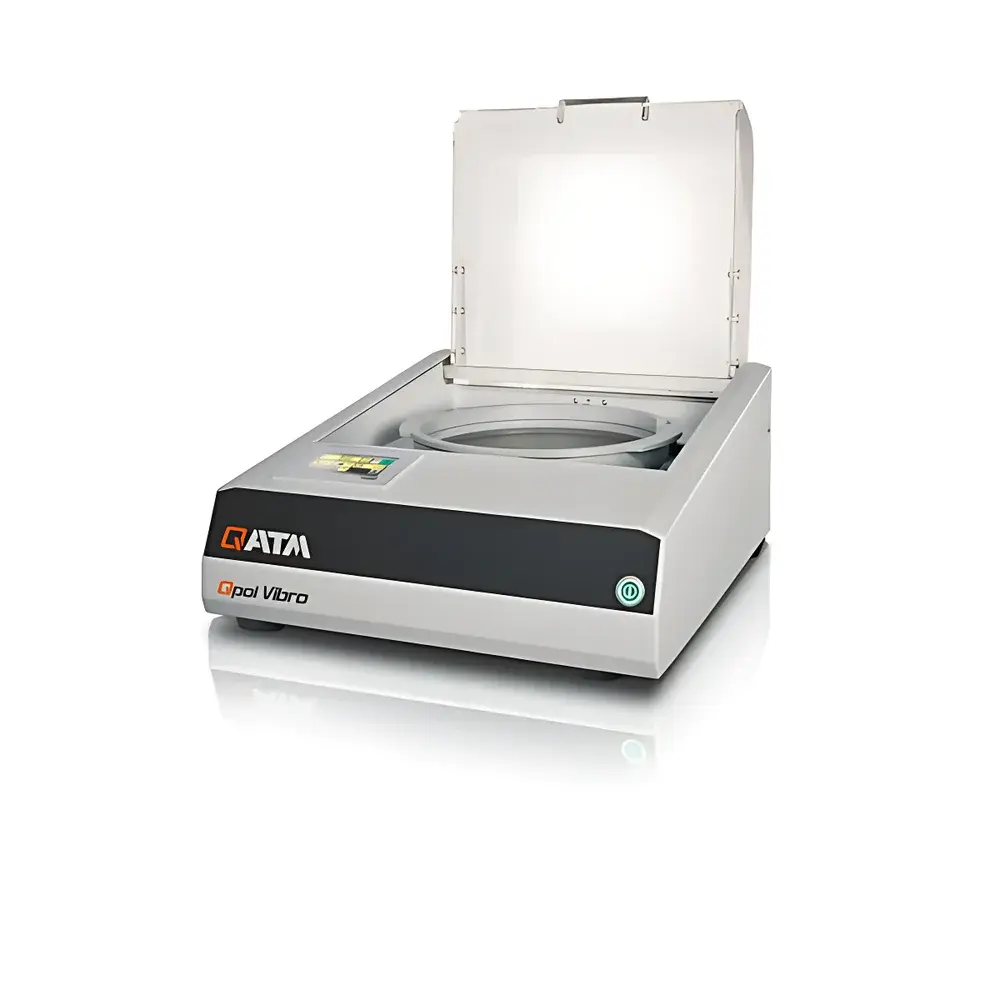
QATM Qpol Vibro (Saphir Vibro) Vibratory Polishing Machine
| Brand | QATM |
|---|---|
| Origin | Germany |
| Model | Qpol Vibro (Saphir Vibro) |
| Dimensions (L×W×D) | 510 × 300 × 590 mm |
| Polishing Dish Count | 1 |
| Polishing Dish Diameter | 300 mm |
| Drive Mechanism | Electromagnetic vibratory drive with automatic frequency control (60–120 Hz) |
| Weight | 45 kg |
| Sample Capacity | Up to 21 specimens simultaneously (using standard 30 mm / 1.25″ holders) |
| Interface | Touchscreen HMI with preloaded preparation protocols |
| Programmability | Up to 200 user-defined protocols via USB |
| Safety Features | Interlocked buffer shield, exhaust port for external fume extraction, intermittent vibration post-cycle, vibration-damping chassis |
| Compliance | Designed for GLP-compliant lab environments |
Overview
The QATM Qpol Vibro (Saphir Vibro) is a high-precision vibratory polishing machine engineered for the final stage of metallographic and ceramographic sample preparation—specifically targeting deformation-free surfaces with sub-micron surface integrity (<1 µm residual deformation). Unlike conventional rotary or planetary polishing systems, the Qpol Vibro employs controlled electromagnetic vibratory motion rather than rotational shear. This principle minimizes mechanical stress accumulation in the near-surface zone, preserving crystallographic continuity essential for advanced microstructural analysis. Its design directly addresses the stringent surface quality requirements of electron backscatter diffraction (EBSD), atomic force microscopy (AFM), nanoindentation, and microhardness testing—where subsurface damage, relief, or preferential phase removal would otherwise compromise data fidelity. The system is optimized for both soft, ductile materials (e.g., pure copper, TiAl alloys, aluminum grades) and harder, work-hardening-prone alloys (e.g., austenitic stainless steels, Ni-based superalloys), enabling consistent planarization without edge rounding or pull-out artifacts.
Key Features
- Electromagnetic vibratory drive with digitally regulated frequency range (60–120 Hz), dynamically adjustable per material class and suspension viscosity to optimize particle trajectory and material removal kinetics.
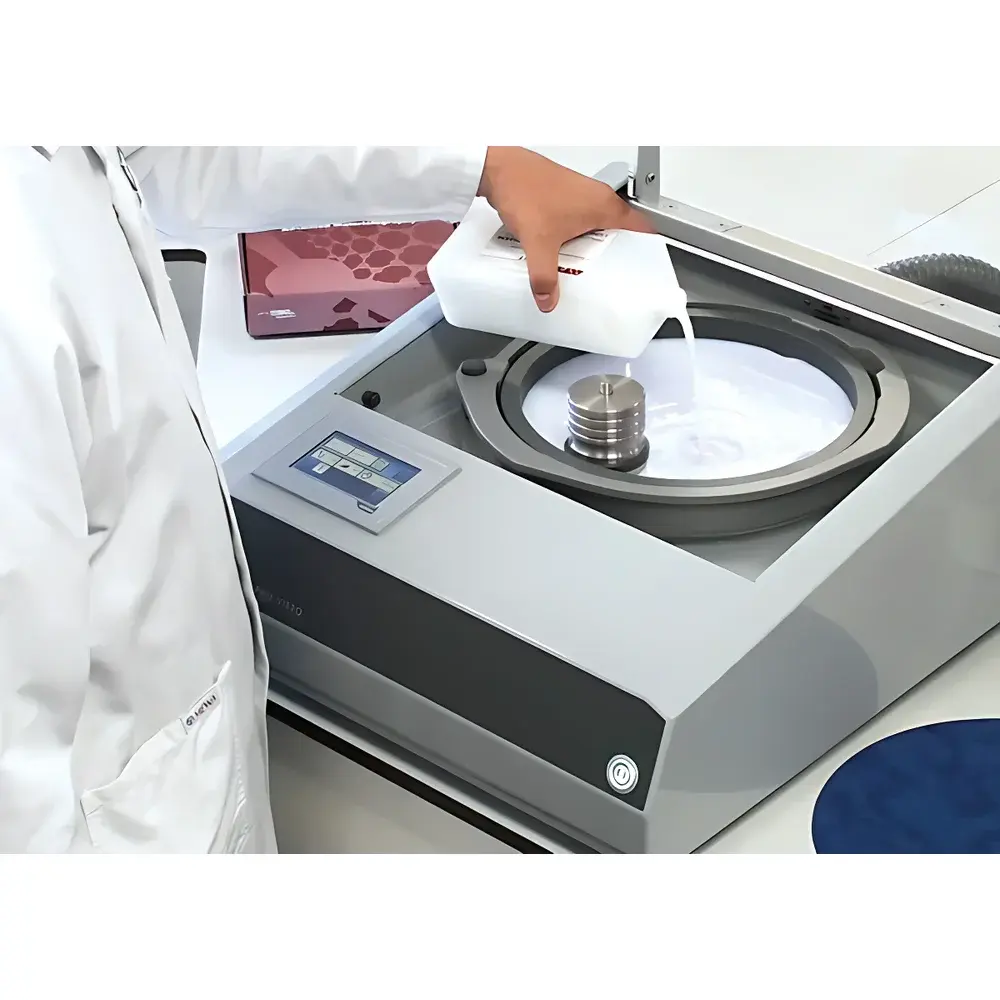
- Large-diameter polishing dish (Ø300 mm) accommodating up to 21 standardized 30 mm (1.25″) specimen holders—ideal for batch processing in QA/QC labs and R&D facilities requiring statistical repeatability.
- Magnetically coupled, tool-free polishing dish exchange—reducing setup time and contamination risk between abrasive chemistries (e.g., colloidal silica vs. diamond suspensions).
- Post-polish “gentle vibration” mode: automatically engages after main cycle completion to disperse residual abrasive agglomerates and mitigate localized chemical etching from prolonged suspension contact.
- Integrated vibration-damping chassis and counterbalanced motor assembly ensure stable operation at full frequency range, with sound pressure level <62 dB(A) — suitable for open-bench deployment in shared laboratory spaces.
- Full touchscreen HMI with intuitive icon-driven navigation, real-time parameter monitoring (vibration amplitude, elapsed time, cycle phase), and password-protected user levels for SOP enforcement.
- Dual-mode operation: manual override for rapid method development; fully automated execution with programmable multi-step sequences (e.g., coarse → intermediate → final polish with timed transitions and suspension dosing logic).
Sample Compatibility & Compliance
The Qpol Vibro demonstrates broad compatibility across non-ferrous and ferrous metallics, intermetallics, and sintered ceramics—including materials prone to smearing (e.g., Cu, Al), twinning (e.g., Mg alloys), or differential phase removal (e.g., WC-Co composites). Its low-stress mechanism avoids the topographical artifacts common in rotational polishing, making it particularly valuable for failure analysis labs validating ASTM E3, ISO 14728, and EN 10360–2 compliant reporting. The exhaust port (Ø32 mm) enables direct integration with centralized lab ventilation or portable fume extractors—supporting OSHA PEL and EU Directive 2004/37/EC exposure limits for airborne abrasives and lubricants. All firmware and protocol logs are timestamped and exportable, facilitating alignment with GLP documentation standards and internal audit trails.
Software & Data Management
Preloaded with over 40 validated preparation protocols covering common alloy families (per ASTM E407, ISO 15510), the system allows users to modify dwell times, frequency profiles, and suspension application intervals directly on-device. Protocols may be exported/imported via USB 2.0 in encrypted .qpr format, preserving calibration metadata and operator annotations. Audit logging records every parameter change, cycle start/stop, and alarm event—including operator ID (if enabled via network authentication). While not natively 21 CFR Part 11 compliant, the architecture supports third-party electronic lab notebook (ELN) integration via CSV/JSON API endpoints for traceable data archival.
Applications
- EBSD sample preparation for grain boundary mapping and orientation imaging in aerospace-grade titanium and nickel alloys.
- AFM substrate finishing for nanoscale topography quantification in thin-film metallization layers.
- Nanoindentation pre-polish for modulus/hardness profiling across heterogeneous microstructures (e.g., weld heat-affected zones).
- Reference standard certification for hardness testing per ISO 6507 and ASTM E384—where surface planarity directly influences indenter penetration reproducibility.
- High-throughput QC polishing of turbine blade coupons, battery electrode cross-sections, and additive manufacturing build plates.
FAQ
What distinguishes vibratory polishing from rotary polishing in terms of surface integrity?
Vibratory motion induces multidirectional micro-oscillations rather than unidirectional shear, significantly reducing subsurface plastic deformation and phase-specific pull-out—critical for diffraction-based techniques.
Can the Qpol Vibro accommodate non-standard specimen geometries?
Yes—custom fixtures (e.g., rectangular mounts, embedded blocks) can be secured within the Ø308 mm polishing basin using magnetic retention or mechanical clamps; maximum height clearance is 65 mm.
Is remote monitoring or network connectivity supported?
The base unit operates standalone; optional Ethernet module (QATM NetLink) enables SNMP status polling and protocol push/pull via secure FTP—no cloud dependency.
What maintenance intervals are recommended for the electromagnetic drive system?
No scheduled lubrication or bearing replacement is required; annual verification of coil impedance and suspension seal integrity is advised per QATM Service Bulletin VB-2023-07.
How does the intermittent post-cycle vibration reduce surface corrosion?
By inducing low-amplitude oscillation after suspension flow ceases, it prevents static pooling of reactive colloids—minimizing localized pH drift and electrochemical dissolution at grain boundaries.



