
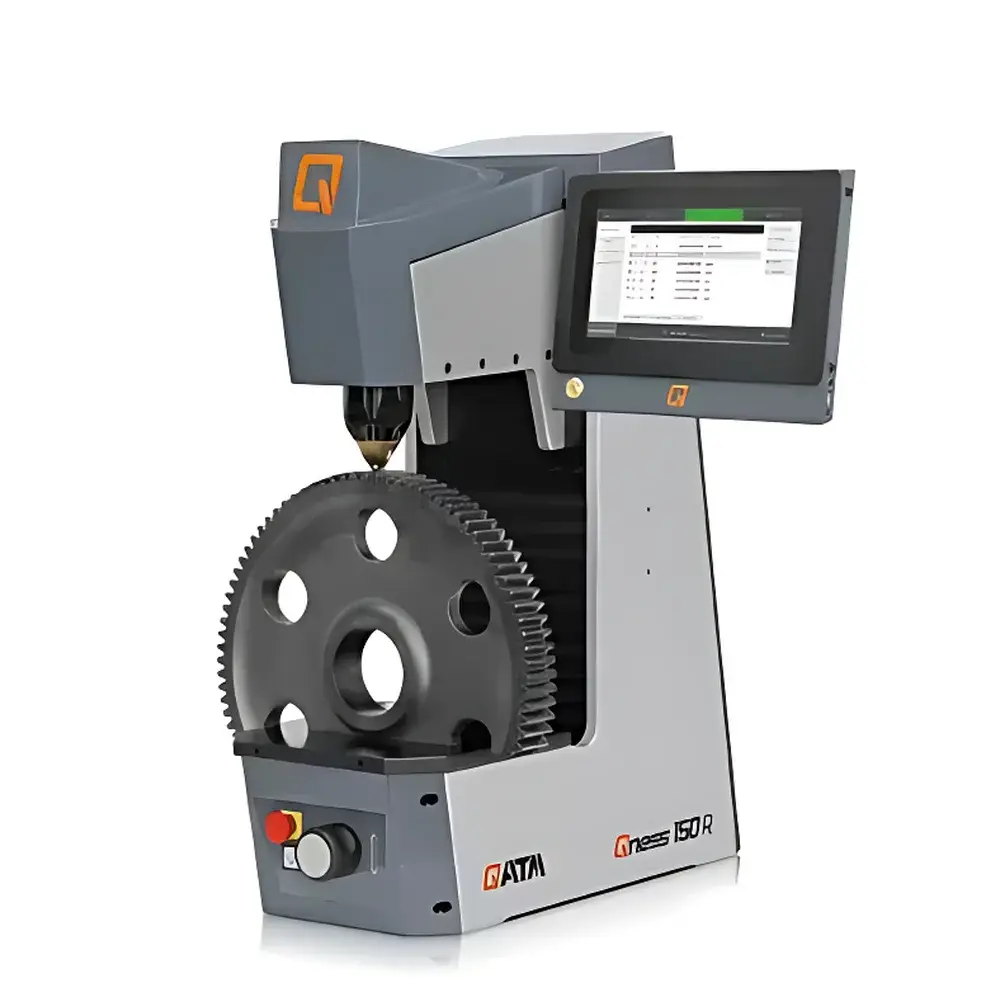
QATM QNESS 150 R Rockwell Hardness Tester
| Brand | QATM |
|---|---|
| Origin | Austria |
| Model | QNESS 150 R |
| Instrument Type | Rockwell Hardness Tester |
| Test Force Range | 1–250 kg (9.81–2450 N) |
| Test Height / Throat Depth | 260 mm / 180 mm |
| Extended Test Height (Optional) | 450 mm |
| Vertical Adjustment Speed | up to 6 mm/s |
| Anvil/Cross Table Dimensions | 250 × 260 mm |
| Data Interfaces | 3× USB, 1× Ethernet, 1× RS232 |
| Unit Weight | 95 kg (112 kg with height extension) |
| Max. Specimen Weight | 100 kg |
| Power Supply | 230 V ~ 1/N/PE or 110 V ~ 1/N/PE |
| Max. Power Consumption | ~240 W |
| Software | Qpix T2R |
Overview
The QATM QNESS 150 R is a fully automated, microprocessor-controlled Rockwell hardness tester engineered for precision, repeatability, and compliance in industrial quality control and materials R&D laboratories. Based on the standardized Rockwell principle—indentation depth measurement under major and minor loads—the QNESS 150 R applies calibrated forces ranging from 1 kg to 250 kg (9.81–2450 N) to determine hardness values across scales including HRA, HRB, HRC, HRD, HRF, HRG, HRH, HRR, and HR15N–HR45N. Its robust cast-iron frame, thermally stable load train, and closed-loop force application system ensure high reproducibility (< ±0.5 HR units per ASTM E18 and ISO 6508-1). Designed and manufactured in Austria, the instrument meets stringent European mechanical safety standards (EN ISO 12100) and electromagnetic compatibility requirements (EN 61326-1).
Key Features
- Fully motorized Z-axis with programmable vertical travel (up to 6 mm/s), enabling precise positioning and repeatable load application without manual intervention.
- Extended test space configuration (optional 450 mm height) accommodates tall or irregularly shaped components—ideal for forged parts, valve bodies, and large-diameter shafts.
- Integrated cross-table (250 × 260 mm) with fine-adjustment micrometer dials supports accurate specimen alignment and multi-point testing sequences.
- Dual-load architecture ensures traceable force application via high-accuracy load cells, validated annually against certified reference standards (e.g., NIST-traceable weights).
- Modular design allows field-upgradable hardware options—including automatic turret with up to 8 indenters, integrated optical surface recognition, and pneumatic sample clamping.
- Compliance-ready architecture with audit trail logging, user access levels (admin/operator/guest), and electronic signature support for GLP/GMP environments.
Sample Compatibility & Compliance
The QNESS 150 R accommodates specimens up to 100 kg and 260 mm in height, with a throat depth of 180 mm—suitable for machined components, heat-treated steels, carbide tooling, and case-hardened surfaces. Its test cycle conforms to international standards including ASTM E18, ISO 6508-1/2/3, JIS Z 2245, and DIN EN ISO 2039-2 (for plastics using superficial Rockwell scales). All hardness values are calculated and reported in accordance with standard conversion tables and uncertainty budgets defined in ISO/IEC 17025-accredited calibration procedures. The system supports optional third-party calibration certification (DAkkS or UKAS) and integrates seamlessly into enterprise LIMS workflows via Ethernet-based data export.
Software & Data Management
Qpix T2R software provides intuitive test setup, real-time force-depth curve visualization, statistical analysis (X̄/R charts, Cpk/Ppk), and customizable reporting (PDF, CSV, XML). It supports full 21 CFR Part 11 compliance with electronic signatures, role-based permissions, and immutable audit trails—including timestamped records of every parameter change, test execution, and result export. Data integrity is reinforced through cyclic redundancy checks (CRC) on all stored measurements and automatic backup to network drives or cloud repositories. Raw indentation depth data (µm resolution) and load-time profiles are retained for retrospective analysis and root-cause investigations in nonconformance events.
Applications
- Automotive: Verification of surface hardness on crankshafts, camshafts, and gear teeth after induction hardening or nitriding.
- Aerospace: Batch qualification of titanium alloys (e.g., Ti-6Al-4V) and nickel-based superalloys per AMS 2242 and BAC 5663.
- Tool & Die: Routine inspection of tungsten carbide inserts and hardened mold steels (e.g., H13, S7) to ensure wear resistance consistency.
- Energy: Hardness mapping of pipeline weld joints and pressure vessel components per API RP 578 and ASME BPVC Section IX.
- Academic Research: Correlation studies between Rockwell hardness and tensile strength, microstructural phase distribution, or residual stress states.
FAQ
Does the QNESS 150 R support both standard and superficial Rockwell scales?
Yes—it covers all standard scales (HRA–HRV) and superficial scales (15N–45N, 15T–45T) via interchangeable indenter holders and programmable load profiles.
Can test data be exported directly to an ERP or MES system?
Yes—via Ethernet interface using TCP/IP protocols or structured CSV/XML exports; optional OPC UA integration available for Industry 4.0 environments.
Is periodic recalibration required, and what documentation is provided?
Annual recalibration is recommended per ISO/IEC 17025 guidelines; QATM-certified service includes DAkkS-recognized calibration certificates with measurement uncertainty statements.
What safety features prevent operator exposure during testing?
The instrument includes light-curtain interlocks, emergency stop circuitry compliant with EN 60204-1, and automatic load disengagement upon door opening or anomaly detection.
How is thermal drift compensated during extended testing sessions?
An internal temperature sensor continuously monitors ambient conditions and adjusts force compensation algorithms in real time, maintaining accuracy within ±0.3 HR over 8-hour operation at 20–25 °C.



