
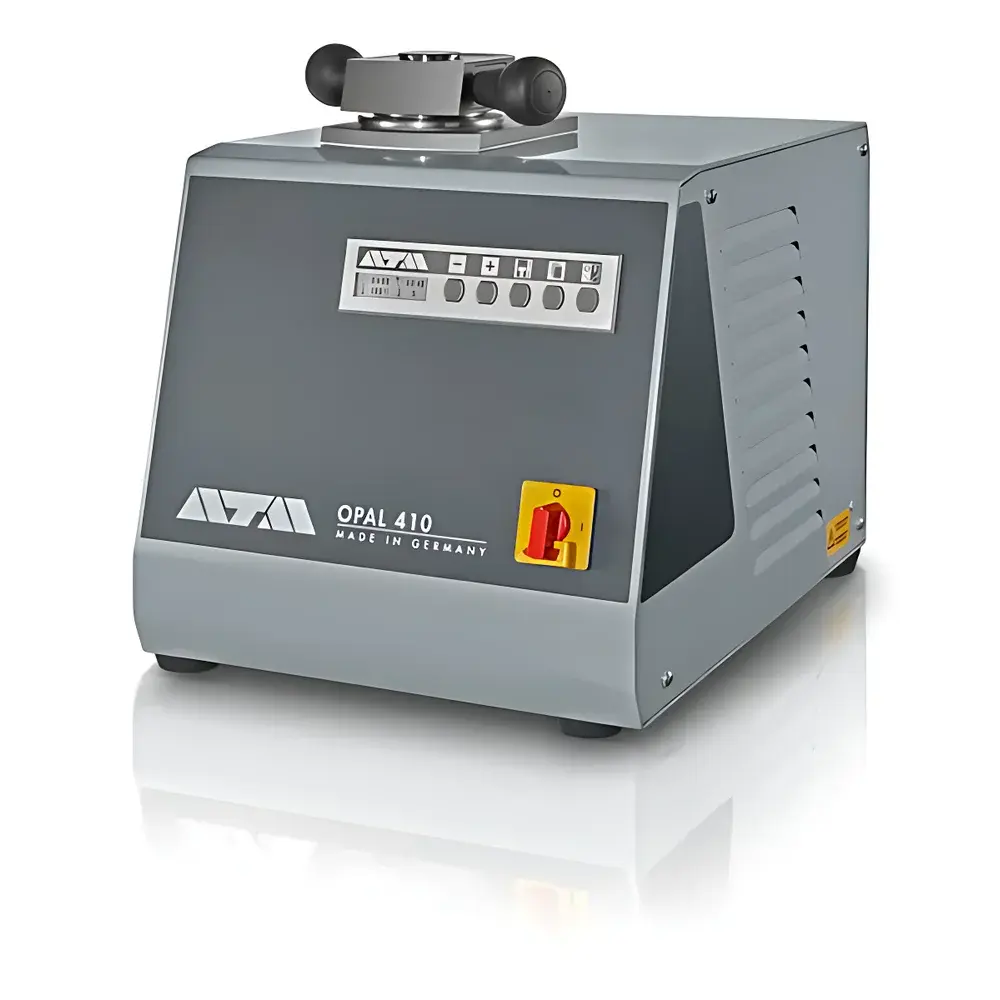
QATM Qpress 40 (formerly ATM Opal 410) Fully Hydraulic Automatic Hot Mounting Press
| Brand | QATM |
|---|---|
| Origin | Germany |
| Model | Qpress 40 (formerly ATM Opal 410) |
| Mounting Cylinder Diameter Range | Ø25.2–50 mm (6 standard sizes) |
| Clamping System | Threaded lid closure |
| Heating Range | 20–200 °C |
| Heating Time | 0–30 min (adjustable) |
| Cooling Time | 0–30 min (adjustable) |
| Maximum Pressure | 450 bar (pressure output varies with die size) |
| Power Supply | 3.1 kVA |
| Heating Power | 4 × 500 W = 2000 W |
| Dimensions (W × H × D) | 350 × 400 × 450 mm |
| Weight | ~40 kg |
| Cooling Method | Integrated water-cooling circuit |
| Automation Level | Fully automatic hydraulic cycle control with sequential process execution |
| Die Change | Tool-free quick-change mounting cylinder assembly |
| Enclosure Material | Powder-coated aluminum alloy chassis |
Overview
The QATM Qpress 40 — formerly marketed as the ATM Opal 410 — is a fully hydraulic, water-cooled automatic hot mounting press engineered for precision metallurgical and materials science sample preparation. Designed for laboratories requiring high reproducibility in specimen encapsulation prior to grinding and polishing, the system employs controlled thermomechanical compression to embed specimens in thermosetting resins (e.g., phenolic, epoxy, or acrylic) under precisely regulated temperature, pressure, and time parameters. Its core operational principle relies on hydraulic force generation combined with PID-regulated resistive heating and active water-based thermal management, ensuring minimal thermal drift and consistent cross-sectional integrity across batches. The machine executes fully automated cycles — including pre-heating, resin flow initiation, pressure application, dwell, cooling, and ejection — without manual intervention, minimizing operator variability and supporting GLP-compliant documentation workflows.
Key Features
- Fully hydraulic actuation system delivering up to 450 bar of clamping pressure, dynamically adjusted per die diameter (Ø25.2–50 mm) to maintain uniform compressive stress distribution across all specimen geometries.
- Integrated water-cooling circuit enabling rapid, programmable post-cure thermal dissipation — critical for minimizing resin shrinkage, interfacial delamination, and edge rounding in high-precision metallographic mounts.
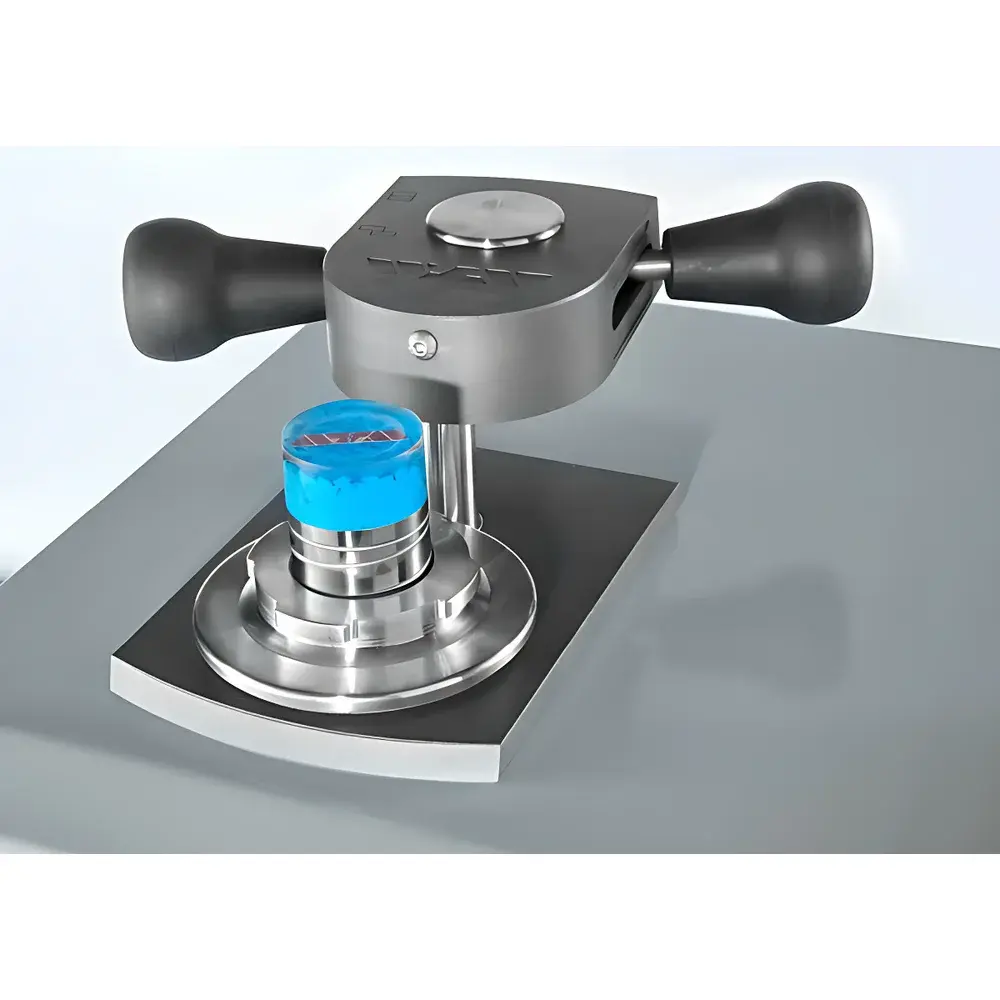
- Tool-free, modular mounting cylinder system with six standardized diameters (Ø25.2, 30, 35, 40, 45, and 50 mm), facilitating rapid reconfiguration between routine QC and R&D applications without recalibration.
- Threaded lid closure mechanism ensures axial alignment stability and leak-tight sealing during resin polymerization, eliminating flash formation and preserving specimen edge definition.
- Powder-coated aluminum frame provides structural rigidity while minimizing vibration transmission and acoustic emissions (<62 dB(A) typical operating noise level), suitable for shared laboratory environments.
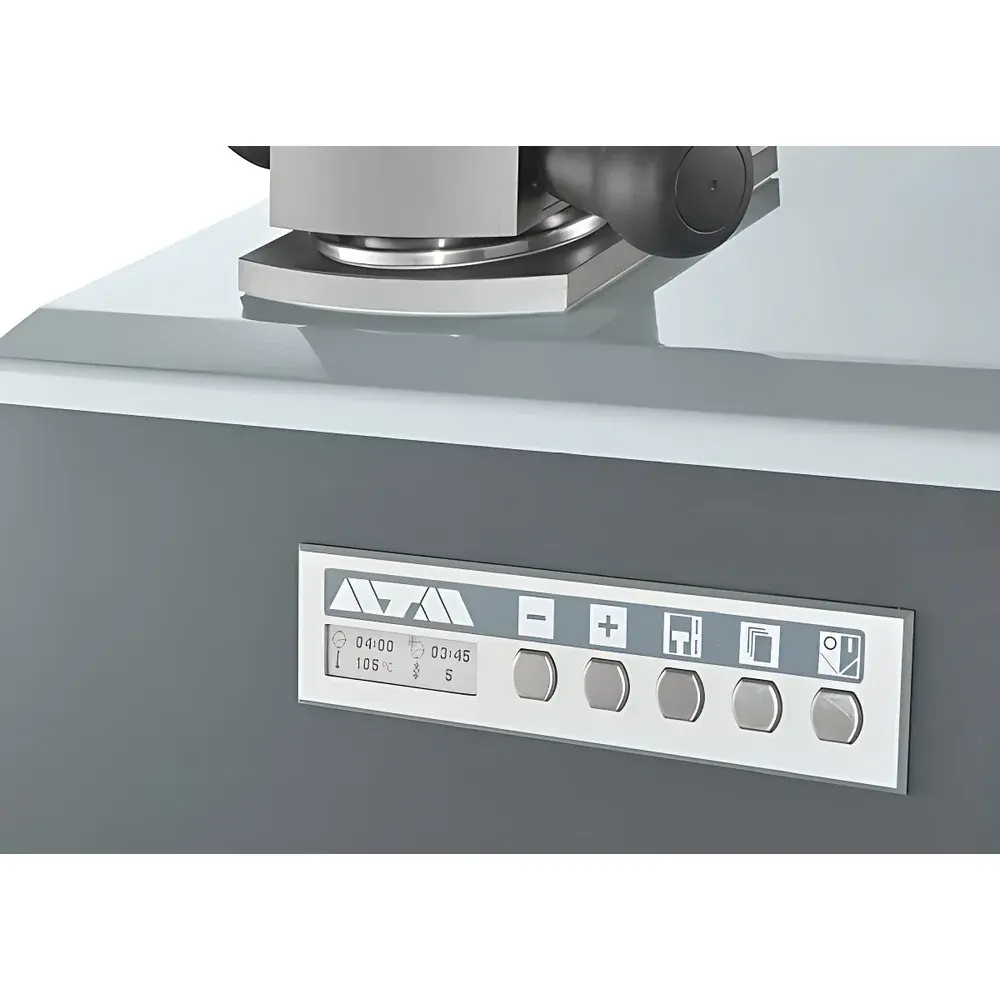
- Intuitive touchscreen interface with password-protected parameter storage, cycle logging, and real-time monitoring of temperature, pressure, and elapsed time for each stage.
Sample Compatibility & Compliance
The Qpress 40 accommodates diverse specimen types including metallic alloys, ceramics, composites, electronic components, geological cores, and biological hard tissues — provided specimens are dimensionally stable below 200 °C and chemically compatible with common thermosetting resins. Dual-sample mounting is supported using optional spacer inserts, enabling parallel processing of comparative or calibration samples. All operational parameters comply with ISO 16071:2022 (Metallographic specimen mounting) and ASTM E3-22 (Standard Guide for Preparation of Metallographic Specimens). The system supports audit-ready data retention (cycle logs with timestamps, operator ID, and parameter sets) and is compatible with 21 CFR Part 11–compliant LIMS integration when paired with QATM’s optional QSoft Pro software module.
Software & Data Management
While the base unit operates via embedded firmware with local touchscreen control, optional QSoft Pro software enables remote configuration, batch cycle scheduling, statistical process monitoring (SPC), and export of CSV/Excel-compatible reports. Each completed cycle generates a timestamped record containing setpoints, actual thermal/pressure profiles, deviations, and operator metadata — stored locally on internal flash memory (16 GB) with configurable auto-purge policies. Data export supports traceability requirements under ISO/IEC 17025 and GMP Annex 11 frameworks. Firmware updates are delivered via USB or Ethernet, with version rollback capability and SHA-256 integrity verification.
Applications
- Routine quality control of castings, welds, and additive-manufactured parts in automotive and aerospace supply chains.
- Failure analysis labs preparing cross-sections of PCBs, solder joints, and thermal interface materials.
- Academic and industrial research groups performing quantitative microstructural analysis (e.g., grain size, phase fraction, inclusion counting) requiring geometrically faithful mounts.
- Third-party testing laboratories accredited to ISO/IEC 17025, where documented process consistency and instrument calibration traceability are mandatory.
- Forensic materials labs embedding evidence fragments under chain-of-custody protocols with immutable digital log records.
FAQ
What resin types are compatible with the Qpress 40?
Phenolic, epoxy, acrylic, and diallyl phthalate (DAP) resins — both standard and low-viscosity formulations — are supported. Resin selection must align with specimen thermal sensitivity and required final hardness.
Is external chiller connection required for water cooling?
No. The integrated closed-loop water circuit uses ambient air heat exchange; connection to a facility chiller is optional for high-throughput environments (>20 cycles/day) or ambient temperatures exceeding 32 °C.
Can the Qpress 40 be integrated into an automated sample prep line?
Yes. Digital I/O ports (24 V DC) and Modbus TCP support enable synchronization with robotic arms, conveyor systems, and central lab automation platforms.
How often does the hydraulic system require maintenance?
QATM specifies hydraulic fluid replacement every 36 months or 2,000 operating hours, whichever occurs first; no periodic seal replacement is required under normal usage conditions.
Does the system include calibration certification?
Each unit ships with a factory-issued calibration certificate covering temperature (±0.5 °C at 100 °C), pressure (±1.5% FS), and timer accuracy (±0.1 s), traceable to DAkkS-accredited standards.



