
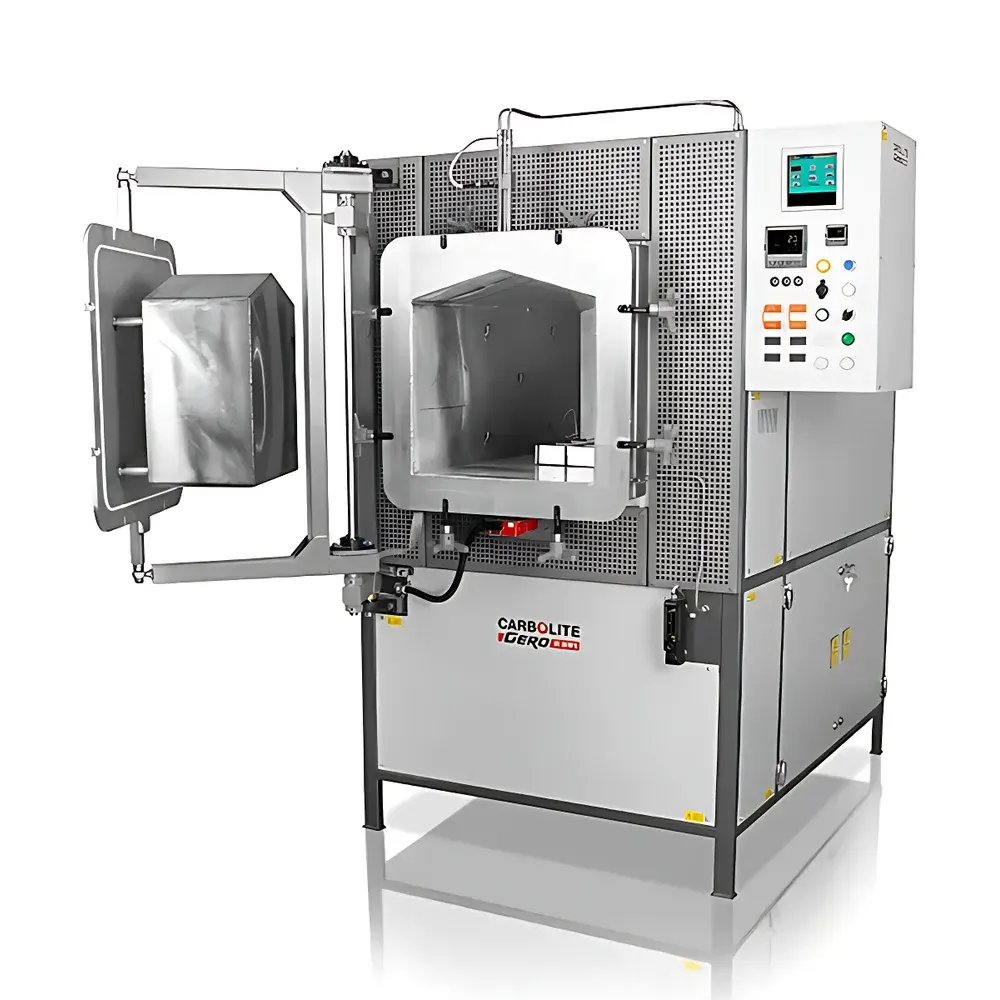
Carbolite Gero GPCMA Controlled-Atmosphere Box Furnace
| Brand | Carbolite Gero |
|---|---|
| Origin | UK |
| Model | GPCMA |
| Furnace Type | Box Furnace |
| Max Temperature | 1150 °C |
| Temperature Uniformity | ±1 °C |
| Max Power | 36 kW |
| Internal Dimensions | 428/495 × 500 × 815 mm (W×D×H) |
| Chamber Volumes | 37–245 L |
| Atmosphere Purity | O₂ ≤ 30 ppm |
| Heating Method | Resistance Wire (NiCr Alloy) |
| Thermocouple Types | R-type (control), K-type (≤1100 °C), N-type (>1100 °C) |
| Cooling | Optional Forced Air / Water-Cooled Door Seal (Silicone) |
| Compliance | Nadcap AMS2750F Class 1 Qualified (Custom Configurable) |
Overview
The Carbolite Gero GPCMA is a high-performance, floor-standing controlled-atmosphere box furnace engineered for precision thermal processing under inert or reducing atmospheres. Designed around a robust metallic process chamber and optimized radiant heating architecture, it delivers exceptional temperature uniformity (±1 °C) across working zones up to 245 L—critical for applications demanding strict thermal consistency and reproducible heat treatment outcomes. Its core operational principle relies on resistive heating via strategically distributed NiCr alloy heating elements (mounted on side walls, top, and base), combined with low-thermal-mass insulation to minimize energy loss and enable rapid, controllable ramp rates. The furnace supports atmosphere control down to ≤30 ppm O₂ using nitrogen or argon supply systems, making it suitable for stress relief of additively manufactured components (e.g., DMLS Inconel 718 or Ti-6Al-4V), annealing of aerospace alloys, and sintering of advanced ceramics where oxidation must be rigorously suppressed.
Key Features
- Metallic process chamber options: 310 stainless steel (1000 °C), 314 stainless steel (1050 °C), Inconel 600/625 (1100 °C), or Haynes 230 (1150 °C)
- Two-zone cascaded temperature control with R-type reference thermocouple and independent chamber-sensing thermocouples (K- or N-type, selected per max operating temperature)
- Parallel-guided heavy-duty furnace door with silicone water-cooled gasket—designed to maintain operator safety and reduce radiant heat exposure during loading/unloading
- High-efficiency insulation system minimizing thermal inertia and enabling faster heat-up while maintaining low standby power consumption
- Standard semi-automatic N₂ supply with analog flowmeter; optional digital mass flow controllers, full automation with gas monitoring, and integrated data logging (when paired with compliant data recorders)
- Configurable overtemperature protection, door interlock safety circuitry, and programmable 3508P1 controller supporting up to 32 segments and 100 ramps/holds
Sample Compatibility & Compliance
The GPCMA accommodates diverse sample geometries and material classes—including metal alloys, ceramic preforms, composite substrates, and AM-fabricated parts—within its scalable chamber volumes (37 L to 245 L). Its construction and calibration protocols are fully compatible with Nadcap AMS2750F requirements for Class 1 furnace qualification, including sensor placement validation, system accuracy tests (SAT), and temperature uniformity surveys (TUS) conducted per defined load configurations. Optional vacuum capability (10⁻² mbar, ambient-only) enables rapid atmosphere exchange prior to heating, though vacuum-rated chambers must be specified at order. All configurations support GLP/GMP-aligned documentation packages, including as-built drawings, calibration certificates traceable to UKAS/NIST standards, and audit-ready temperature mapping reports.
Software & Data Management
Equipped with the Carbolite Gero 3508P1 programmable controller as standard, the GPCMA supports multi-stage thermal profiles with real-time deviation alarms and event-triggered outputs. When upgraded with optional digital controllers (e.g., 3504 series), it integrates seamlessly with Ethernet/IP or RS485 networks for remote monitoring and centralized lab management. Data recording—whether via internal memory or external PC-linked software—complies with FDA 21 CFR Part 11 requirements when configured with electronic signatures, audit trails, and user-access controls. Optional oxygen monitoring systems provide continuous ppm-level feedback synchronized with thermal events, enabling closed-loop atmosphere adjustment in critical processes such as HIP preheating or brazing cycle validation.
Applications
- Stress relief of additively manufactured aerospace components (e.g., turbine blades, fuel nozzles)
- Annealing and homogenization of nickel-based superalloys (Inconel, Waspaloy) and titanium alloys (Ti-6Al-4V)
- Sintering of technical ceramics (Al₂O₃, SiC, ZrO₂) under inert gas
- Heat treatment qualification per ASTM E2550, ISO 11357, and AMS 2750
- Controlled-atmosphere debinding of MIM and CIM green parts
- Research-scale thermal cycling studies requiring repeatable, documented atmosphere integrity
FAQ
What chamber materials are available, and how do they affect maximum operating temperature?
Chamber linings include 310 SS (1000 °C), 314 SS (1050 °C), Inconel 600/625 (1100 °C), and Haynes 230 (1150 °C). Selection depends on required temperature, atmosphere compatibility, and service life expectations under cyclic thermal loads.
Can the GPCMA be validated to Nadcap AMS2750F Class 1?
Yes—custom configurations include certified SAT/TUS procedures, calibrated thermocouple placement per AMS2750F Annex C, and documentation packages supporting Nadcap audit readiness.
Is vacuum capability compatible with all atmosphere options?
No. Vacuum pumping (10⁻² mbar) is only permitted at ambient temperature and requires a dedicated vacuum-rated chamber. It cannot operate concurrently with forced cooling or tail gas combustion systems.
What level of atmosphere purity can be achieved, and how is it monitored?
Oxygen levels as low as 30 ppm are attainable using high-purity N₂ or Ar with proper leak-tight sealing and purge protocols. Optional paramagnetic O₂ analyzers (3504 controller-integrated) provide real-time verification.
Are digital communication interfaces and remote operation supported?
Yes—Ethernet, Modbus TCP, and RS485 interfaces are available via optional controllers. Integration with SCADA, MES, or LIMS platforms is achievable with appropriate protocol configuration and cybersecurity hardening.
Related Products



