
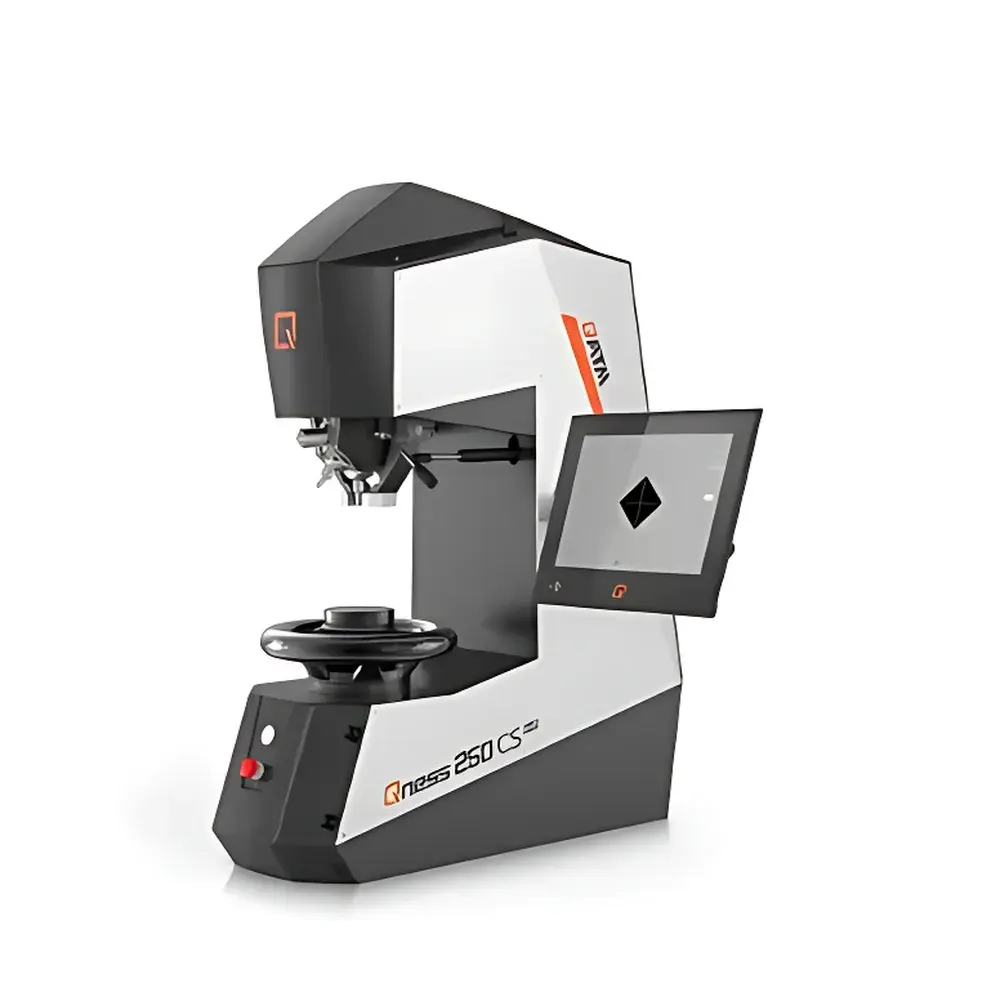
QATM QNESS 250 / 750 / 3000 CS/C EVO Universal Hardness Tester
| Brand | QATM |
|---|---|
| Origin | Austria |
| Model | QNESS 250 / 750 / 3000 CS/C EVO |
| Test Force Range | QNESS 250 CS: 1–250 kg (9.81–2450 N) |
| QNESS 750 CS | 0.3–750 kg (2.94–7358 N) |
| QNESS 3000 CS | 0.3–3000 kg (2.94–29430 N) |
| QNESS 250 C | 1–250 kg (9.81–2450 N) |
| QNESS 750 C | 0.3–750 kg (2.94–7358 N) |
| QNESS 3000 C | 0.3–3000 kg (2.94–29430 N) |
| Test Height | C version: 395 mm |
| CS version | 175 mm |
| Throat Depth | 220 mm |
| Anvil Diameter | Ø100 mm |
| Turret Configuration | 2-position standard or 8-position optional |
| Imaging System | 5 MP industrial Ethernet camera, up to 270 FPS |
| Objective Lenses | XLED 1, XLED 2, XLED 5, 5×, 10×, 20×, 50×, 100× |
| Field of View | 0.113 × 0.084 mm (at 100×) to 7.98 × 5.97 mm (at XLED 1) |
| Display | 12″ capacitive touchscreen |
| Operating System | Windows 10 IoT |
| Storage | 128 GB SSD |
| Power Supply | 230 V ~1/N/PE or 110 V ~1/N/PE |
| Max. Power Consumption | ~480 W |
| Weight | QNESS 250/750 CS: 250 kg |
| QNESS 3000 CS & all C versions | 300 kg |
Overview
The QATM QNESS 250 / 750 / 3000 CS/C EVO series represents a generation of universal hardness testers engineered for precision, repeatability, and operational efficiency in R&D laboratories, quality control departments, and accredited testing facilities. Built upon QATM’s decades-long heritage in mechanical metrology, the EVO platform integrates electro-mechanical force application, high-resolution digital imaging, and deterministic test sequencing to deliver fully traceable hardness measurements across Brinell, Vickers, Knoop, Rockwell, and plastic hardness standards. The “C” and “CS” designations refer to the structural configuration of the machine frame: the C-type features an open-front “C-frame” architecture with a maximum test height of 395 mm—ideal for taller components such as shafts, castings, or forged parts—while the CS variant offers a compact footprint with 175 mm test height, optimized for high-throughput benchtop environments without compromising load capacity or optical resolution. All models employ a motorized, closed-loop electronic force control system compliant with ISO 6506-1, ISO 6507-1, ISO 4545-1, ASTM E10, E384, E18, and ISO 2039-1, ensuring full alignment with international calibration and accreditation requirements.
Key Features
- Electronically controlled, feedback-regulated test force application with real-time load monitoring and dynamic compensation for thermal drift and mechanical hysteresis.
- Dual-platform mechanical architecture: C-frame (395 mm test height) and CS-frame (175 mm test height), both with 220 mm throat depth and Ø100 mm hardened steel anvil.
- Modular turret system supporting up to eight interchangeable indenters and objectives—enabling rapid method switching between Brinell, Vickers, Knoop, Rockwell, and macro/micro-plastic hardness tests.
- 5-megapixel industrial-grade Ethernet camera with programmable frame rate (up to 270 FPS), synchronized illumination (XLED multi-intensity LED optics), and sub-pixel edge detection algorithms for automated indentation measurement.
- Integrated 12″ capacitive touchscreen interface running Windows 10 IoT, enabling intuitive workflow navigation, parameter configuration, and on-device result review without external peripherals.
- Full compliance with ISO/IEC 17025 documentation requirements: audit trail logging, user access levels, electronic signatures, and data export in CSV, PDF, XML, and SPC-compatible formats.
Sample Compatibility & Compliance
The QNESS EVO series accommodates a broad spectrum of metallic, ceramic, polymer, and composite specimens—from thin foils and coatings to large structural components—with no practical upper limit on specimen weight. Its rigid C-frame construction (300 kg mass) and vibration-damped base ensure stability during high-force Brinell testing up to 3000 kgf (29.4 kN), while the CS variant maintains identical metrological integrity within its reduced envelope. All models are certified to EN ISO/IEC 17025:2017 for hardness testing laboratories and support GLP/GMP workflows via Qpix CONTROL 2 M software, which includes FDA 21 CFR Part 11-compliant electronic records, role-based authentication, and immutable audit trails. Optional accessories—including cross-laser positioning aids, V-groove anvils, anti-collision sensors, and barcode/QR code readers—further extend traceability and operator safety in regulated production environments.
Software & Data Management
Qpix T2 serves as the embedded firmware interface for routine operation, offering guided test setup, live image preview, automatic indentation recognition, and statistical reporting per ISO 14644 and ASTM E29. For advanced metrology applications, Qpix CONTROL 2 M provides extended functionality: multi-sample batch processing, custom report templates, SPC charting (X̄/R, Cp/Cpk), database integration via ODBC, and remote diagnostics over dual Ethernet ports. All measurement data—including raw images, force-time curves, environmental metadata (temperature, humidity), and operator ID—are timestamped, digitally signed, and stored locally on the 128 GB SSD. Export options include encrypted USB transfer and network-based push to LIMS or MES systems using TLS 1.2–secured HTTP(S) or FTPS protocols.
Applications
- Metallurgical QA/QC in foundries, forging shops, and heat treatment facilities—validating case depth, core hardness, and homogeneity of steels, aluminum alloys, and superalloys.
- R&D validation of additive manufacturing (AM) build parameters, including post-process heat treatment effects on microhardness gradients.
- Automotive component certification per VW 60300, Ford WSS-M29, and GMW14872 specifications.
- Aerospace material qualification per AMS 2430, AMS 2438, and Nadcap AC7101/AC7114 requirements.
- Plastics and elastomers testing per ISO 2039-1/-2 and ASTM D785, including Shore D correlation studies.
- Accredited third-party testing labs performing ISO/IEC 17025-compliant hardness certification for ISO 9001 and AS9100 auditors.
FAQ
What hardness standards does the QNESS EVO series support?
Brinell (ISO 6506, ASTM E10), Vickers (ISO 6507, ASTM E384), Knoop (ISO 4545, ASTM E384), Rockwell (ISO 6508, ASTM E18), and plastic hardness (ISO 2039-1, ASTM D785).
Is the system compatible with existing laboratory IT infrastructure?
Yes—dual RJ45 Ethernet ports support VLAN segmentation, DHCP/static IP assignment, and seamless integration with enterprise Active Directory, LIMS, and MES platforms.
Can the QNESS EVO perform automated sequential testing across multiple specimens?
Yes—via Qpix CONTROL 2 M, users can define multi-location test plans with XY-stage coordination (optional), automatic focus adjustment, and pass/fail logic based on configurable tolerance bands.
What is the calibration interval recommendation for ISO/IEC 17025 compliance?
Annual verification by an accredited body is required; internal daily verification using certified reference blocks (e.g., NIST-traceable Brinell/Vickers standards) is recommended prior to critical test runs.
Are software updates and technical support included post-purchase?
QATM provides lifetime firmware updates at no additional cost and offers remote diagnostic support, on-site service contracts, and ISO 17025-specific validation documentation packages upon request.



