
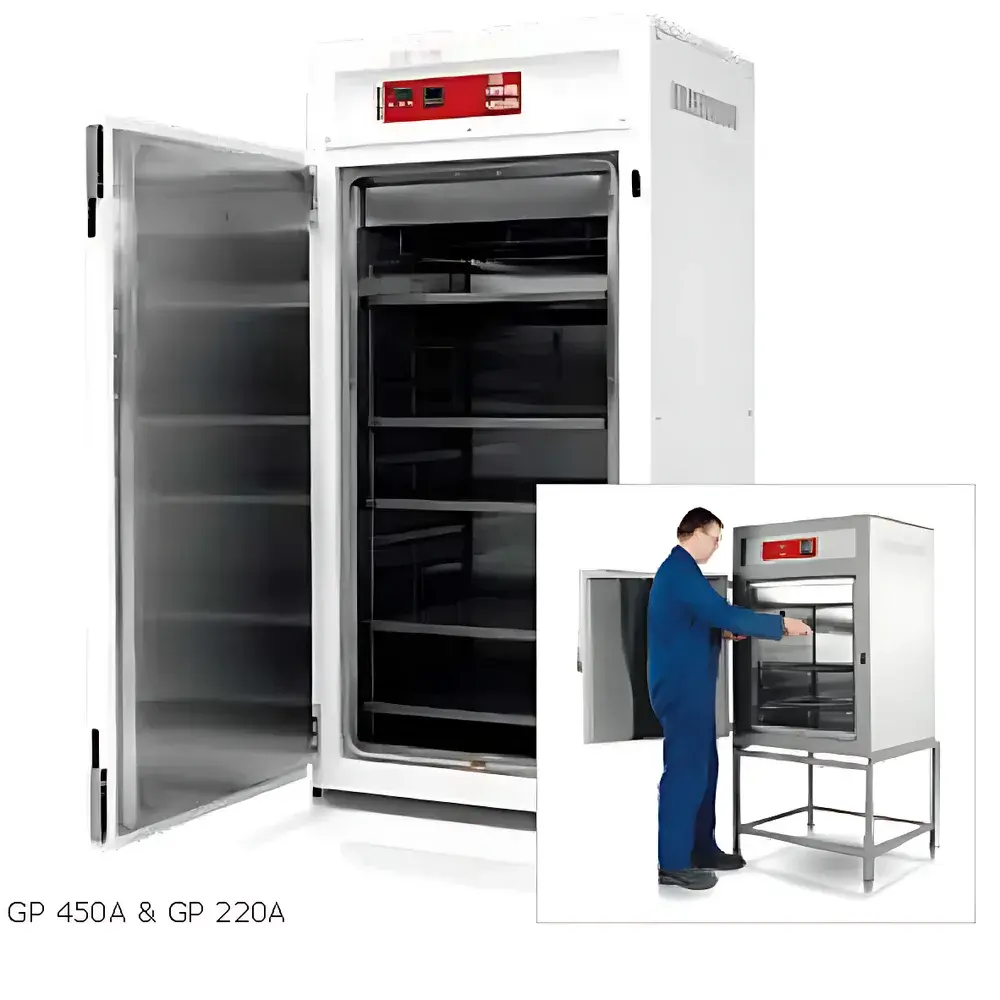
Carbolite Gero GP Series General Purpose Drying Oven
| Brand | Carbolite Gero |
|---|---|
| Origin | United Kingdom |
| Model | GP 450A & GP 220A |
| Temperature Range | Up to 300 °C |
| Temperature Uniformity | ±0.5 °C |
| External Dimensions (H×W×D) | 1850 × 862 × 850 mm |
| Internal Chamber Dimensions (H×W×D) | 1220 × 610 × 610 mm |
| Chamber Material | 430-grade ferritic stainless steel |
| Heating Method | Forced-air convection with vertical (A) or horizontal (B) airflow configuration |
| Controller | PID301 single-segment programmable controller |
| Insulation | Low-thermal-mass mineral wool |
| Heating Elements | Mineral-insulated metal-sheathed (MIMS) resistive elements |
| Compliance Options | AMS 2750E-compliant configurations available upon customization |
Overview
The Carbolite Gero GP Series General Purpose Drying Oven is an industrial-grade, forced-convection thermal processing system engineered for precision drying, curing, conditioning, and pre-heating applications in R&D laboratories, quality control environments, and production support facilities. Based on the fundamental principle of uniform convective heat transfer, the GP oven employs a robust, fan-driven air circulation system—configured either vertically (GP-A variants) or horizontally (GP-B variants)—to ensure high spatial temperature uniformity across the entire working chamber. Designed and manufactured in the United Kingdom, each unit adheres to stringent CE marking requirements and integrates thermally stable mechanical architecture with ISO 9001-certified production protocols. The standard operating envelope spans ambient +10 °C to 300 °C, with thermal stability maintained within ±0.5 °C under steady-state conditions—a specification validated per ASTM E220 and IEC 60068-3-5 methodologies for laboratory ovens.
Key Features
- High-reliability 430-grade ferritic stainless steel chamber lining—resistant to oxidation, corrosion, and thermal cycling fatigue up to 300 °C
- Mineral-insulated metal-sheathed (MIMS) heating elements embedded in low-thermal-mass ceramic fiber insulation for rapid thermal response and energy efficiency
- PID301 digital temperature controller with single-segment ramp/soak programming, real-time deviation monitoring, and auto-tuning capability
- Adjustable internal airflow baffles enabling fine-tuned ventilation control for sensitive or volatile sample loads
- Structurally reinforced outer casing fabricated from galvanized stainless steel sheet, rated for continuous operation in demanding industrial lab environments
- Modular electrical interface panel supporting optional RS232, RS485, or Ethernet connectivity for integration into centralized facility monitoring systems
Sample Compatibility & Compliance
The GP Series accommodates a broad spectrum of non-volatile, non-explosive solid and semi-solid samples—including polymer pellets, metal powders, pharmaceutical excipients, ceramic green bodies, and coated substrates. Chamber geometry supports standardized DIN/ISO test fixtures, crucible racks (optional), and custom jigs. For regulated environments, Carbolite Gero offers factory-configured AMS 2750E-compliant versions—including Class 1 or Class 2 instrumentation, calibrated NIST-traceable thermocouples, redundant overtemperature protection, and audit-ready data logging compliant with FDA 21 CFR Part 11 and EU Annex 11 requirements. All standard models meet EN 61000-6-3 (EMC) and EN 61000-6-4 emission standards, and are suitable for GLP/GMP-aligned workflows when paired with documented calibration and preventive maintenance protocols.
Software & Data Management
While the base PID301 controller operates as a standalone hardware interface, optional data acquisition modules enable seamless integration with third-party SCADA or LIMS platforms. The GP Series supports configurable analog output (4–20 mA) for external chart recording, and digital communication via RS232 (up to 115.2 kbps), RS485 (multi-drop capable), or Ethernet (TCP/IP). Optional firmware upgrades provide multi-segment program control (up to 16 segments), real-time CSV export, time-stamped event logging (door open/close, alarm triggers, setpoint changes), and password-protected user access levels. All logged datasets include embedded metadata—controller serial number, thermocouple ID, calibration date, and operator ID—to satisfy traceability mandates in accredited testing laboratories.
Applications
- Moisture content determination per ASTM D229, ISO 1183, and USP <645>
- Pre-drying of filter media, catalyst supports, and chromatographic columns prior to activation
- Curing of epoxy, silicone, and acrylic-based adhesives and encapsulants
- Thermal conditioning of reference materials and calibration standards
- Stabilization annealing of sintered metal components prior to dimensional inspection
- Residual solvent removal from coated films and battery electrode slurries
FAQ
What is the maximum allowable load mass for continuous operation at 300 °C?
The GP 450A and GP 220A models are rated for full-chamber loading with inert, non-outgassing materials; however, sustained operation above 250 °C with >70% volumetric fill requires validation of airflow obstruction and thermal recovery time per internal SOP.
Can the GP oven be validated for IQ/OQ/PQ protocols?
Yes—Carbolite Gero provides factory-issued Installation Qualification (IQ) templates, Operational Qualification (OQ) test scripts aligned with ISO 17025, and supports User Acceptance Testing (UAT) with third-party metrology partners.
Is remote monitoring supported without additional hardware?
No—the base unit does not include network interfaces; RS232/RS485/Ethernet modules must be specified at time of order and installed by certified service personnel.
Does the oven comply with ATEX or IECEx for use in hazardous areas?
Standard GP models are not certified for Zone 1/2 explosive atmospheres; explosion-proof variants require bespoke engineering and separate certification pathways.
What calibration documentation is supplied with delivery?
Each unit ships with a UKAS-accredited certificate of conformity, factory calibration report (including 5-point temperature uniformity mapping at 100 °C, 200 °C, and 300 °C), and traceable thermocouple calibration data.



