
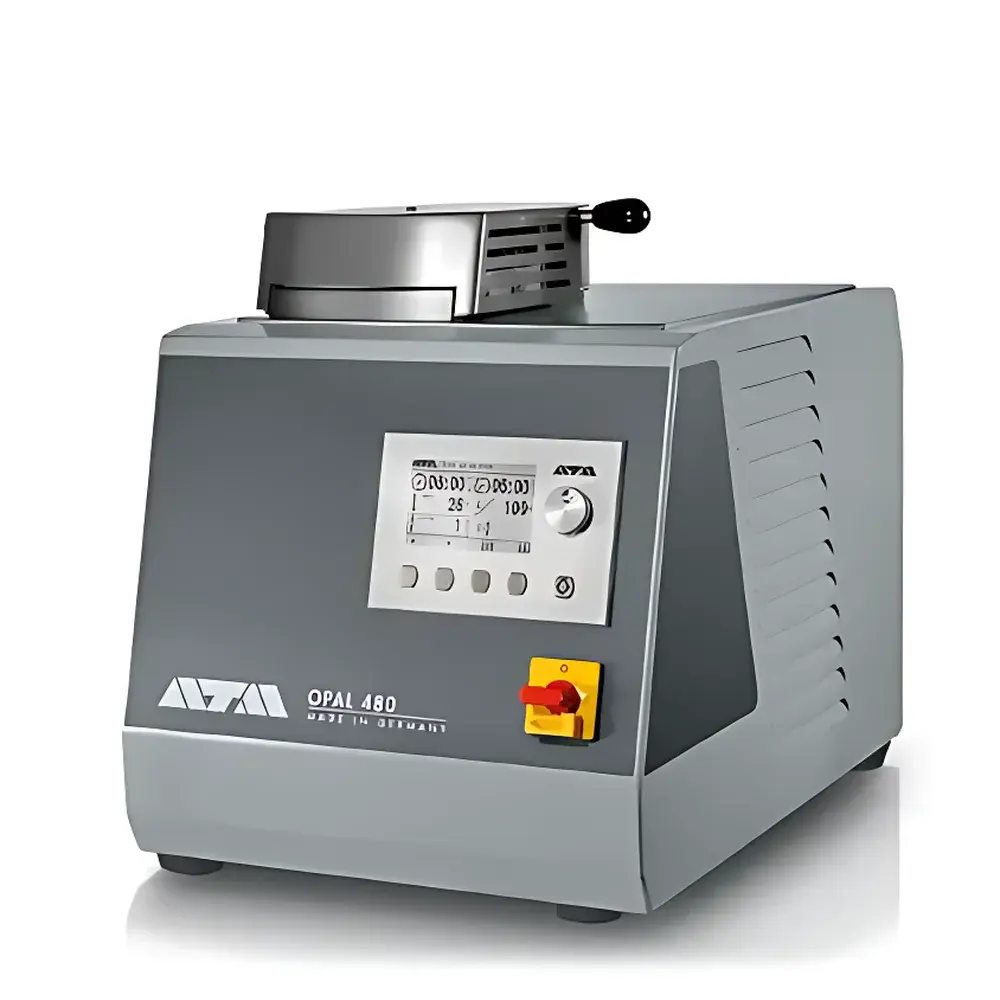
QATM Opal 480 Fully Hydraulic Hot Mounting Press
| Brand | QATM |
|---|---|
| Origin | Germany |
| Model | Opal 480 |
| Instrument Type | Hot Mounting Press |
| Mounting Chamber Dimensions | Ø50 mm / Ø60 mm / Ø70 mm |
| Rectangular Options | 30×60 mm, 40×60 mm |
| Heating Range | 20–200 °C |
| Max Pressure | 310 bar (dependent on mold size) |
| Hydraulic Power Supply | 3.6 kVA |
| Heating Power | 4 × 630 W |
| Cooling | Integrated Water-Cooled System (Optional Closed-Loop, 6 L Fixed Volume) |
| Dimensions (W×H×D) | 390 × 450 × 500 mm |
| Weight | ~68 kg |
| Control Interface | LCD Display with 18 Preprogrammed Mounting Cycles |
| Pressure Modes | 4 Configurable Profiles |
| Housing | Powder-Coated Aluminum Alloy |
Overview
The QATM Opal 480 is a fully hydraulic, water-cooled hot mounting press engineered for high-reproducibility specimen encapsulation in metallurgical, materials science, and quality control laboratories. It operates on the principle of thermosetting resin consolidation under controlled temperature, pressure, and dwell time—enabling consistent, void-free embedding of metallic, ceramic, composite, or polymer specimens prior to sectioning and polishing. Unlike pneumatic or manual systems, the Opal 480 employs a precision-engineered hydraulic actuation system that delivers stable, pulse-free pressure application across the full operational range (up to 310 bar), minimizing thermal stress gradients and ensuring uniform resin flow around irregular sample geometries. Its integrated water cooling circuit—optionally configurable as a closed-loop system with fixed 6 L coolant volume—eliminates dependency on municipal water supply while maintaining ISO 14644-compliant thermal stability during rapid cooldown cycles. Designed for compliance with DIN EN ISO 15630-1 and ASTM E3 for metallographic specimen preparation, the Opal 480 supports GLP-aligned workflows through electronic process logging and traceable parameter retention.
Key Features
- Fully hydraulic pressure generation with zero air-borne noise emission and mechanical vibration damping—optimized for shared laboratory environments.
- Electronically actuated sliding lid mechanism enabling tool-free, one-handed opening/closing of the mounting chamber in <2 seconds.
- Modular mold carrier system compatible with standard round molds (Ø50 mm, Ø60 mm, Ø70 mm) and rectangular variants (30×60 mm, 40×60 mm), all interchangeable without wrenches or alignment tools.
- 18 factory-preset mounting programs stored in non-volatile memory, each configurable for temperature ramp rate, hold duration, pressure profile (constant, ramped, stepped, or dwell-modulated), and cooling sequence.
- Large backlit LCD interface with intuitive icon-driven navigation, multilingual support (EN/DE/FR/ES), and real-time graphical display of temperature/pressure/time curves.
- Dual-sample capability via precision-machined aluminum spacers—enabling parallel mounting of two specimens under identical thermal-mechanical conditions.
- Powder-coated aluminum housing (RAL 7035) offering corrosion resistance, ESD-safe surface properties, and seamless integration into ATM System laboratory furniture configurations.
Sample Compatibility & Compliance
The Opal 480 accommodates a broad spectrum of specimen types—including ferrous and non-ferrous metals, sintered carbides, geological cores, electronic components, and brittle ceramics—without requiring pre-drying or vacuum impregnation in most cases. Its pressure-tuned resin consolidation protocol mitigates edge rounding, shrinkage cavities, and interfacial delamination commonly observed with low-pressure or cold-mount alternatives. The system conforms to DIN EN ISO 20457:2021 for automated mounting equipment validation and supports audit-ready documentation per FDA 21 CFR Part 11 when paired with QATM’s optional data export module (CSV/Excel). All electrical components meet CE/EMC Directive 2014/30/EU; heating elements comply with IEC 60519-1 for industrial electroheating safety.
Software & Data Management
While the Opal 480 operates as a standalone unit with embedded firmware, its RS-485 serial interface enables bidirectional communication with QATM’s optional LabControl Suite v3.2. This Windows-based application permits remote parameter configuration, real-time monitoring of up to 16 concurrent units, automated report generation (PDF/HTML), and long-term trend analysis of cycle deviation metrics (e.g., ΔT max, pressure overshoot %, cooling rate variance). Audit trails include operator ID, timestamp, parameter set ID, and pass/fail flags per ISO/IEC 17025 clause 7.7. Data encryption (AES-256) and role-based access control ensure integrity in regulated environments.
Applications
- Routine metallographic preparation for ASTM E3, ISO 643, and EN 10360-1 conformance testing.
- High-volume QC labs performing hardness testing (ISO 6507, ASTM E384) where specimen geometry repeatability directly impacts indenter contact area accuracy.
- Failure analysis labs embedding fractured surfaces or cross-sections of additively manufactured parts for porosity quantification (ASTM E2109).
- Academic research facilities conducting multi-parameter studies on resin–substrate interfacial adhesion under variable T/P histories.
- Automotive and aerospace suppliers validating coating adhesion (ISO 2409) and thermal barrier layer integrity after thermal cycling.
FAQ
Does the Opal 480 support custom pressure–temperature–time profiles beyond the 18 preset programs?
Yes—users may define and save up to 32 additional custom cycles via the front-panel interface or LabControl Suite, with independent control over heating ramp (0.1–20 °C/min), dwell stabilization tolerance (±0.5 °C), and pressure modulation timing resolution (1 s).
Is closed-loop cooling mandatory for ISO 17025 accreditation?
No—but it is strongly recommended to eliminate external water source variability (e.g., inlet temperature drift, pressure fluctuations), which constitutes an uncontrolled variable in uncertainty budgets per EURACHEM/CITAC Guide CG4.
Can the Opal 480 be integrated into a robotic sample prep line?
Yes—the device provides dry-contact I/O signals (start/ready/error) and Modbus RTU support for synchronization with third-party automation controllers (e.g., Beckhoff CX9020, Siemens S7-1200).
What maintenance intervals are specified for hydraulic system integrity verification?
QATM recommends annual calibration of pressure transducers and thermal sensors by an accredited metrology lab, with hydraulic fluid replacement every 24 months under continuous operation (per DIN 51524 Part 2 HLP 46 specification).



